Son My Memorial
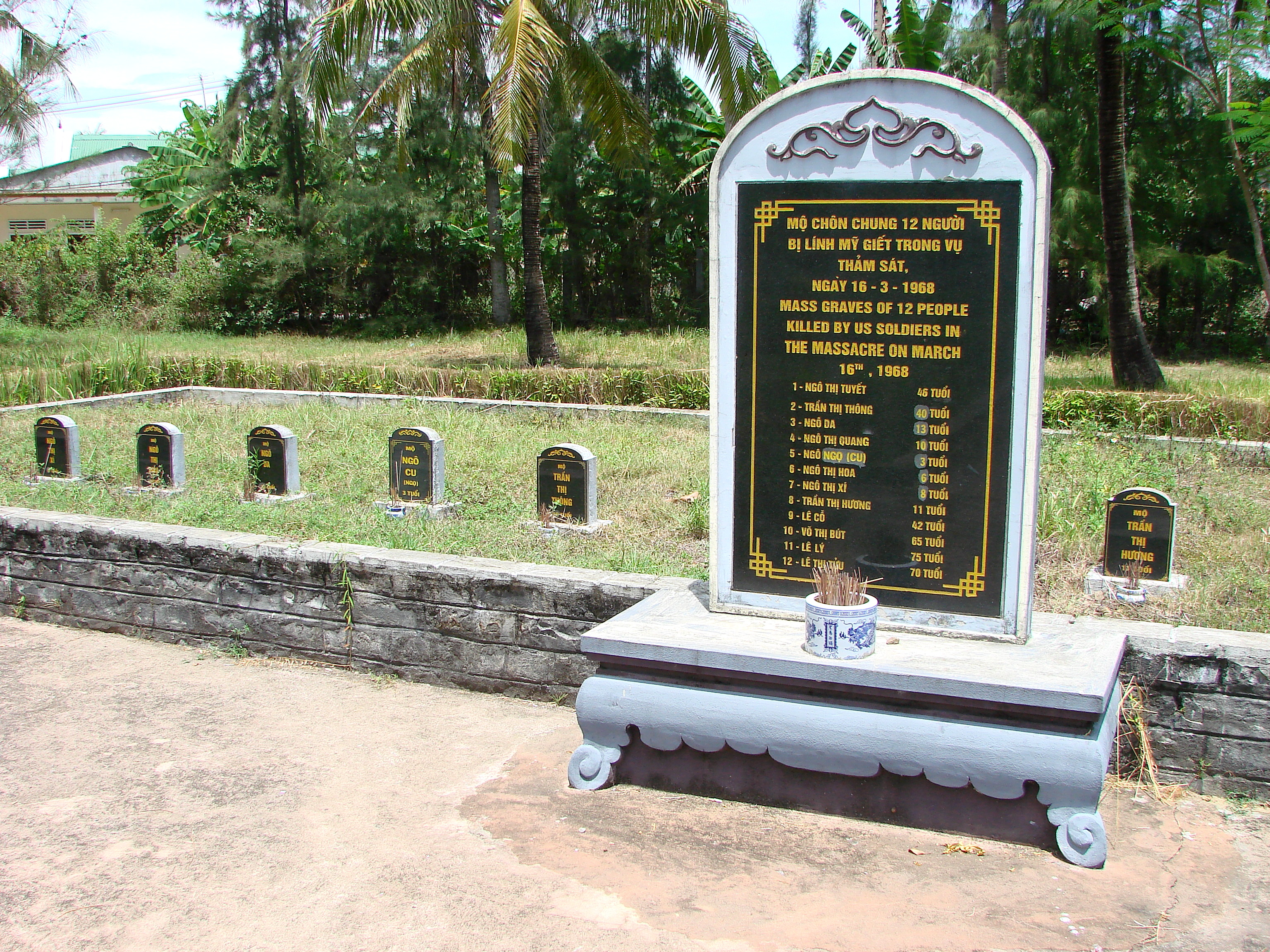
A large black marble plaque greets visitors just inside the entrance. It lists 504 names, arranged by family, with ages ranging from one to eighty-two. Among them: seventeen pregnant women and two hundred and ten children under the age of thirteen. The Son My Memorial stands on the ground where the village itself once stood, in Quang Ngai Province on Vietnam's central coast. Americans know this place as My Lai, though that was only one of several hamlets within the larger village of Son My where the killing happened on March 16, 1968. The Vietnamese have always called it the Son My massacre, and the memorial insists on that wider, more accurate name.
What the Museum Holds
Inside the museum, enlarged versions of U.S. Army photographer Ronald Haeberle's photographs line the walls. Haeberle was attached to Charlie Company that morning as part of the 11th Brigade Information Office, carrying both an official Army camera and his own personal color camera. The official photographs, as he later testified, generally avoided identifying individual perpetrators. The personal photographs did not. The images are dramatically backlit in color and share the central back wall with a life-size recreation depicting American soldiers rounding up and shooting cowering villagers. The effect is not subtle, and it is not meant to be. But the museum does not deal only in horror. It celebrates the Americans who tried to stop the killing: Ronald Ridenhour, the veteran whose letters to Congress broke the cover-up; Warrant Officer Hugh Thompson, who landed his helicopter between the soldiers and their victims; and Lawrence Colburn and Glenn Andreotta, Thompson's crew members who were prepared to fire on their own countrymen to protect the civilians.
The Ground Itself
The memorial compound preserves the remains of the village, and walking through it is a different experience from looking at photographs inside a building. The Son My Vestige Site, where the main monument was built in 1978, includes the foundations of burned homes, the irrigation ditch where soldiers executed a group of seventy to eighty villagers, and the paths that connected hamlets which no longer exist. Son My was a patchwork of homesteads, rice paddies, and dirt roads linking hamlets and sub-hamlets -- My Lai, Co Luy, My Khe, and Tu Cung among them. What the memorial preserves is the geography of an ordinary village, the kind of place where people cooked breakfast over outdoor fires on a March morning and where, on one particular March morning, roughly one hundred soldiers from Charlie Company spent several hours methodically destroying every sign of that ordinary life. The landscape has been allowed to speak for itself. Fruit trees still grow among the ruins.
Names for What Happened
The distinction between "My Lai massacre" and "Son My massacre" matters to the people who live here. My Lai was one hamlet within Son My; the killing spread across multiple hamlets, including My Khe, where B Company of the 4th Battalion killed an additional sixty to one hundred and fifty-five villagers in an action that received far less international attention. The American name stuck because the first investigative reports used it, and because My Lai was the hamlet where the worst of the documented killings occurred -- the irrigation ditch, the largest groups of victims, the photographs that eventually broke the story open. But the Vietnamese name encompasses the full scope of what happened that day across the entire village, and the memorial reflects that insistence on completeness. Every family's losses are recorded. The official Vietnamese count of 504 dead stands alongside the U.S. Army's lower estimate of 347, and the memorial does not pretend the difference is academic.
Remembrance and Reconciliation
On the thirtieth anniversary of the massacre, March 16, 1998, two ceremonies took place. At the memorial itself, local people and former soldiers -- American and Vietnamese -- stood together in commemoration. Among the crowd was Phan Thi Nhanh, who had been fourteen years old on the morning of the massacre and was saved by Hugh Thompson's intervention. "We don't say we forget," she told those gathered. "We just try not to think about the past, but in our hearts we keep a place to think about that." Thompson and Colburn attended and addressed the crowd. A mile away, a groundbreaking ceremony was held for the My Lai Peace Park, championed by American veteran Mike Boehm. "We cannot forget the past," Boehm said, "but we cannot live with anger and hatred either." The memorial draws visitors from around the world -- Vietnamese families, American veterans on pilgrimages of conscience, tourists who know the name but have never seen the photographs up close. It is the most visited site in Quang Ngai Province, a place where history is preserved not as abstraction but as five hundred and four names carved into black marble.
From the Air
The Son My Memorial is located at 15.18N, 108.886E in Quang Ngai Province on Vietnam's central coast, visible from the air as a cleared compound with monument structures amid the coastal plain. Best viewed from 2,000-3,000 feet AGL. The terrain is flat agricultural land with rice paddies stretching to the coast. The Batangan Peninsula is visible to the east. Nearest airport is the former Chu Lai airfield, approximately 15 nm northwest. Da Nang International (VVDN) is roughly 80 nm north. The My Lai Peace Park is located approximately 1 mile from the memorial site.