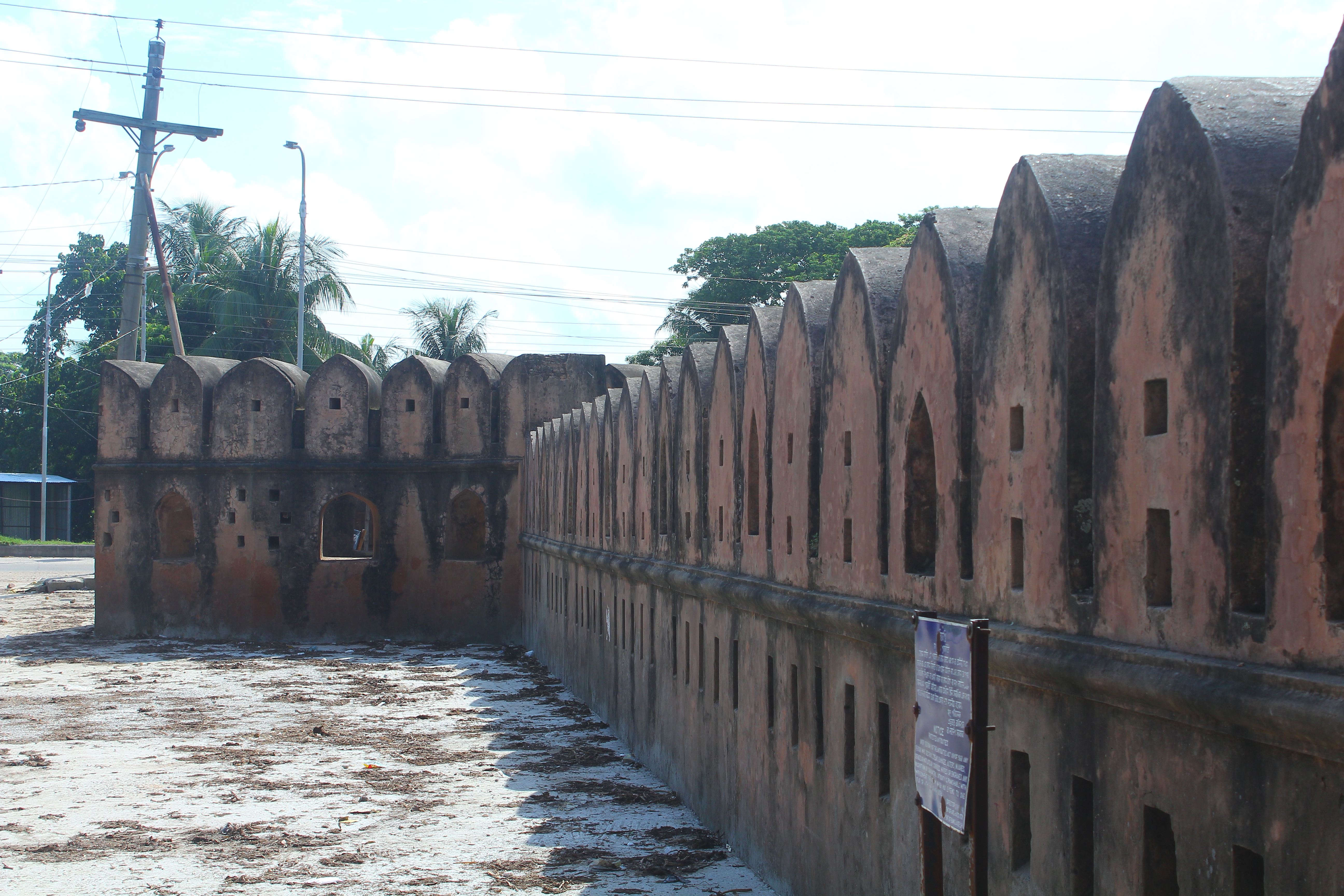
Sonakanda Fort
The name itself is a lament. Sonakanda -- from sona, meaning gold, and kanda, the Bengali word for weeping. One legend traces it to Swarnamoyee, a woman who cried for days within its walls; another to Sona Bibi, a widow confined here against her will by the soldiers of Isa Khan. Either way, the fort that guards the eastern bank of the Shitalakshya River in Narayanganj carries grief in its very syllables. But Sonakanda was built for a harder purpose than mourning. It was built to kill pirates.
The Governor's Shield
When Mir Jumla II became Subahdar of Bengal in 1660, the Mughal Empire's eastern capital had a problem. Pirates terrorized the waterways that connected Dhaka to the wider world, raiding merchant vessels and threatening the prosperity of one of the empire's richest provinces. The Mughals had controlled Bengal since defeating Daud Khan Karrani in 1574, but controlling the rivers proved far more difficult than conquering the land. Mir Jumla's solution was blunt and architectural: three river forts ringing Dhaka, each positioned to command a critical stretch of water. Sonakanda was one of them, planted squarely on the Shitalakshya's eastern bank where it could intercept aggressors heading upstream toward the capital.
Walls Built for War
The fort is a study in functional brutality. Its quadrangular plan measures roughly 86 meters on each side, with octagonal bastions anchoring the four corners -- the western bastions wider at 6.85 meters than their eastern counterparts at 4.26 meters, because the river threat came from the west. Defensive walls rise over three meters high, thickening toward the base, perforated with loopholes of varying widths for guns and light cannons. But the fort's most distinctive feature is its massive circular artillery platform, a raised outwork on the western face where heavy cannons once aimed downriver. Two concentric circular walls enclose it -- the inner ring 15.70 meters in diameter, the outer 19.35 meters -- with a stairway spiraling up to the gun positions 6.09 meters above the ground. This is not decoration. This is a machine designed to pour fire onto pirate vessels fighting the current.
Ghost Passages and Golden Tears
Legends cling to Sonakanda like river mist. Local tradition holds that hidden tunnels once connected the fort to Sonargaon, the old capital of Bengal, and to Lalbagh Fort across the city. No such tunnels have been verified, but the stories persist, feeding the fort's mystique. The competing origin tales for the name add another layer of sadness to the stonework. In one version, Swarnamoyee -- whose name contains the Bengali word for gold -- wept for days within the fort after some unnamed shock. In the other, Isa Khan, the Baro-Bhuiyan chieftain, forcibly married a widow named Sona Bibi and imprisoned her here, where her cries gave the fort its name. Both stories center a woman's anguish in a structure built for men's wars -- an irony the fort's builders almost certainly never considered.
Sentinel on the Watch List
Sonakanda endures, though the centuries have not been gentle. The World Monuments Fund placed it on its 2008 Watch List of endangered heritage sites, drawing international attention to a fort that most visitors to Dhaka never see. The pirates it was built to repel are long gone, and the Shitalakshya flows past without incident. Narayanganj has grown dense around it, factories and apartment blocks pressing close to walls that once commanded open water and empty floodplain. Yet the artillery platform still stands, its circular ramparts intact, its stairway still climbable. From the top, you can see the river the Mughals fought to control -- slower now, quieter, but still the same water that once carried raiders upstream toward the empire's treasures.
From the Air
Located at 23.607N, 90.512E on the eastern bank of the Shitalakshya River in Narayanganj, just southeast of central Dhaka. Best viewed at 2,000-3,000 feet. The fort's quadrangular outline and circular artillery platform are distinctive from above. Nearby airport: Hazrat Shahjalal International Airport (VGHS), approximately 20 km northwest. The river provides a useful navigation reference.