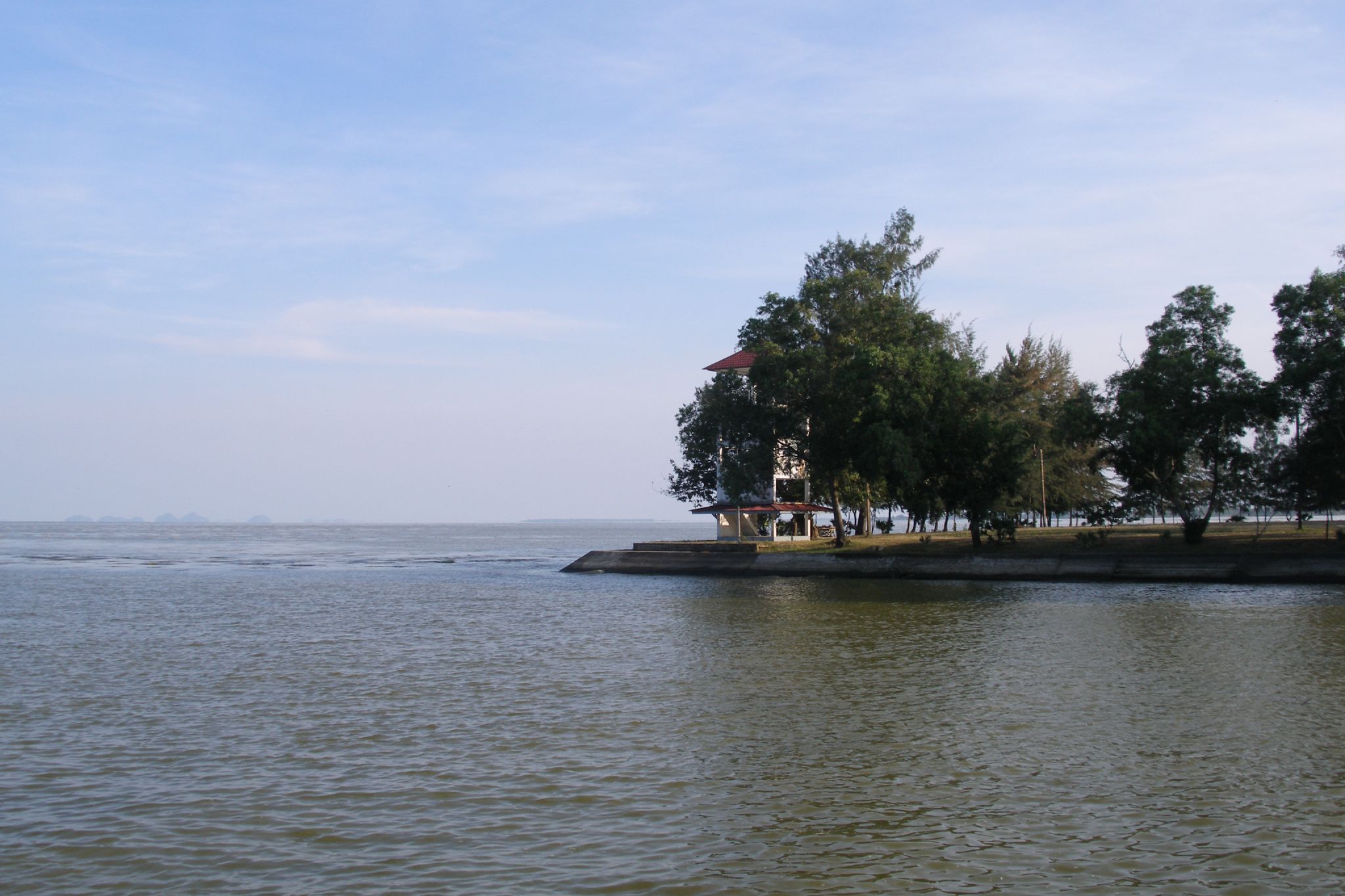
Songkhla Lake
Fourteen dolphins are all that remain. In the brackish shallows of Thale Luang, near the Si-Ha Islands of Phatthalung, a tiny population of Irrawaddy dolphins surfaces and dives in waters their species has inhabited for millennia. They are the most visible symbol of what makes Songkhla Lake extraordinary and what it stands to lose. Sprawling across 1,040 square kilometers of southern Thailand's Malay Peninsula, this is the country's largest natural lake -- though calling it a lake understates its complexity. It is a lagoon system, a meeting place of fresh and salt water, of mangrove and marsh, of ancient ecology and modern pressure.
Three Waters in One
Songkhla Lake divides itself into three distinct realms, each with its own character. At the southern end, a narrow strait just 380 meters wide opens to the Gulf of Thailand at the city of Songkhla, allowing seawater to push inland and create brackish conditions at roughly half ocean salinity. Farther north, past a bottleneck where the lake narrows to six kilometers, the vast Thale Luang stretches across nearly 783 square kilometers. At the northern extreme, tucked between mangrove swamps, lies the 28-square-kilometer Thale Noi in Phatthalung Province, where the water runs fresh. What separates this entire system from the sea is a 75-kilometer sand spit -- an unusual formation likely created not by longshore drift but by ancient islands that were slowly connected by sediment washing down from the lake's precursor.
Paperbark Islands and Reed Weavers
The Thale Noi wetlands at the lake's northern reaches represent one of Thailand's few surviving intact freshwater ecosystems, recognized as a Ramsar wetland since 1998 and protected within the Thale Noi Non-Hunting Area established in 1975. The landscape here is a mosaic: open lake gives way to marsh, which yields to Melaleuca swamp forest -- stands of paperbark trees rising from shallow water. Within these flooded forests, small elevated patches called "kuans" emerge as dry islands for most of the year. More than 5,000 families live around Thale Noi, and their livelihoods are woven into the wetland itself. Fishermen work the shallows, cattle graze the swamp grasslands, and local artisans weave mats from the reeds that grow along the margins. Over 200,000 visitors arrive annually, drawn by a landscape where human life and wetland ecology have reached an uneasy but enduring equilibrium.
The Last Fourteen
The Irrawaddy dolphins of Thale Luang are among the most endangered marine mammals on Earth. As of March 2024, researchers believe only fourteen individuals survive in the lake -- a number that concentrates the mind. These stocky, round-headed dolphins, found in scattered populations across Southeast Asia's coastal and riverine waters, face threats from overfishing, pollution, and entanglement in fishing gear. The IUCN Red List classifies several Irrawaddy dolphin populations, including those in the Mahakam River and Malampaya Sound, as Critically Endangered. Each death in Songkhla Lake's population carries disproportionate weight. Conservation efforts here are a race against arithmetic: with so few animals, a single bad season could tip the balance permanently.
Where the Lake Meets the Sky
From the air, Songkhla Lake is unmistakable. The long sand spit traces a pale arc between the blue-green lagoon and the darker Gulf of Thailand, while the lake's three sections read like a gradient from the turquoise salt-influenced south through the broad central waters to the emerald freshwater north. The mangrove fringes show as dark borders, and the paperbark forests of Thale Noi form a textured green carpet threaded with silver channels. The city of Songkhla perches at the southern outlet where lake and sea converge. It is a system that reveals its logic best from altitude -- the way fresh and salt water negotiate their boundary, the way sediment and current have shaped a coastline that is neither fully lake nor fully ocean, but something rarer than either.
From the Air
Songkhla Lake is centered at approximately 7.2N, 100.47E on the Malay Peninsula in southern Thailand. The lake is highly visible from cruising altitude, distinguished by the 75 km sand spit separating it from the Gulf of Thailand. The city of Songkhla sits at the southern outlet. Nearest significant airport is Hat Yai International Airport (VTSS), approximately 25 km inland to the west. Songkhla Airport is closer but has limited operations. Best viewed at 5,000-10,000 ft to appreciate the three-part lagoon structure and the spit formation. The flat coastal terrain and large water body make this an excellent visual navigation reference for the southern Thai peninsula.