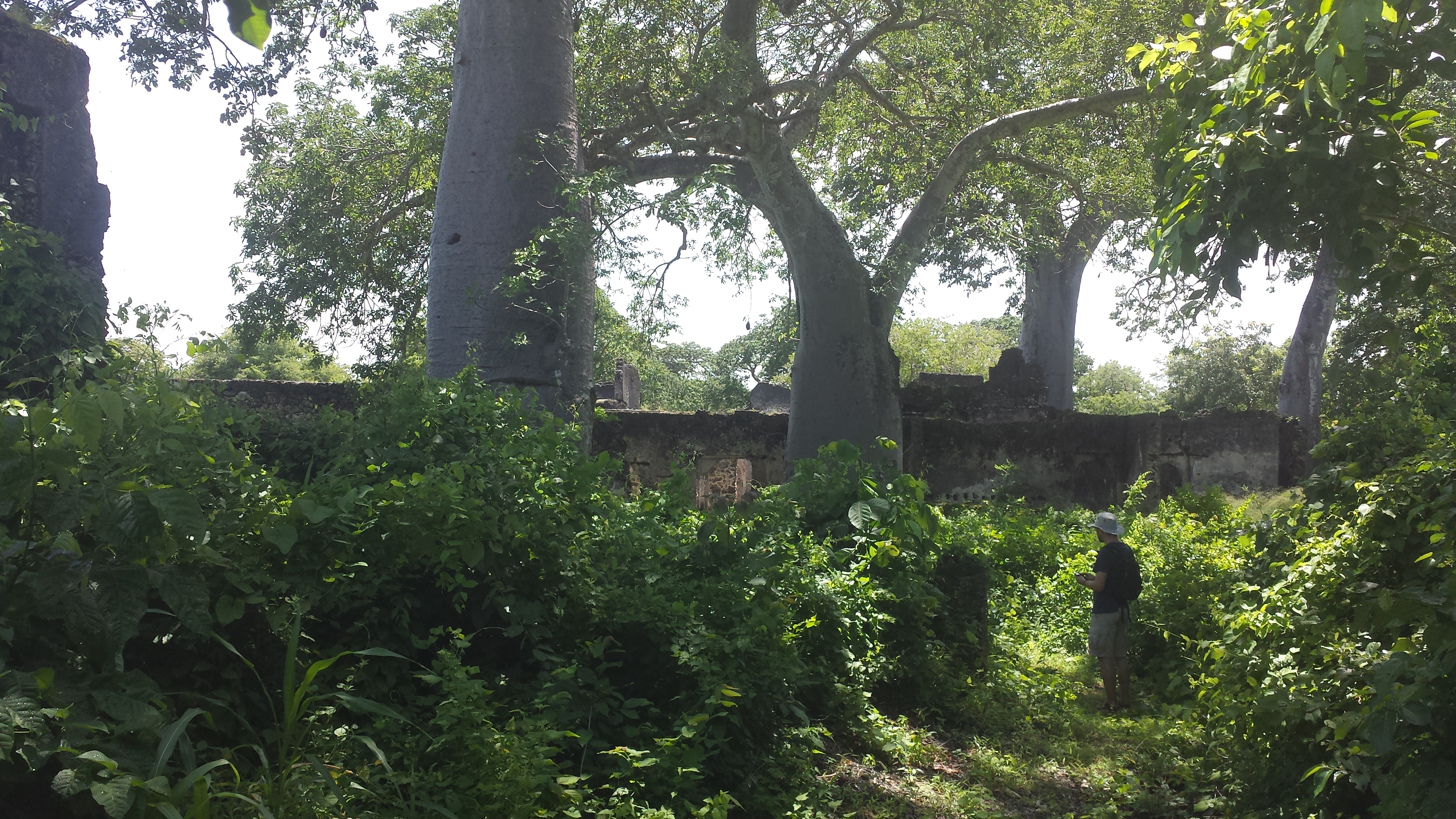
Songo Mnara
Beneath the floor of House 44, archaeologists found coins. Not scattered loose, as if dropped, but embedded in the plaster -- placed there deliberately during construction, as though the builders of Songo Mnara were sealing something into the foundation of their lives. The coins bore the name of Ali ibn al-Hasan, one of the earliest rulers of the Kilwa Sultanate, and they turned up not just in houses but in the open courtyards between them. On this small island south of Kilwa Kisiwani, off Tanzania's southern coast, a medieval Swahili stone town thrived from the 14th to 16th centuries. It was a place where the boundaries between public and private life blurred in ways that modern archaeology is only beginning to understand.
Coral Walls and Shared Courtyards
Songo Mnara was built from the Indian Ocean itself. Rough coral, quarried and mortared, formed the walls of six mosques, two dozen house blocks, and a palace. Three enclosed open spaces punctuated the town -- not empty gaps between buildings but intentional public areas where community life unfolded. Archaeologists studying the layout of Swahili stone towns have focused on the relationship between mosques and houses to understand how Islamic culture, commerce, and land ownership intersected on this coast. What they found at Songo Mnara challenged assumptions. The open spaces were not merely transitional zones. Coins scattered across them suggest market activity or ritual use, while phytolith analysis -- the study of microscopic plant remains in soil -- revealed palm traces in entrance rooms and different activity patterns in rear chambers, painting a picture of a settlement where domestic and communal life flowed into each other.
Porcelain from Across the Sea
The ceramic fragments tell the story of a town plugged into trade networks that spanned half the globe. Shards of Chinese blue-and-white porcelain and green-glazed stoneware dating from the 14th century turned up in excavations across the site, alongside ceramics from Southeast Asia. These were not everyday goods. On the Swahili coast, imported ceramics carried deep symbolic weight -- status markers displayed in wall niches, visible to anyone entering a home. The tradition persisted into modern Swahili culture. At Songo Mnara, these fragments confirm what the architecture already suggested: this was a prosperous town whose residents participated in the Indian Ocean trading world that connected East Africa to Arabia, Persia, India, and China. The coins found at the site -- mostly bearing the markings of Ali ibn al-Hasan, with additional types from Nasir al-Dunya and al-Hasan ibn Sulaiman -- place the settlement firmly within the economic orbit of the Kilwa Sultanate.
African and Asian Roots, Intertwined
A 2023 genetic study examining medieval remains from the Swahili coast revealed something the Kilwa Chronicle had claimed all along: the people of these stone towns carried both African and Asian ancestry. The introduction of foreign DNA was estimated to have occurred between 708 and 1219 CE, though the authors noted this likely happened across multiple generations rather than in a single event. The mixing of Eurasian and African populations continued for centuries afterward. At Songo Mnara and neighboring Kilwa Kisiwani, this genetic evidence aligned with the oral traditions recorded in the Kilwa Chronicle, which described Persian founders intermarrying with local populations. The result was the Swahili culture itself -- a coastal civilization that was neither purely African nor purely Asian, but something distinctly its own, expressed in language, architecture, trade practices, and the coral-stone towns that lined the coast from Somalia to Mozambique.
What the Back Rooms Reveal
House 44 became a key to understanding daily life at Songo Mnara. Excavations in each of its rooms uncovered distinct patterns of use. The front rooms were active spaces, thick with ceramic layers that archaeologists dug through carefully. The back rooms were comparatively tidy -- less debris, fewer artifacts, suggesting more private or specialized functions. Entrance rooms contained traces of palm phytoliths in soil samples but little else, as if they served as thresholds rather than living spaces. The pattern repeated across other houses on the site. Combined with the coins found in both domestic and public areas, the evidence pointed to a settlement where space was used communally. Houses were shared. Open areas were shared. Even the boundaries of individual dwellings seemed to be social conventions rather than hard limits, a finding that has reshaped how archaeologists think about urbanism on the medieval Swahili coast.
Ruins in the Mangroves
Songo Mnara was designated a UNESCO World Heritage Site alongside Kilwa Kisiwani in 1981, and it was removed from the List of World Heritage in Danger after conservation efforts. Yet the site remains remote and largely unvisited. The stone town sits on Songo Mnara Island in the Kilwa District of Tanzania's Lindi Region, reachable only by boat. Between 2005 and 2009, the Zamani Project documented the ruins using terrestrial 3D laser scanning, producing textured models and panorama tours that preserve what time and vegetation are slowly consuming. The palace, the mosque, the residential buildings -- all are recorded in digital detail. But the physical structures continue to weather, and much of the site has never been systematically excavated. Songo Mnara remains a place where the Indian Ocean's past is written in coral and mortar, waiting to be fully read.
From the Air
Located at 9.04S, 39.55E on Songo Mnara Island, south of Kilwa Kisiwani off Tanzania's southern coast. Best viewed from 2,000-3,000 feet AGL approaching from the east, where the island's flat profile and coral-stone ruins contrast with surrounding turquoise waters. The larger island of Kilwa Kisiwani is visible to the north. Nearest airfield: Kilwa Masoko Airport (HTKI). The Mafia Archipelago lies to the northeast.