Songshan Cultural and Creative Park
The cigarettes stopped rolling off the line in 1998, but the building kept its smell of industry for years afterward -- machine oil, concrete dust, the ghost of tobacco leaf pressed between rollers on the second floor. The Songshan Cultural and Creative Park occupies a former tobacco factory in Taipei's Xinyi District, and its transformation from production facility to cultural destination tells a story about what happens when a city decides its industrial past is worth more as memory than as real estate.
The Monopoly Bureau's Factory
Construction began in 1937 under the name Matsuyama Tobacco Plant of the Monopoly Bureau of the Taiwan Governor's Office -- a title as bureaucratic as the institution that built it. The Japanese colonial government operated tobacco as a state monopoly, and the Songshan factory was designed for industrial efficiency: long open hallways without dividing walls, columns on the first floor supporting the weight of machines on the second, a conveyor system that moved packaged cigarettes directly from the production floor to Warehouse No. 2 via a turntable. After Japan ceded Taiwan in 1945, the Taiwan Provincial Monopoly Bureau took over and renamed the plant. In 1947, it was renamed again under the Taiwan Tobacco and Wine Bureau. The factory employed roughly 1,200 workers at its peak, enough to justify an on-site nursery, cafeteria, dormitories, a hospital, and entertainment rooms -- a self-contained industrial village within the city.
Closure and Resurrection
Urban planning pressures, shifting tobacco regulations, and declining demand for cigarettes combined to shut the factory in 1998. The buildings sat idle until 2001, when the Taipei City Government designated the defunct plant as Taipei's 99th historic site. The decision to preserve rather than demolish was not inevitable -- the site sits in Xinyi District, one of Taipei's most commercially valuable neighborhoods, adjacent to the Taipei Dome in what is now known as the Taipei Cultural and Sporting Complex. Developers would have paid handsomely for the land. Instead, in 2011, the factory complex was formally reopened as the Songshan Cultural and Creative Park, its warehouses and production halls converted into exhibition spaces, performance venues, and studios for the creative economy that Taiwan's government has spent two decades trying to cultivate.
Baroque Women and Ecology Ponds
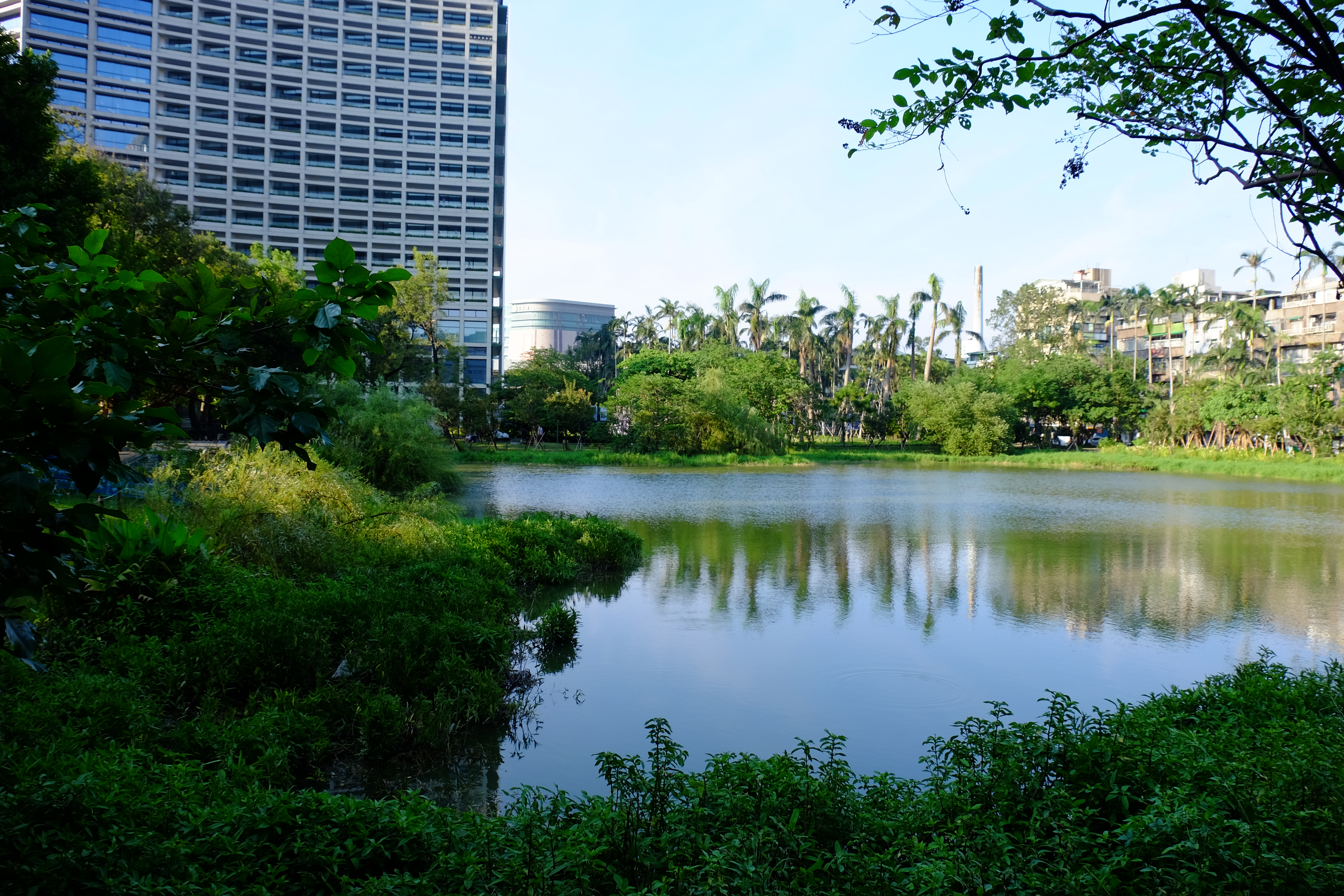
The park's physical spaces carry the tension between their industrial origins and their cultural present. The five warehouses, once staging areas for boxed cigarettes awaiting shipment, now host rotating exhibitions. The former office building for factory supervisors has become the Taiwan Design Museum. The machine repair plant houses a restaurant. Perhaps most striking is the Baroque Garden, enclosed on three sides by the tobacco factory's north, south, and east wings. A fountain at its center is surrounded by sculptures of women emerging from baths -- an oddly sensual flourish for a government tobacco facility. The ecology pond, originally installed for fire suppression and ventilation, has been rewilded into a habitat where frogs and insects have reclaimed the water that once served industrial purpose. The boiler room, where coal was burned to power the factory's machines, still stands with its original chimneys intact.
Design Capital of the Pacific
The park's cultural ambitions extend beyond preservation. The Taiwan Design Research Institute, established in 2003 and operational since 2004, occupies space in the complex as a national center for promoting creative design across Taiwanese industries. The Eslite Spectrum Songyan bookstore, part of the beloved Eslite chain, began 24-hour operations in January 2024 -- a move that transforms the park from a daytime cultural destination into something that pulses around the clock. Exhibitions rotate through the warehouses and factory spaces, covering fashion, industrial design, visual art, and architecture. The park sits within walking distance of both the Sun Yat-sen Memorial Hall and Taipei City Hall metro stations, placing it in the heart of the Xinyi commercial district where Taipei's cultural aspirations and its commercial instincts occupy the same city blocks.
From the Air
Coordinates: 25.044N, 121.563E. Located in Xinyi District, Taipei, immediately east of the Taipei Dome complex. From the air, the park appears as a cluster of low-rise industrial buildings with distinctive warehouse rooflines and green courtyard spaces, contrasting sharply with the surrounding high-rise commercial development. Taipei 101 is visible approximately 1.5 km to the south. Nearby airport: RCSS (Taipei Songshan Airport, ~3 km north). Best viewed at 2,000-4,000 feet.