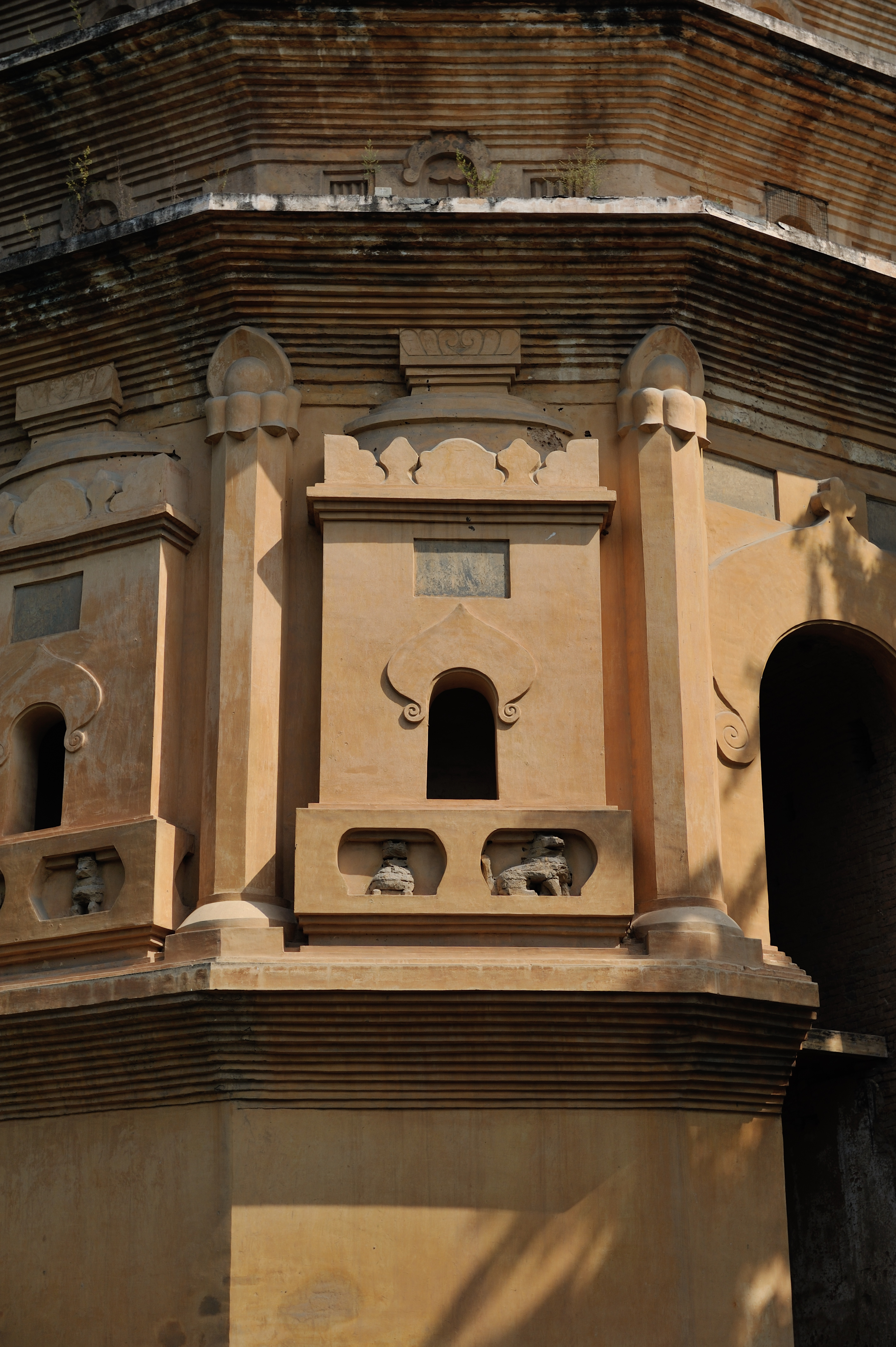
Songyue Pagoda
Every pagoda in China that came after owes something to this one. Built in 523 AD at the Songyue Monastery on Mount Song in Henan province, the Songyue Pagoda is the oldest surviving pagoda in the country -- and the earliest known Chinese pagoda constructed of brick. At a time when virtually all pagodas were built of wood and have long since rotted or burned away, this tower of yellowish brick and clay mortar has endured for fifteen centuries, outlasting dynasties, invasions, and earthquakes.
Twelve Sides, Two Traditions
The Songyue Pagoda's most striking feature is its twelve-sided plan -- a shape found nowhere else in Chinese pagoda architecture. The design represents what scholars believe was an early attempt to reconcile two architectural traditions: the straight-edged geometry of Chinese building with the circular forms of Indian Buddhist architecture. The pagoda's profile tapers as it rises, echoing the proportions of Indian and Central Asian Buddhist cave temple pillars. Standing 40 meters tall, it bridges the visual languages of two civilizations, neither fully Chinese nor fully Indian in character. Later Chinese pagodas would settle into square, hexagonal, or octagonal plans, but none would repeat Songyue's dodecagonal experiment.
A Survivor from the Northern Wei
The Northern Wei dynasty (386-534) was a period of intense Buddhist influence on Chinese culture. Originally a nomadic Xianbei regime, the Northern Wei rulers embraced Buddhism as a unifying ideology and poured resources into monumental religious architecture -- the Yungang Grottoes, the Longmen Grottoes, and temples across their domains. The Songyue Pagoda belongs to this wave of construction. Emperor Xiaoming commissioned it at the Songyue Monastery, one of several religious institutions clustered on Mount Song. That the pagoda has survived while so much else from this era has crumbled speaks to the durability of its brick construction at a time when wood was the standard material.
Brick Against the Centuries
The tower's construction is deceptively simple: yellowish bricks bonded with clay mortar, stacked and corbeled into fifteen stories of diminishing tiers. There are no elaborate brackets or complex joinery -- just the patient accumulation of brick upon brick, shaped into curves and arches that distribute the structure's weight downward. The surface bears carved ornamental details that reflect sixth-century Buddhist artistic conventions, including lotus motifs and guardian figures. These decorations, along with the brick composition and mortar analysis, have helped archaeologists confirm the pagoda's Northern Wei dating, making it a benchmark for understanding early medieval Chinese construction techniques.
Mount Song's Sacred Skyline
Mount Song was proclaimed one of China's Five Holy Peaks as early as the first century BC, and religious structures have accumulated on its slopes for over two millennia. The Songyue Pagoda is the most ancient survivor of this sacred landscape. Today it stands as part of the Historic Monuments of Dengfeng UNESCO World Heritage Site, inscribed in 2010 alongside the nearby Shaolin Monastery and other monuments. From a distance, the pagoda's tapered silhouette rises above the forested hillside like a stone finger pointing upward -- a fifteen-hundred-year-old landmark that remains the defining feature of the Songyue Monastery skyline.
From the Air
Located at 34.502N, 113.016E on the slopes of Mount Song near Dengfeng, Henan province. The pagoda stands 40 meters tall and is visible as a distinctive tapered spire on the mountainside. Nearest major airport is Zhengzhou Xinzheng International (ZHCC/CGO), about 80 km to the east. Luoyang Beijiao Airport (ZHLY) is approximately 55 km to the northwest. Best viewed at 2,000-4,000 feet altitude in clear conditions; the pagoda's twelve-sided profile is most distinctive when viewed from above.