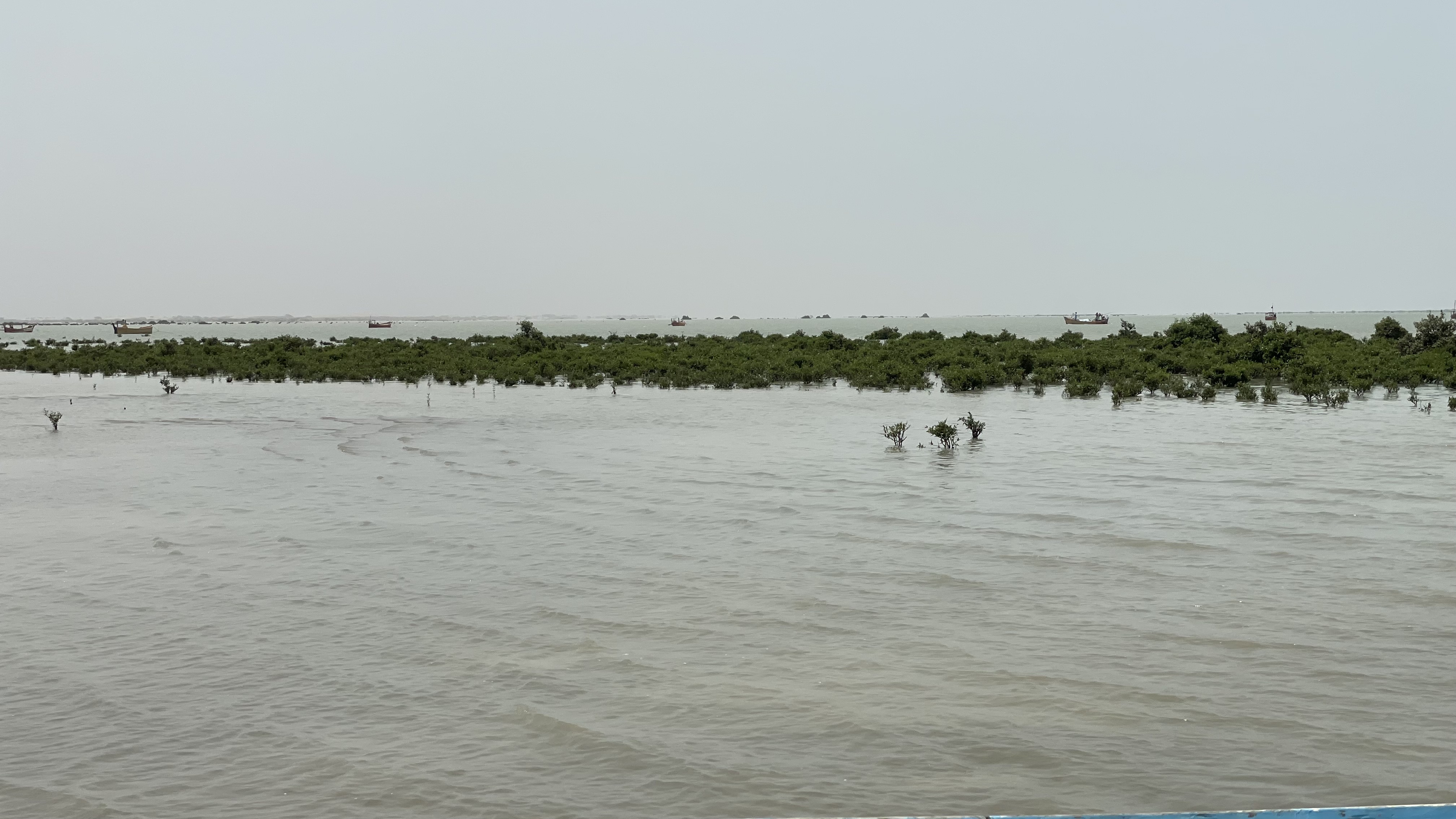
Sonmiani Bay
At the very top of the Arabian Sea, where the Makran Coast of Balochistan meets the Sindh border northwest of Karachi, a crescent of water called Sonmiani Bay holds contradictions that no planner could have intended. Pakistan launches its rockets here. The Air Force conducts live-fire exercises over the water. A ship-breaking yard leaks heavy metals into the shallows. And yet rare dolphin species still surface in the bay, flamingos breed in the connected lagoon of Miani Hor, and fishermen haul in shrimp, crabs, pomfret, and mackerel as their families have done for generations.
Where the Sea Begins
Sonmiani Bay marks the Arabian Sea's northernmost point, its shores shaped by mudflats, sandy beaches, and stands of mangrove forest. The bay takes its name from the village of Sonmiani, located north of where the Winder River empties into the sea through a silting delta. To the northwest, the bay connects to Miani Hor, a shallow estuarine lagoon designated as a Ramsar Wetland of international importance for its role as a breeding ground for migratory birds and a nursery for fish. At least 15 fishmeal processing plants operate in the broader area around Windar and Sonmiani, converting the day's catch into animal feed and fertilizer. The bay is a habitat for rare dolphin species and occasional whales.
Rockets Over the Mangroves
The coastal flats at Sonmiani host an unlikely neighbor to the fishing boats: the Sonmiani Spaceport, the primary launch facility of SUPARCO, Pakistan's national space agency. Established in 1961 with assistance from NASA, the Flight Test Range here was where Pakistan launched its first sounding rocket -- the Rehbar-I, a Nike-Cajun combination -- on June 7, 1962. The facility spans 200 hectares and has since shifted its focus from civilian space research to military missile testing. The Pakistan Air Force uses the nearby range for live-fire demonstrations and training exercises. The juxtaposition is jarring from the air: fishing dhows and rocket gantries sharing the same stretch of coastline.
Pressures from Every Direction
Sonmiani Bay faces environmental stress from nearly every angle. The nearby Gadani Ship Breaking Yard introduces maritime pollution. Overfishing depletes stocks that sustain coastal communities. Mangrove forests, which serve as natural storm barriers and fish nurseries, are degrading as freshwater flows from the Winder River diminish. Siltation at the river delta has changed access to traditional fishing grounds. Pollution from settlements and the fishmeal industry further degrades water quality. Despite these pressures, the bay lacks formal status as a marine protected area. Conservation concerns have been raised by NGOs and the Balochistan Forests and Wildlife Department, but enforcement remains limited.
A Bay of Competing Futures
Pakistan's Economic Coordination Committee has identified Sonmiani Bay as a potential site for a future liquefied natural gas terminal, which would add industrial infrastructure to an already stressed ecosystem. The proposal highlights a tension that runs through the entire bay: every stakeholder sees a different resource. Military planners see a test range. Energy planners see a deepwater terminal. Fishing communities see their livelihood. Conservationists see a Ramsar-connected wetland with rare marine mammals. The mangroves that fishermen rely on for storm protection are the same ones that rocket launches occasionally scorch. Sonmiani Bay is a small body of water asked to serve too many masters at once.
From the Air
Located at 25.17°N, 66.50°E on the Balochistan coast, northwest of Karachi. From altitude, the bay's crescent shape is visible with mudflats, mangrove patches, and the Miani Hor lagoon to the northwest. The Sonmiani Flight Test Range and Gadani Ship Breaking Yard are visible along the coast. Nearest major airport is Jinnah International (OPKC), approximately 50 km southeast. Note: military flight test range -- check NOTAMs for active restricted areas.