Soo Locks
Say the name right and you have already learned something: it is "Soo," not "Salt" or "Sault." The anglicized pronunciation of Sault Ste. Marie has become shorthand for one of the most important pieces of infrastructure on the continent -- a set of parallel locks that lift and lower 10,000 ships a year between Lake Superior and the lower Great Lakes. Without the Soo Locks, the iron ore, grain, coal, and limestone that move through the Great Lakes shipping system would come to a halt. The locks are owned and operated by the United States Army Corps of Engineers, passage is free, and every winter from January through March, when ice shuts down Great Lakes shipping entirely, the Corps closes the locks to inspect and rebuild the machinery that keeps North America's industrial heartland connected to its greatest natural highway.
Before the First Lock
The St. Marys River drops roughly 21 feet between Lake Superior and Lake Huron, and for centuries that drop defined the limit of navigation. Indigenous peoples portaged around the rapids. French voyageurs and British fur traders did the same. The first lock on the river was built on the Canadian side in 1798 by the North West Company to ease the fur trade, but American troops destroyed it during the War of 1812. For decades afterward, cargo bound for Lake Superior had to be unloaded, hauled overland past the rapids, and reloaded onto another vessel. The inefficiency was staggering, and as the iron ranges of Michigan's Upper Peninsula began producing ore in the 1840s, the pressure to build an American lock became irresistible. The first U.S. Soo Locks opened in May 1855, and alongside the Erie Canal -- completed thirty years earlier in New York -- they ranked among the greatest infrastructure projects of pre-Civil War America.
A Parade of Engineering Firsts
The locks have been rebuilt and expanded repeatedly, and each generation has pushed the boundaries of what was possible. The Weitzel Lock, completed in 1881, was the longest lock in the world and the first to be operated by the federal government rather than the state of Michigan. The Poe Lock, engineered by Orlando Metcalfe Poe and completed in 1896, was the largest lock in the world at the time. The Davis Lock, finished in 1914, took the title of longest lock in the world back from any competitor. The MacArthur Lock, built in 1943, was sized to handle ocean-going vessels -- the "salties" that would later arrive through the Saint Lawrence Seaway after it opened in 1959. The Sabin Lock, built in 1919, served until it became obsolete; groundbreaking for its massive replacement began on June 30, 2009, with the new lock designed to match the Poe Lock's dimensions and provide critical additional capacity for the thousand-foot lake freighters that dominate modern Great Lakes shipping. Construction on Phase One began in May 2020.
The Poe Lock Bottleneck
Today, only two of the lock chambers are in regular operation: the MacArthur Lock and the Poe Lock. The Poe Lock, rebuilt in 1968 to accommodate the largest lake freighters, is the only lock capable of handling the thousand-footers -- vessels too large for the MacArthur Lock, too large for the Welland Canal, and too large for anything else in the Great Lakes system. If the Poe Lock were to fail for an extended period, the economic consequences would ripple across the continent. Iron ore shipments from Minnesota and Michigan to steel mills in Indiana, Ohio, and Pennsylvania would stop. Coal and limestone movements would be disrupted. The U.S. Department of Homeland Security has identified the Soo Locks as one of the nation's critical infrastructure assets, and the new lock under construction is intended to eliminate the single-point-of-failure vulnerability that the Poe Lock currently represents.
Engineers Day
The locks are federal property under the command of the U.S. Army Corps of Engineers, and on every other day of the year, unauthorized civilians who cross the security fence face fines or imprisonment. But on the last Friday of every June, the gates open for Engineers Day. Visitors walk across the lock gates themselves, stand close enough to touch thousand-foot freighters as they slide through the chambers, and get a visceral sense of the scale involved -- the walls rising stories above, the water churning below, and a ship longer than three football fields gliding past at arm's length. The Soo Locks Visitors Center operates a viewing deck year-round, but Engineers Day is the one chance to step inside the machinery rather than just watching it work. The locks were designated a National Historic Landmark in 1966, recognition of their role in shaping the economic geography of an entire continent.
The River Between Two Lakes
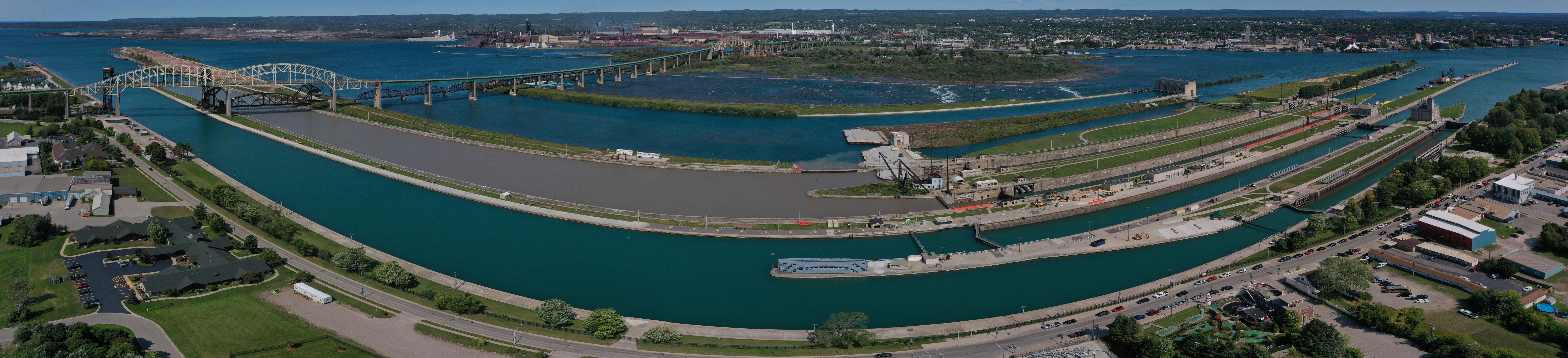
From the air, the Soo Locks appear as a series of narrow concrete channels cut into the southern bank of the St. Marys River, with the International Bridge arching overhead and the Canadian lock visible on the opposite shore. The twin cities of Sault Ste. Marie flank either bank, and the rapids that made all of this necessary still churn between the engineered channels. The locks sit at the hinge point of the Great Lakes, the place where the largest freshwater lake on Earth empties into the second-largest system of lakes on the planet. Ten thousand ships pass through each shipping season, carrying more tonnage than the Panama and Suez Canals combined in many years. The Soo Locks do not get the fame of those ocean-connecting canals, but they carry the cargo that built the American Midwest -- and they still do.
From the Air
The Soo Locks are located at 46.503N, 84.350W on the St. Marys River at Sault Ste. Marie, Michigan. From the air, the lock chambers are clearly visible as parallel channels on the south (American) side of the river, with the Canadian lock visible on the north (Ontario) side. The International Bridge crosses directly above. Ships waiting to lock through are often visible queued in the river approaches. Recommended viewing altitude: 1,500-3,000 feet AGL for lock chamber detail, 5,000-8,000 feet AGL for the full river context including both cities and the rapids. Nearest airports: Chippewa County International (KCIU) 12nm south, Sanderson Field (KANJ) 3nm south, Sault Ste. Marie Airport (CYAM) 8nm west on the Ontario side.