Soom Shale
Most fossils preserve what was hard in life -- bones, shells, exoskeletons. The Soom Shale does the opposite. Embedded in this thin geological member of the Cederberg Formation, soft tissues that normally vanish within days of death have been preserved in exquisite detail for 440 million years, while the hard parts -- the very structures that usually survive -- are demineralized and faintly recorded as molds. It is fossilization in reverse, and it makes the Soom Shale one of the most remarkable fossil deposits on Earth.
Born from Catastrophe
The Soom Shale was deposited in the immediate aftermath of the Hirnantian glaciation, the global ice age that is considered the most likely primary cause of the Late Ordovician mass extinction -- one of the five great die-offs in Earth's history. As glaciers retreated across what is now southern Africa roughly 444 million years ago, meltwater filled basins with cold, still water. At the bottom of these basins, oxygen was scarce or absent entirely. Without oxygen, there were no scavengers, no burrowing organisms, no bioturbation to churn and destroy what settled on the seafloor. The conditions were occasionally euxinic -- not just oxygen-poor but actively toxic, with dissolved hydrogen sulfide poisoning the bottom waters. In this hostile environment, death was perfectly preserved.
The Fossil Bestiary
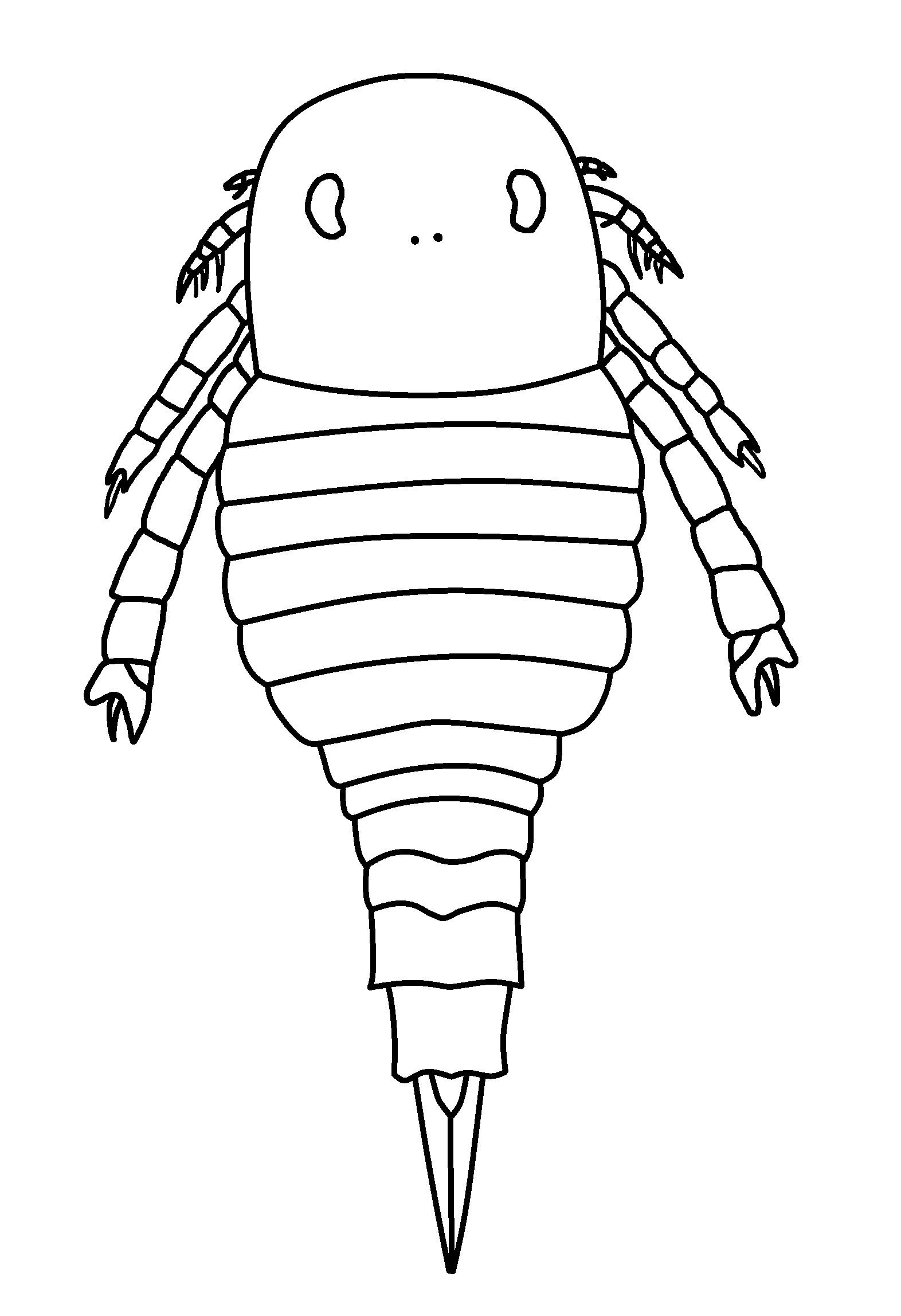
What the Soom Shale contains reads like a catalog of Ordovician marine life. Trilobites of the genus Mucronaspis appear alongside eurypterids -- the ancient sea scorpions that would later grow to terrifying sizes. Conodonts, the enigmatic eel-like animals whose tooth-like elements are among the most useful fossils for dating rocks, are preserved here with their soft anatomy intact, a rarity that has helped scientists reconstruct what these creatures actually looked like. Brachiopods of several families colonized the seafloor during brief oxygenated intervals. An undescribed jawless fish hints at early vertebrate diversity. Perhaps most remarkable is a lobopodian -- a soft-bodied, worm-like creature with stubby legs, related to the bizarre animals of the Cambrian Burgess Shale -- found here in strata 100 million years younger than its more famous relatives.
Preservation in Negative
The quality of preservation in the Soom Shale is extraordinary not just for what it shows, but for how it inverts the normal fossil record. There is almost no taphonomic distortion: little evidence of transport by currents, no alignment of fossils by water flow, no signs that anything fed on the carcasses after death. The soft tissues may have been replaced by aluminosilicate minerals, though whether this replacement happened during burial or was an artifact of later diagenesis and metamorphism remains debated. What matters is the result: muscles, gills, and connective tissues are recorded in fine-grained shale with a clarity that hard-part fossils in conventional deposits rarely achieve. A 2025 study of a newly described euarthropod from the Soom Shale revealed connective endoskeleton and muscle anatomy in exceptional detail, demonstrating that the deposit continues to yield discoveries.
A Window in the Mountains
The Soom Shale outcrops in the Cederberg mountains of the Western Cape, part of the Table Mountain Group whose sandstone peaks and wind-sculpted formations draw hikers and climbers from around the world. That these mountains contain a world-class Ordovician fossil deposit is one of the region's quieter wonders. The shale sits within the broader Cederberg Formation, squeezed between layers of harder sandstone that dominate the landscape. From the air, the Cederberg is all reddish rock and deep valleys; the paleontological treasure is invisible, buried in thin, dark bands that only reveal their contents under careful excavation and microscopic examination. Four hundred and forty million years of deep time, folded into a mountain range that is still being sculpted by wind and winter rain.
From the Air
The Soom Shale outcrops in the Cederberg mountains at approximately 32.17S, 18.87E in the Western Cape. The Cederberg range is a prominent terrain feature visible from altitude, characterized by reddish sandstone peaks and dramatic rock formations. The shale itself is not visible from the air. Nearest town is Citrusdal to the southwest or Clanwilliam to the north. Cape Town International (FACT) is approximately 200 km to the south. Caution: mountainous terrain with variable weather.