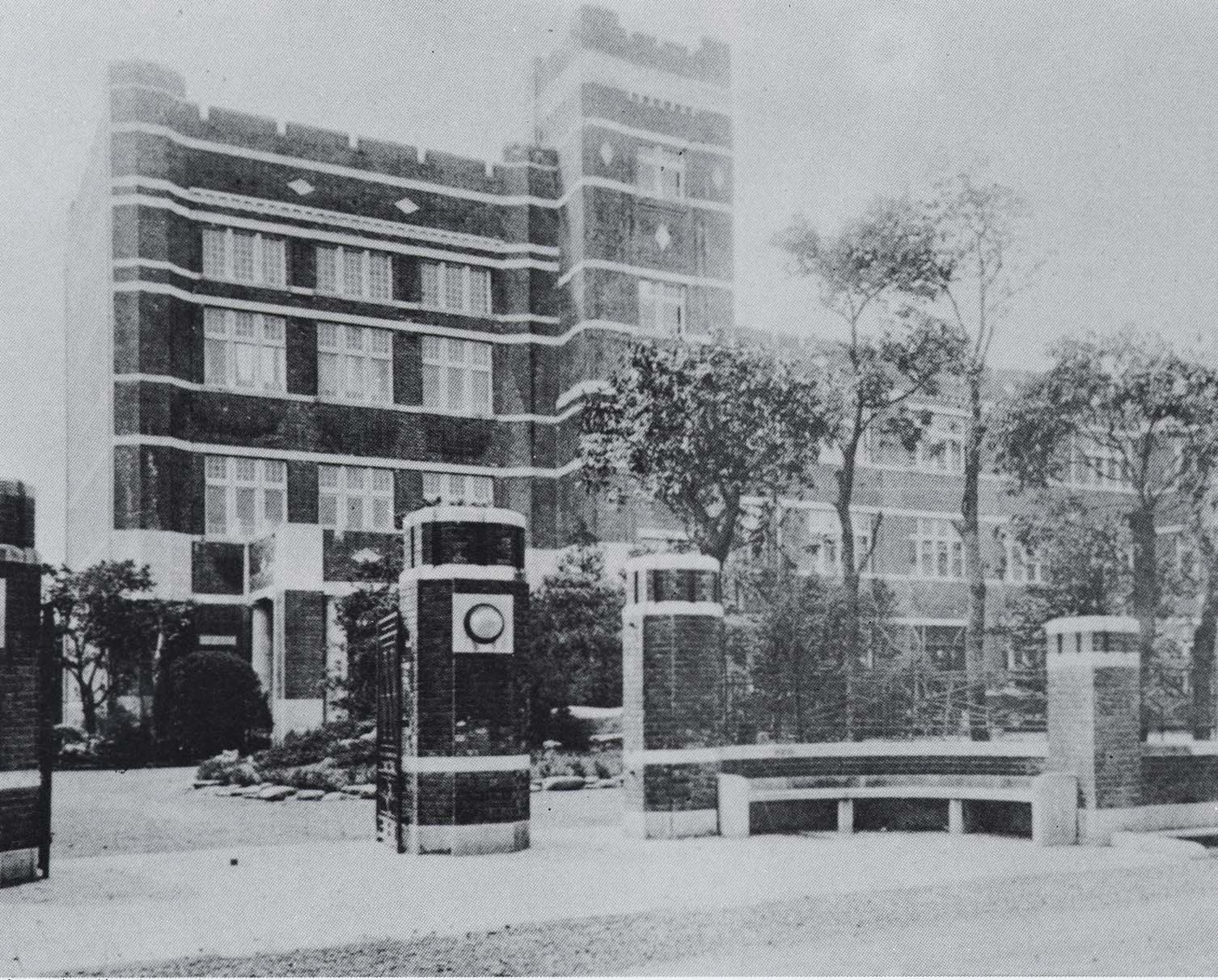
Sophia University
In 1905, a German Jesuit priest named Joseph Dahlmann secured a private audience with Pope Pius X and made an audacious request: let the Society of Jesus build a Catholic university in Japan. The Pope's response, recorded in Dahlmann's Latin memoirs, was unequivocal -- "Habebitis collegium in Japonica, magnam universitatem" -- you will have in Japan a college that is a great university. Eight years later, in 1913, Sophia University opened its doors in Tokyo's Yotsuya district with three departments: German Literature, Philosophy, and Commerce. It was the fulfillment of a vision that stretched back 354 years, to when Saint Francis Xavier himself, co-founder of the Jesuits, first set foot in Japan and wrote to his brethren about establishing a university there. Today Sophia stands as one of Japan's most selective private universities, its campus tucked against the former outer moat of Edo Castle in the governmental heart of Chiyoda ward.
A 354-Year Promise Kept
The thread connecting Sophia to the earliest days of Christianity in Japan is not legend -- it is documented in Xavier's own correspondence. When the Jesuit missionary arrived in 1549, he wrote letters expressing his hope for a university that could bridge Eastern and Western scholarship. During the Kirishitan period that followed, the Catholic Church established educational institutions called Collegios and Seminarios across Japan, but the dream of a full university went unfulfilled for centuries. It took until 1903, when three Jesuit priests arrived from Europe to restart the mission. Dahlmann, who had traveled from Germany through India, gathered the petitions of Japanese Catholics who wanted a university as the cultural and spiritual anchor of the Church's presence. After winning papal approval, the Jesuits faced the formal blessing of the 25th General Congregation of the Society of Jesus in September 1906, where delegates voted unanimously to establish the institution. The first president, Father Hermann Hoffmann, opened the school in 1913 with a handful of students and the determination that this university would last.
The Yasukuni Standoff
In 1932, Sophia faced a crisis that tested the boundary between faith and national loyalty. A small group of students refused to salute the war dead at Yasukuni Shrine in the presence of a Japanese military attache, citing their religious convictions. The attache was withdrawn from the university, and the incident damaged Sophia's standing with the increasingly nationalist government of the Japanese Empire. The Archbishop of Tokyo intervened, ruling that Catholic students could participate in the rites as a civic rather than religious act. Hoffman himself eventually took part in ceremonies at Yasukuni. Four years later, the Vatican's Congregation for the Evangelization of Peoples issued the Pluries Instanterque, encouraging Catholics worldwide to attend Shinto shrines as a patriotic gesture -- a document the Vatican reaffirmed as late as 1951. The episode revealed the difficult position of a Catholic institution operating under an empire that demanded absolute allegiance, and it shaped the university's cautious path through the militarist era that culminated in the Pacific War.
Wisdom in Greek
The university's English name arrived almost by accident. For its first decade, the school was known in Japanese by a term meaning "higher wisdom" or "supreme wisdom," the equivalent of the Latin sapientia. Then, in 1924, a Belgian Jesuit named Joseph Eylenbosch began teaching Greek and noticed that the Japanese name corresponded neatly to the Greek word sophia. Students seized on the idea and petitioned to rebrand the university. President Hoffmann initially resisted, but eventually submitted the proposal to Rome. By 1938, when the peer-reviewed journal Monumenta Nipponica identified itself as published by Sophia University, the name had stuck permanently in both Japan and abroad. The naming story captures something essential about the institution -- a European religious order, Japanese students, and a Greek word converging in a Tokyo classroom to produce an identity that none of them had planned.
Where the World Converges on Yotsuya
Sophia's main campus at Yotsuya sits in Chiyoda ward, steps from the Imperial Palace and the political center of Japan. Roughly 25 buildings occupy the compact urban campus, serving more than 10,000 undergraduates across nine faculties -- Theology, Humanities, Law, Economics, Foreign Studies, Global Studies, Liberal Arts, Human Sciences, and Science and Engineering. Students from 77 countries study here, and the university maintains exchange agreements with some 400 institutions across 81 countries, including Georgetown, Yale, and the University of Hong Kong. The alumni roster reads like an international diplomatic corps: Japan's 79th Prime Minister Morihiro Hosokawa, the 15th President of the Philippines Benigno Aquino III, Colombian Foreign Minister Carlos Holmes Trujillo, and Malaysian politician Mukhriz Mahathir all passed through these gates. George Takei, known worldwide as Star Trek's Mr. Sulu, studied here, as did Jake Adelstein, the journalist whose Tokyo Vice became a bestselling chronicle of Japanese organized crime. In 2019, Pope Francis visited the campus -- the first papal visit in 38 years.
The Compact Footprint
From the air, Sophia's Yotsuya campus is a tight cluster of modern buildings wedged between the green corridor of the old Edo Castle moat and the dense commercial blocks of Chiyoda. The campus is not large -- it shares its athletic field, the Sanadabori field, with the Tokyo Metropolitan Government and must yield to public use on weekends. But the institution's reach extends well beyond this footprint. Additional campuses at Mejiro Seibo in Shinjuku, Shakujii in Nerima, and Hadano in Kanagawa Prefecture house specialized faculties, while overseas offices in Luxembourg, Bangkok, Beijing, Shanghai, Cologne, Los Angeles, and New York maintain the global network that has defined Sophia since a German Jesuit, a Belgian Greek teacher, and a room full of Japanese students decided this place should carry the name of wisdom.
From the Air
Located at 35.684N, 139.732E in Chiyoda ward, central Tokyo, adjacent to the former outer moat of Edo Castle. The compact campus is identifiable by its cluster of modern buildings between the moat's green corridor and Yotsuya Station. The Imperial Palace grounds are visible approximately 1km to the east. Nearest airports: Tokyo Haneda (RJTT) approximately 12nm south-southwest, Narita International (RJAA) approximately 35nm east. This is heavily restricted Class B airspace controlled by Tokyo Approach. The campus sits at approximately 30m elevation. Urban haze common; best visibility in autumn and winter months.