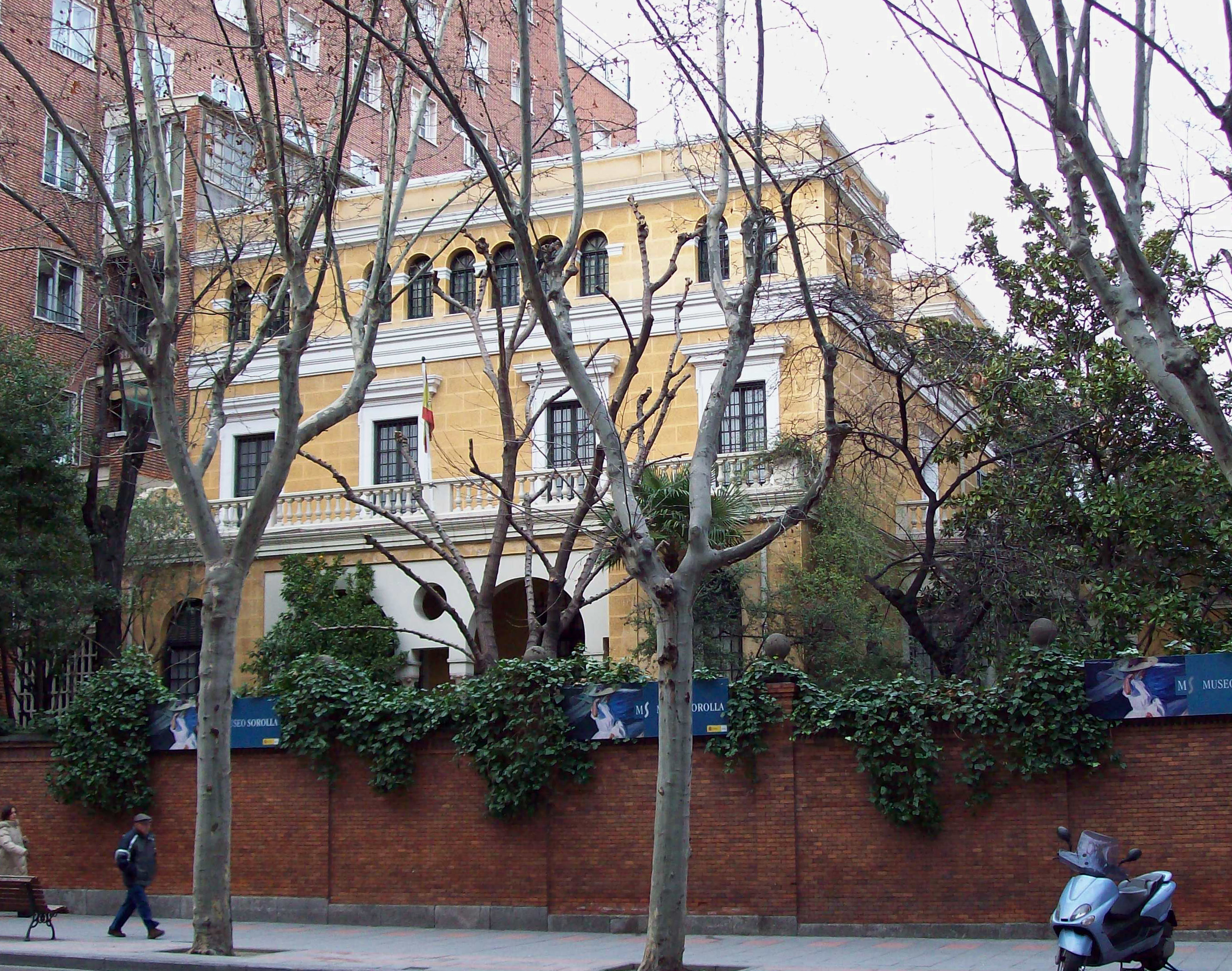
Sorolla Museum
Walk into the Sorolla Museum and the first thing you notice is the light. It pours through the tall studio windows, falling across the room the way it falls in Sorolla's paintings -- warm, diffused, impossibly alive. This is not a museum that was built to house art. It is the house where the art was made, the rooms where Joaquin Sorolla lived and worked until a stroke ended his career in 1920, and it preserves the particular quality of attention he brought to everything: the garden he designed, the tiles he chose, the precise angle at which he placed his easel.
The Painter of Light
Joaquin Sorolla y Bastida was born in Valencia in 1863 and became, by the early twentieth century, the most celebrated Spanish painter of his generation. His subject was light itself -- the way it scattered across wet sand at the beach, the way it turned a white dress translucent, the way it made the Mediterranean shimmer. He painted outdoors, quickly, with a confidence that bordered on recklessness. His canvases of children playing in the surf, fishermen hauling nets, and women strolling along the shore earned him international fame and commissions that stretched from Madrid to New York, where the Hispanic Society of America asked him to paint a monumental series depicting the regions of Spain.
A House Built for Making
In 1910, Sorolla commissioned the architect Enrique Maria Repulles to design a house in Madrid's Chamberi district that would serve as both home and workshop. The result is a building organized entirely around the act of painting. The studio dominates: a vast, high-ceilinged room with enormous north-facing windows that flood the space with the even, cool light every painter craves. The walls are still hung with Sorolla's canvases, layered and overlapping as he left them. Adjoining rooms hold his collection of ceramics, sculptures, and furniture. The Andalusian-inspired garden, which Sorolla designed himself, provided a private oasis -- and a frequent subject. After his death in 1923, his widow Clotilde Garcia del Castillo lived in the house until her own death, when the family donated it to the Spanish state.
From Home to National Treasure
The house became a museum and was declared a Bien de Interes Cultural in 1962, placing it among Spain's most important cultural landmarks. The principal rooms remain furnished as they were during Sorolla's life, giving visitors the rare experience of standing in the exact space where a great artist worked. Upstairs galleries rotate temporary exhibitions. In 2014, the museum hosted photographs by David Palacin documenting a ballet inspired by Sorolla's paintings, performed by the Spanish National Dance Company -- a reminder that Sorolla's influence extends well beyond the canvas.
Renewal and Return
The museum closed for a major renovation, with plans to reopen in 2026. During the closure, part of the collection has been temporarily displayed at the Royal Collections Gallery near the Royal Palace, introducing Sorolla's luminous canvases to audiences who might never have found the quiet museum in Chamberi. When the doors reopen, visitors will step back into a world where the boundary between art and life was deliberately erased -- where the garden outside the window is also the garden inside the painting, and where the light that fills the room is the same light the painter spent his life trying to capture.
From the Air
Located at 40.435N, 3.693W in the Chamberi district of central Madrid, north of the Paseo de la Castellana. The museum is a residential-scale building not individually visible from altitude, but the neighborhood is identifiable between the large green spaces of the Retiro Park to the southeast and the university campus to the northwest. Nearest major airport is Madrid-Barajas (LEMD), approximately 13 km northeast. Best viewed at low altitude in the context of central Madrid's urban fabric.