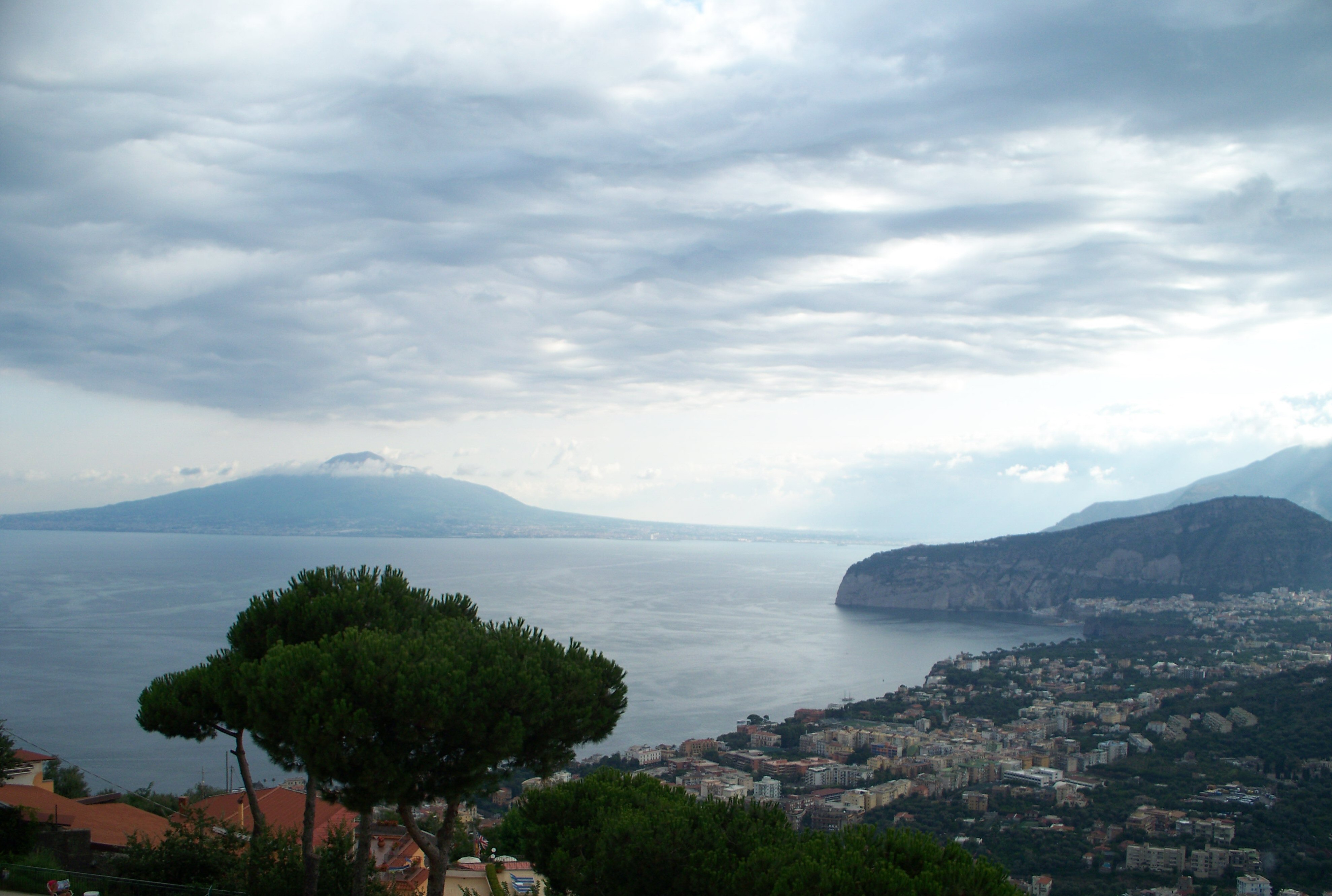
Sorrento
The lemons here are absurd. They hang from trellised terraces along the hillside in clusters the size of softballs, their thick, knobbly rinds a yellow so saturated it looks hand-painted. Sorrento has built an entire economy around these fruits — limoncello, lemon soap, lemon candy, lemon ceramics — but the lemons are more than souvenirs. They are the reason the terraces were carved into the cliff in the first place, the reason the town smells the way it does on a warm afternoon, and the quiet engine behind a food culture that has perfected the art of turning a few simple ingredients into something worth traveling for.
The Cliff-Top Crossroads
Sorrento occupies a position that is as strategic as it is scenic: a limestone plateau dropping sharply to the Bay of Naples, with Vesuvius smoking on the northeast horizon and the island of Capri floating to the southwest. The town sits at the end of the Circumvesuviana rail line from Naples, making it the natural jumping-off point for the entire region. Ferries depart the marina for Capri, Positano, and Amalfi. Buses wind east along the serpentine SS163 toward the Amalfi Coast. The Circumvesuviana itself passes through Pompeii and Ercolano on its way from Naples, which means a visitor based in Sorrento can reach two of the ancient world's most famous ruins without renting a car. This convergence of routes is no accident — Sorrento has been a transit hub since the Romans, who valued the same mild climate and sheltered harbor that draw visitors today.
Piazza Tasso After Dark
Sorrento's social life revolves around Piazza Tasso, named for the Renaissance poet Torquato Tasso, who was born here in 1544. By early evening, the square fills with the particular Italian ritual of the passeggiata — the slow, purposeful walk that has nothing to do with exercise and everything to do with being seen, greeting neighbors, and delaying dinner until the proper hour. Restaurants and cafes ring the piazza with outdoor tables, and the dining rarely begins before eight. Gnocchi alla Sorrentina — potato gnocchi baked with tomato sauce and mozzarella until the cheese blisters — is the signature dish, but the artichoke parmigiana and fresh seafood from Marina Grande are equally essential. The evening ends, as evenings in southern Italy often do, with a glass of limoncello served so cold it is almost viscous, the alcohol tempered by sugar and the perfume of those enormous local rinds.
Two Marinas and a Hidden Cove
Sorrento's coastline splits into two harbors. Marina Grande, the old fishing village at the base of the western cliffs, still operates as a working port where boats bob between waterfront restaurants serving the morning's catch. Marina Piccola, the more sheltered harbor to the east, handles the ferry traffic and tourist boats. Both have small beaches, though Sorrento is not really a beach town — the coast is steep and rocky, and the best swimming requires either paying a few euros for access to a stabilimento with lounge chairs and umbrellas, or knowing where to find Bagni Regina Giovanna. This natural rock pool, formed by the ruins of a Roman villa that once belonged to the Queen Giovanna, sits about two kilometers west of the center. The walk there follows a footpath through olive groves along the cliff edge, arriving at a cove where the sea pours through gaps in the ancient foundation walls. It is Sorrento's best-kept semi-secret, known to every local and discovered by every persistent visitor.
The Scooter and the Narrow Road
Driving in Sorrento requires a particular temperament. The roads are nominally one lane in each direction, but oncoming traffic treats lane markings as suggestions rather than rules. Scooters and motorcycles outnumber cars, threading between buses on roads that were designed for donkey carts. Parking is nearly impossible, and the sound of a Vespa engine bouncing off stone walls is as characteristic of Sorrento as church bells. Most visitors learn quickly that the Circumvesuviana — crowded, noisy, and lacking air conditioning on most trains — is still preferable to navigating the coastal roads. From mid-March to October, the Campania Express offers a faster, air-conditioned alternative between Naples and Sorrento, cutting the journey to 50 minutes. The SITA buses that connect Sorrento to Positano and Amalfi deliver some of the most terrifying and beautiful rides in Europe, swinging around hairpin turns with sheer drops to the sea below.
From the Air
Sorrento sits at 40.628°N, 14.374°E on the northern edge of the Sorrento Peninsula, overlooking the Bay of Naples. From 3,000-5,000 feet AGL, the town is visible as a cluster of buildings atop dramatic limestone cliffs, with the harbor and marina at their base. Mount Vesuvius dominates the view to the northeast, and Capri is clearly visible to the southwest. The nearest major airport is Naples International Airport (LIRN), approximately 18 nautical miles to the northwest. The Sorrento Peninsula forms the southern boundary of the Bay of Naples, with the Amalfi Coast continuing along its southern shore. Marine haze and thermals off the cliffs are common, particularly in summer months.