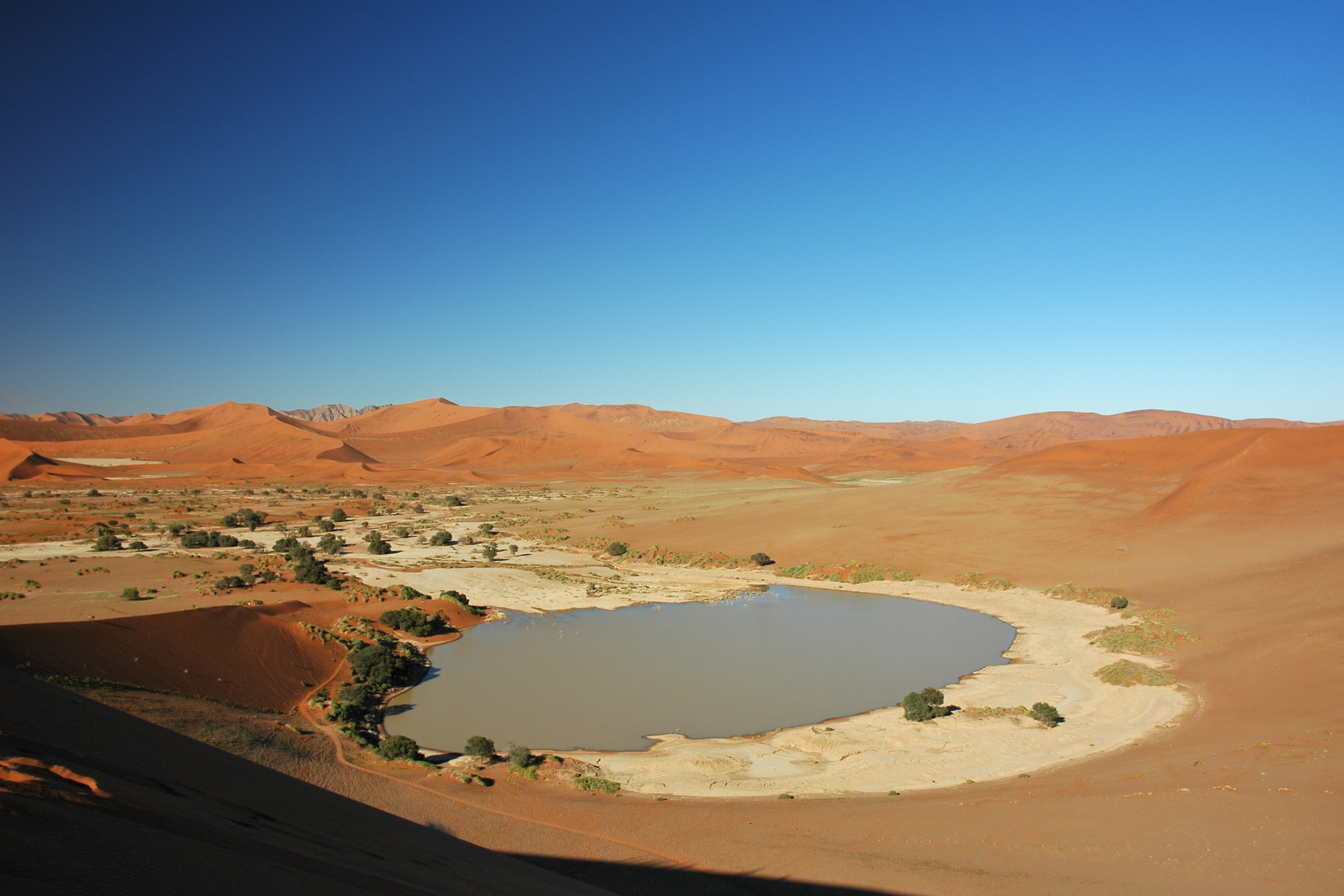
Sossusvlei
The trees in Dead Vlei have been dead for centuries, but they have not fallen. They stand upright, blackened trunks against white clay, framed by dunes that glow orange at sunrise -- perfectly preserved because the air is so dry that even decomposition cannot complete its work. Sossusvlei, the main attraction of Namibia's Namib-Naukluft National Park, is a clay pan enclosed by towering sand dunes in the oldest desert on Earth. The name comes from the Nama language: sossus means "place of no return," and vlei is Afrikaans for clay pan. It is one of those rare landscapes that looks surreal in photographs and more surreal in person.
The Oldest Desert's Tallest Dunes
The Namib Desert stretches over 1,500 kilometers along Africa's southwestern coast, from the Orange River in the south into Angola in the north. It is the oldest desert in the world, its arid conditions dating back at least 55 million years. Within this vast landscape, the sandy portion -- designated a UNESCO World Heritage Site as the Namib Sand Sea -- contains some of the tallest dunes on Earth, reaching heights above 300 meters. The dunes shift in color from pale yellow to deep orange-red depending on the iron oxide content of the sand and the angle of the light. At dawn, the eastern faces blaze orange while the western slopes remain in cool blue shadow, creating the dramatic contrast that has made Sossusvlei one of the most photographed landscapes in Africa.
A River That Never Arrives
Sossusvlei exists because of the Tsauchab River, which flows through the Namib perhaps once every five to ten years. Even in the wettest seasons, the river never reaches the Atlantic. Sand dunes block its path, and the water pools into clay pans before slowly evaporating. The clay deposited by the Tsauchab over millennia created both Sossusvlei and, centuries ago when the river followed a different course, the neighboring Dead Vlei. The two pans lie side by side: one with living acacia trees sustained by rare floodwater, the other completely severed from all moisture, its trees reduced to dark skeletal forms. Dead Vlei's trees are estimated to be 600 to 700 years old -- long dead, but standing because nothing in this environment can break them down.
Dune 45 in the Dark
The classic Sossusvlei experience begins in darkness. Dune 45 -- named for its distance from the Sesriem gate, 45 kilometers into the park -- is the most popular climb, taking roughly an hour to ascend its sinuous ridge. Those who stay at the Namibia Wildlife Resorts accommodations inside the park gate can enter before sunrise; everyone else waits for the gates to open at dawn and drives the 65 kilometers of tarred road from Sesriem, plus the final five kilometers of deep soft sand that requires a 4x4 or a shuttle. The reward at the top is the view: an ocean of dunes extending to every horizon, their crests catching the first light while the valleys remain in shadow. Springbok, gemsbok, and ostrich move through the lower ground, improbably alive in a landscape that looks as barren as another planet.
A Delicate Emptiness
Deserts deceive. The Namib looks lifeless from above, but its dune ecosystem supports a surprising amount of life -- fog-basking beetles that drink moisture from Atlantic mist, sidewinding adders, golden moles that swim through loose sand. The gravel plains surrounding the dune sea host gemsbok and springbok adapted to survive on almost no surface water. This fragility is part of why access to Sossusvlei is controlled: the park requires permits, the road is gated, and the deep-sand section at the end is notorious for swallowing inexperienced drivers and their rental cars. Guides tell the story with dry humor, but the concern is real. Tire tracks in desert sand can persist for decades. The Namib's age is measured in millions of years; a careless moment can leave a mark that outlasts a human lifetime.
From the Air
Sossusvlei is at 24.74°S, 15.29°E in the Namib-Naukluft National Park. From 10,000-15,000 feet AGL, the star dune formations and white clay pans are strikingly visible against the orange sand sea. The Tsauchab River's dry course can be traced from the east. The nearest significant airstrip is Sesriem (not ICAO-coded), located 65 km northeast at the park entrance. Windhoek Hosea Kutako International Airport (FYWH) is the nearest major airport, roughly 350 km northeast. Swakopmund Airfield (FYSM) to the north is another option. Visibility is usually excellent, with clear skies predominating, though heat haze at lower altitudes can reduce ground detail.