Soul City, North Carolina
"This is neither integration nor segregation, but letting black people do whatever they damn please, and go where they please." When Floyd McKissick spoke those words in January 1969, he was announcing something no one had attempted before: a planned city in the rural South, built from scratch on a former tobacco plantation, designed to prove that Black Americans could create their own economic destiny. He called it Soul City. The land he chose -- 1,800 acres of woods, pastures, and creeks in Warren County, North Carolina, the third poorest county in the state -- had once been the Circle P Ranch, a cattle and timber farm centered around a historic manor house. McKissick, a civil rights lawyer who had led the Congress of Racial Equality, saw profound symbolism in transforming a segregationist legislator's former plantation into a beacon of Black self-determination.
A Plantation Reborn
McKissick's legal colleague T. T. Clayton quietly scouted sites across North Carolina before settling on Leon Perry's Circle P Ranch in Warren County. Perry was losing money and eager to sell, but when McKissick's plans became public, the rancher received death threats and briefly fled to Florida. Clayton negotiated a $390,000 purchase price and secured a $4,000 option on December 19, 1968. With a $200,000 loan from Chase Bank and seller financing from Perry for the balance, McKissick received the deed on February 21, 1969. The Big Three television networks covered his announcement on their evening news, and The Washington Post put it on the front page. Warren County was a majority-Black rural area hemorrhaging population, with over 40% of residents lacking a high school diploma. McKissick believed its low labor costs, proximity to U.S. Route 1, and access to the Seaboard Coast Line Railroad could attract industry to a place the rest of America had written off.
Blueprint for a Village Republic
McKissick hired architect Harvey Gantt to design Soul City, and Gantt drew inspiration from Columbia, Maryland, one of the era's most celebrated planned communities. His vision called for a collection of villages, each with its own unique character and activity center, orbiting a town core that would include a mall, a hospital, a college, and a central library. An 800-acre industrial park would sit north of the core near the railway. A man-made lake would anchor the center of town. Wide sidewalks and bike paths would link the villages together, and one third of the land would remain undeveloped natural area. The buildings themselves would be sleek and modular -- glass, brick, and concrete in 1970s contemporary style. Eva Clayton led the Soul City Foundation, a nonprofit charged with cultivating social life and culture. McKissick envisioned three villages housing 18,000 people by 1989, growing to 44,000 residents and 24,000 jobs by 2004.
A City Tested by Hurricanes of a Different Kind
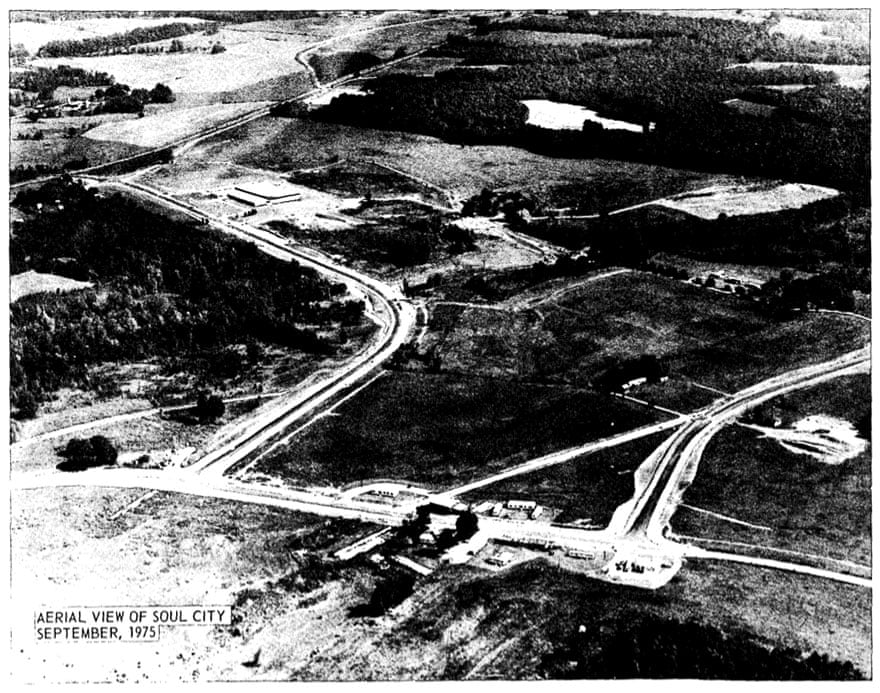
By 1974, pioneering families had moved in. Water and sewer lines were laid. Roads were paved. A health care center and day care center opened. Soul Tech I, a 52,000-square-foot industrial building, began construction. A community lake was completed in 1977. But Soul City launched into a hurricane -- an economic one. Double-digit inflation in 1973 and 1974 gave way to years of stagflation. Companies like Burlington Industries and CC Grander, which had planned to move operations to Soul City, froze their expansion. Michael Spear, the former general manager of Columbia, Maryland, later observed that launching a new towns program in the early 1970s was "like asking the Wright brothers to test their airplane in a hurricane and then concluding, when it crashed, that the invention did not work." Meanwhile, press coverage framing Soul City as a "new black town" deterred white homeowners, and the Wall Street Journal's unflattering portrait of McKissick undermined his credibility with the business community.
The Dream That Wouldn't Die
HUD pulled its funding in 1979. Lawsuits and investigations followed, though a Government Accountability Office audit eventually cleared the Soul City Company of wrongdoing. McKissick never left. He remained in Soul City until his death in 1991, buried on his family's property in the community he willed into existence. The decades that followed brought further indignities: a failed industrial park venture in 1989, a medium-security prison completed in 1997, Soul Tech I converted into a factory producing janitorial supplies for the state prison system. When a new landowner threatened to demolish the Soul City monolith sign in the mid-2000s, residents rallied to save it, and county officials relocated it to the entrance of Green Duke Village. Soul City never became the metropolis McKissick imagined. But its water system -- the Kerr Lake Regional Water Treatment Plant, completed in 1974 through McKissick's collaboration with nearby Oxford and Henderson -- still serves the region. And the idea at its heart, that Black communities could build their own future from the ground up, remains as radical and necessary as the day McKissick stood before the cameras and dared America to believe it.
From the Air
Located at 36.41°N, 78.27°W in Warren County, North Carolina, near the intersection of Manson-Axtell Road and Soul City Boulevard outside Norlina. From 2,000-3,000 feet AGL, look for the Green Duke Village residential area and scattered infrastructure among the woods and pastures of the original Circle P Ranch. Kerr Lake is visible several miles to the north. The nearest significant airport is Henderson-Oxford Airport (KHNZ), approximately 15 nm to the southwest. Raleigh-Durham International Airport (KRDU) is roughly 50 nm south-southwest.