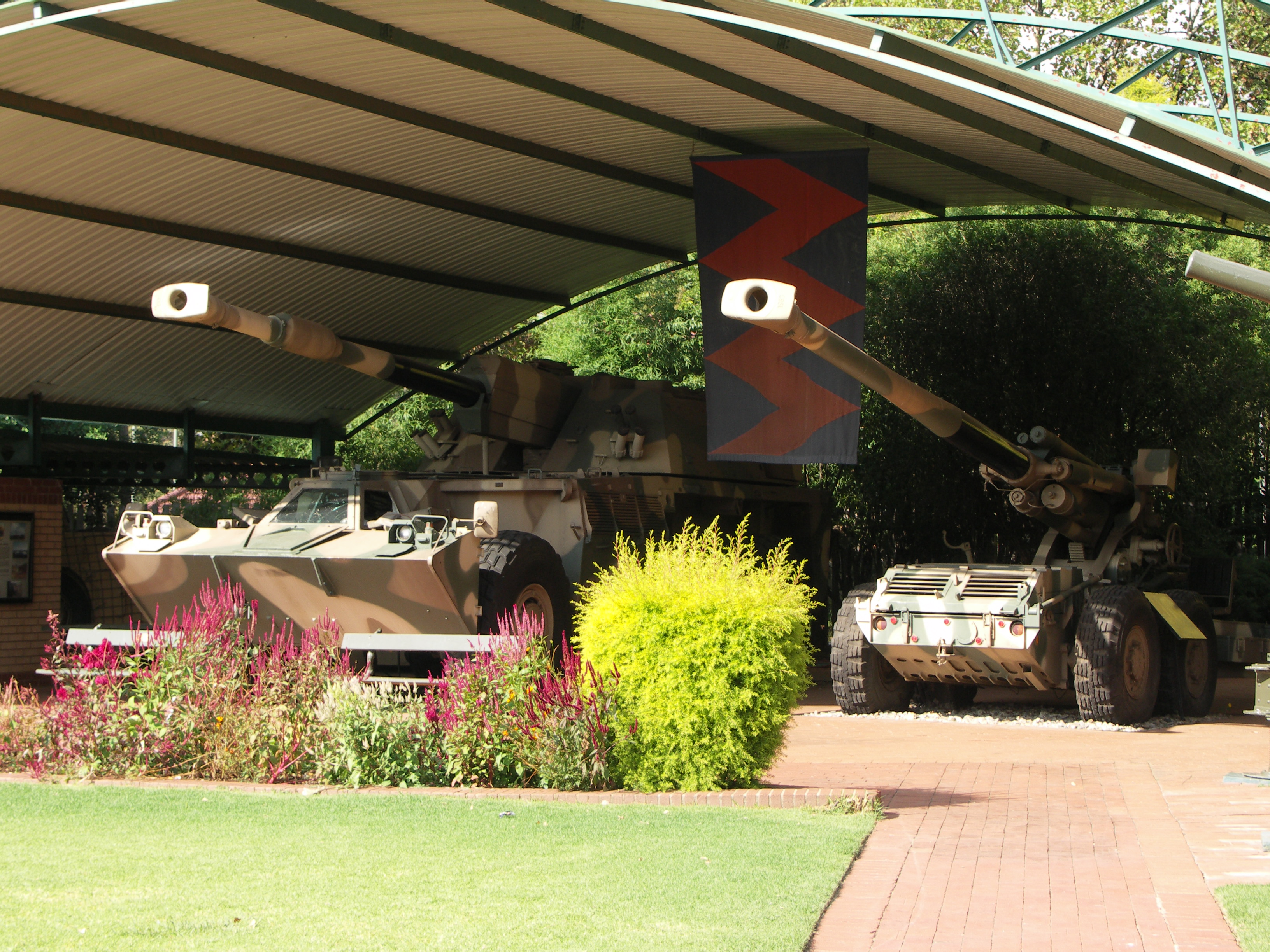
South African National Museum of Military History
A Messerschmitt Me 262 -- the world's first operational jet fighter -- sits inside a hall named for "Sailor" Malan, the South African-born fighter ace who shot down thirty-five Luftwaffe aircraft over Britain. Nearby, a captured Soviet T-54 tank from the Angolan bush war faces a row of South African-built G5 howitzers. Outside, a Blackburn Buccaneer strike aircraft shares the grounds with a memorial designed by Sir Edwin Lutyens. The South African National Museum of Military History in Johannesburg does not tell a simple story, because South Africa's military history is not a simple story. It is tangled, uncomfortable, and sprawling -- exactly the kind of history that benefits from being preserved rather than forgotten.
Smuts Opens the Doors
On August 29, 1947, Prime Minister Jan Smuts officially opened the museum to preserve South Africa's role in the Second World War. The country had contributed significantly to the Allied cause: the 6th South African Armoured Division fought its way up the Italian peninsula, South African pilots flew Spitfires and Hurricanes over North Africa and Europe, and South African naval vessels patrolled waters from the Cape to the Mediterranean. Smuts -- himself a former Boer War guerrilla commander who had fought against the British before becoming one of Britain's closest wartime allies -- understood the complexity of his nation's military identity better than most. Originally named the South African National War Museum, the institution was renamed in 1975 to encompass all conflicts South Africa has been involved in. In 1999 it was amalgamated into what became the Ditsong Museums of South Africa.
Lutyens on the Highveld
In the museum grounds stands a large memorial designed by Sir Edwin Lutyens, the British architect who designed the Cenotaph in London and much of New Delhi. On November 30, 1910, Prince Arthur, Duke of Connaught and Strathearn, laid the commemorative stone. Originally called the Rand Regiments Memorial, it was dedicated to British soldiers who died during the Second Boer War -- a conflict that devastated the region and left deep scars across the Afrikaner community. In an act of reconciliation that took nearly a century, the memorial was rededicated on October 10, 1999, to all people who died during the Second Boer War, regardless of which side they fought on. It was renamed simply the Boer War Memorial.
Halls of Hardware
The museum sprawls across multiple halls and outdoor exhibits, each packed with the machinery of twentieth-century warfare. The GE Brink Hall houses a Hawker Hurricane, a Supermarine Spitfire, and a de Havilland Mosquito alongside Battle of Britain exhibits and artifacts from the Royal Air Force. The FB Adler Hall displays an M4 Sherman tank, an M3 Stuart, and exhibits spanning South Africa's involvement in World War II, the Anglo-Zulu War, and the South African Border War. A Molch one-man submarine sits in the outdoor collection next to Centurion and Churchill tanks. The small arms collection ranges from Maxim guns and Lee-Enfield rifles to AK-47s and Vektor R4s -- weapons that trace South Africa's arc from colonial conflicts through Cold War proxy battles.
The Stories Behind the Steel
Beyond the hardware, the museum preserves human stories that complicate easy narratives. An exhibit honors members of the Native Military Corps, the Indian Service Corps, and the Cape Corps -- non-white soldiers who served South Africa during the World Wars under a system that simultaneously relied on their sacrifice and denied them full citizenship. The Delville Wood Room contains a plaster cast of a Danie de Jager relief from the South African memorial in France, commemorating the devastating 1916 battle where a South African brigade suffered catastrophic casualties. The Captain William Faulds Centre, built using insurance funds after the theft of Faulds' Victoria Cross and Military Cross medals, houses conference and gathering rooms dedicated to these layered memories of service and loss.
A Nation's Contradictions on Display
An exhibit traces South African history from the Boer Wars through the 1994 democratic elections, covering the political fractures of both World Wars, the 1921-1922 Rand Rebellion by white mineworkers, the Ossewabrandwag's sabotage campaign during World War II, and the country's controversial involvement in the Angolan Civil War. Captured Angolan, Cuban, and Soviet vehicles -- T-34 tanks, PT-76 amphibious tanks -- sit alongside the South African equipment that faced them in the Border War. The museum does not resolve the contradictions of a country that fought fascism abroad while practicing racial oppression at home. It lays the artifacts side by side and trusts visitors to wrestle with what they find.
From the Air
The museum is located at 26.163°S, 28.042°E in the Saxonwold area of Johannesburg, adjacent to the Johannesburg Zoo and Hermann Eckstein Park. From 3,000-5,000 feet AGL, the outdoor military exhibits (tanks, aircraft, artillery) are visible in the park grounds. O.R. Tambo International Airport (FAOR/JNB) is approximately 14 nm east. Lanseria International Airport (FALA) is about 23 nm northwest. Rand Airport (FAGM) lies to the south. The nearby Johannesburg CBD skyline and the Northcliff Ridge serve as visual references. Clear Highveld mornings are typical; afternoon thunderstorms are common in summer.