South-East Asian Theatre of World War II
The landing at Singora, on the east side of the Isthmus of Kra, preceded the bombing of Pearl Harbor by several hours. While the world's attention fixed on Hawaii on 7 December 1941, Japanese forces were already ashore in Thailand, and within hours they struck the Philippines, Hong Kong, Singapore, and Malaya simultaneously. What followed was the largest and most rapid territorial conquest in modern military history -- and then, over three grinding years, its complete reversal. The South-East Asian Theatre of World War II stretched from the Bay of Bengal to the Philippine Sea, from the Himalayan foothills to the jungles of Java, and it involved millions of soldiers from more than a dozen nations fighting across terrain that ranged from monsoon-drenched mountains to open ocean.
The Dominoes Fall
Japan's opening offensive was devastating in its speed and coordination. On 10 December 1941, just two days after the attacks began, Japanese aircraft sank the British battleship Prince of Wales and the battlecruiser Repulse off the coast of Malaya -- a shock that demonstrated aircraft could destroy capital ships at sea. Thailand's government formally allied with Japan on 21 December. Hong Kong surrendered on Christmas Day. January 1942 brought the invasions of Burma and the Dutch East Indies, along with the capture of Manila and Kuala Lumpur. Then came Singapore. Japanese forces drove the Indian III Corps, the Australian 8th Division, and British units down the Malay Peninsula despite fierce resistance. On 15 February 1942, Lieutenant General Arthur Percival surrendered the garrison -- approximately 130,000 Allied troops became prisoners of war in the largest capitulation in British military history. Within months, Japan controlled an empire stretching from the borders of India to the western Pacific.
The Ocean Shifts
The Japanese Indian Ocean raid of March-April 1942 drove the British Eastern Fleet from Ceylon to Kilindini at Mombasa, Kenya -- a retreat of thousands of miles that left the Indian Ocean virtually undefended. The fleet was reduced to little more than a convoy escort force. In Madras, a single Japanese seaplane dropped one bomb near Fort St. George; the physical damage was negligible, but the psychological impact triggered a mass evacuation of the city, with wealthy families relocating permanently to hill stations in the interior. The British began improving the road from Kodaikanal to Munnar as an evacuation route, anticipating a Japanese invasion of India that never came. It was not until the war in Europe began winding down in late 1943 that significant British naval forces returned to the Indian Ocean. Ships released from the Home Fleet after the neutralization of the German navy, and amphibious craft freed by the success of D-Day, gradually rebuilt Allied naval power in the theatre.
The Forgotten Army
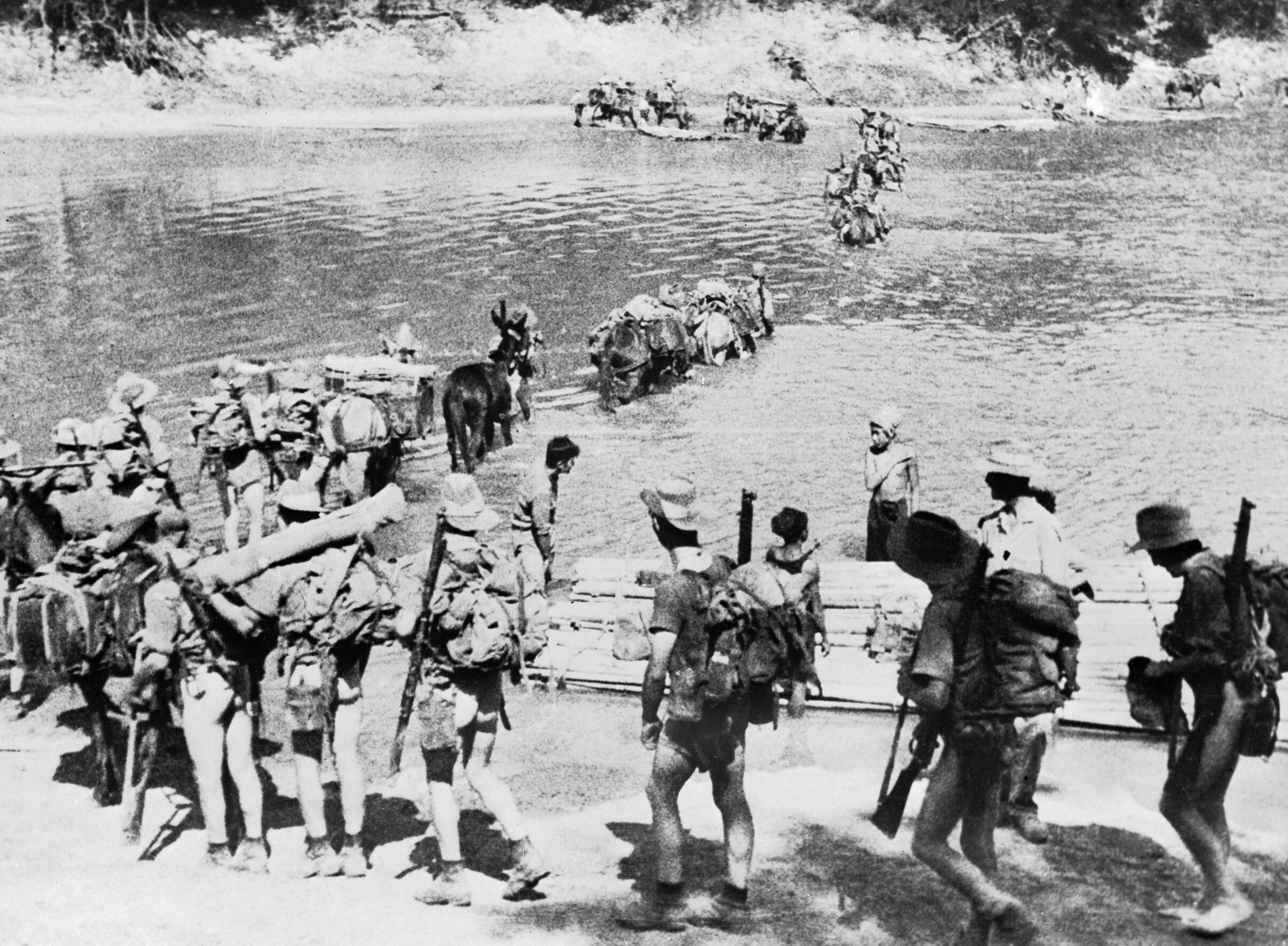
The Burma Campaign earned its bitter nickname honestly. The British Fourteenth Army, fighting in some of the most punishing terrain on Earth, received less attention, fewer supplies, and lower priority than virtually every other Allied force in the war. The retreat of the Burma Corps in 1942 was one of the longest in British military history. But the tide turned. The Japanese attack on India -- the offensives at Imphal and Kohima in 1944 -- became a catastrophe for the attackers, and the Fourteenth Army under Lieutenant General William Slim launched a counteroffensive that drove through central Burma toward Rangoon. Meanwhile, the Americans ran their own parallel war in the China-Burma-India Theatre. Pilots flew 'the Hump' -- supply runs over the Himalayas from India to China, one of the most dangerous air routes ever flown. Engineers carved the Ledo Road through mountain jungle to replace the severed Burma Road. Merrill's Marauders fought behind Japanese lines in conditions that broke men and machines alike.
A Tangle of Commands
No theatre of the war suffered more from command confusion. At the outset, British forces fell under at least three separate commands that overlapped in jurisdiction and sometimes contradicted each other. General Wavell was appointed Supreme Commander of all American-British-Dutch-Australian forces in January 1942, but the Japanese advance split his command in two within weeks, and ABDACOM was dissolved on 25 February. Burma shuffled between Far East Command, India Command, and ABDA in a matter of months. In August 1943, the Allies created South East Asia Command under Admiral Lord Louis Mountbatten, with the American General Joseph Stilwell as deputy -- a partnership that generated as much friction as cooperation. The Japanese, by contrast, operated under a single Southern Expeditionary Army headquartered in Saigon, commanded throughout the war by General Count Hisaichi Terauchi, with four numbered armies controlling forces from the Philippines to Burma.
The War's Long Shadow
Japan announced its intent to surrender on 15 August 1945, and the formal ceremony took place aboard USS Missouri on 2 September. But the war's consequences in Southeast Asia were only beginning. The Japanese had shattered the myth of European colonial invincibility, and the independence movements that followed -- in Indonesia, Vietnam, Burma, Malaya, and the Philippines -- drew directly on that rupture. On the Andaman and Nicobar Islands, Japan had handed nominal control to Subhas Chandra Bose's Indian National Army government in 1943, renaming the islands 'Shaheed' and 'Swaraj' -- martyr and self-rule. The sovereignty was fictional, but the symbolism endured. Across the theatre, the war had displaced millions, destroyed infrastructure, and created political vacuums that would fuel decades of conflict. Southeast Asia Command itself was not disbanded until 30 November 1946, more than a year after the fighting stopped, because the aftermath proved almost as complex as the war itself.
From the Air
This theatre spans all of Southeast Asia. The article's coordinates center at approximately 10.0N, 110.0E, in the South China Sea between Vietnam and Borneo. Key locations include Singapore (WSSS), Rangoon/Yangon (VYYY), Imphal, the Malay Peninsula, and the Dutch East Indies. For a representative flyover, follow the Malay Peninsula from Singapore northward through Kuala Lumpur toward Burma. The Andaman Islands (VOPB at Port Blair) offer a remote perspective on the Japanese occupation. Recommended cruising altitude for historical context: 15,000-25,000 feet to appreciate the vast distances this theatre encompassed.