South Georgia Island
The smell reaches you before the sight does - a rich, organic, overwhelming reek of penguin colony that somehow becomes tolerable, even nostalgic, within hours. Then you see them: not hundreds, not thousands, but hundreds of thousands of king penguins packed into St Andrews Bay, their orange ear patches glowing against the grey scree, their constant braying creating a wall of sound. Behind them, glaciers tumble from peaks that rise 2,900 meters straight from the Southern Ocean. This is South Georgia - 170 kilometers of mountain, ice, and teeming wildlife, floating alone in the grey seas between the Falklands and Antarctica. No one lives here permanently. Few places on Earth feel more alive.
The Wildlife Metropolis
The numbers defy comprehension. St Andrews Bay alone hosts 150,000 breeding pairs of king penguins - over 400,000 birds when you count the fluffy brown chicks that look like a completely different species. Salisbury Plain adds another enormous colony. Gold Harbour, Right Whale Bay, Fortuna Bay - every accessible beach is packed with wildlife that has never learned to fear humans.
Elephant seals haul out in the thousands, the massive bulls bellowing challenges and slamming into each other with a violence that shakes the ground. Antarctic fur seals carpet the beaches so densely that landing is impossible during peak breeding season - too many aggressive males defending territory. Wandering albatrosses nest on the hillsides, their three-meter wingspans dwarfing everything else that flies. And in the waters around the island, humpback whales breach and blow, having returned after near-extinction from the whaling that once defined this place.
The Whaling Graveyard
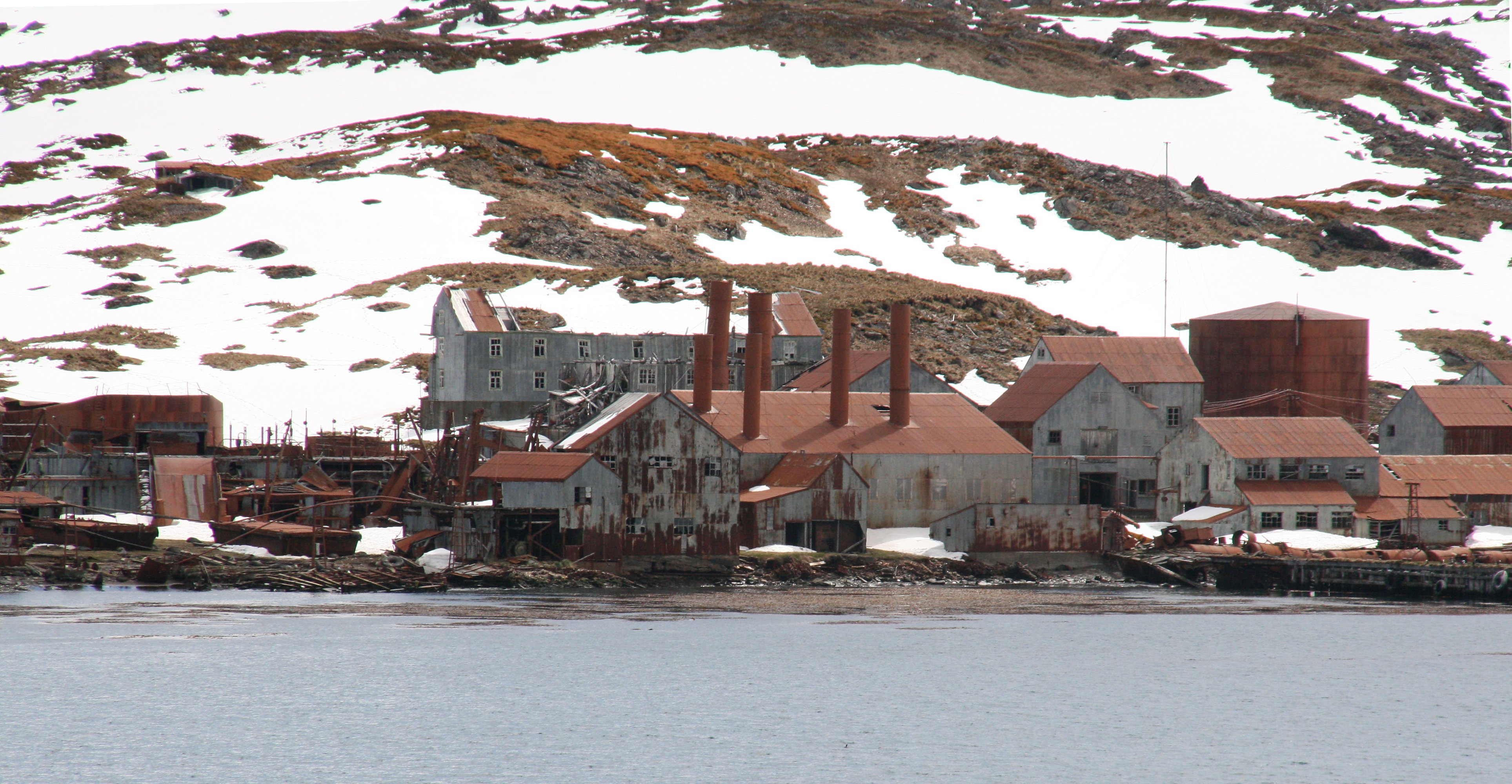
Grytviken is a ghost town that still smells faintly of whale oil. From 1904 to 1965, this was a processing center where thousands of whales were hauled from the surrounding seas, stripped of blubber, and rendered into oil and margarine for Europe. The rusting machinery still stands - flensing platforms, boiling vats, a fleet of catcher boats slowly collapsing into the harbor. The scale of the slaughter is written in the whale bones scattered across the beaches, in the oil that still seeps from the soil.
A small museum and post office now operate in summer. The wooden Norwegian church has been restored, improbably pretty against the industrial wreckage. And in the small cemetery, Ernest Shackleton lies beneath a simple granite headstone, facing south toward the continent he never conquered. He died here in 1922, on his way to yet another Antarctic expedition, his heart giving out at 47. His men buried him where he fell, in the place he'd reached after one of history's greatest survival stories.
The Crossing
In 1916, Shackleton and five others made landfall at King Haakon Bay on South Georgia's savage south coast after sailing 1,300 kilometers across the Southern Ocean in a 22-foot lifeboat. Their ship Endurance had been crushed by Weddell Sea ice months before; their remaining crew was stranded on Elephant Island. The only hope was to reach the whaling stations on South Georgia's north coast.
But they'd landed on the wrong side of the island, separated from rescue by 40 miles of unmapped mountains and glaciers. Shackleton, Tom Crean, and Frank Worsley set off with fifty feet of rope, a carpenter's adze, and a few screws in their boots for traction. Thirty-six hours later, exhausted and frostbitten, they staggered into Stromness whaling station. Every man on Elephant Island was eventually rescued. The route they pioneered is now called the Shackleton Crossing - still attempted by mountaineers, still considered serious and dangerous.
Resurrection Island
For decades, South Georgia seemed doomed to become a different kind of wildlife graveyard. Rats had arrived with the sealers and whalers, and they were devastating the ground-nesting birds - pipits, pintails, petrels. Reindeer introduced for meat had multiplied to 7,000, trampling vegetation and nests. The island's ecology was collapsing.
Then came the most ambitious conservation project ever attempted in such a hostile environment. From 2011 to 2015, helicopters dropped poisoned bait across the entire rat-infested zone - thousands of square kilometers of mountain and glacier. Every reindeer was culled. Sniffer dogs searched for survivors. In 2018, South Georgia was declared rat-free. The pipits and pintails are returning. The recovery is visible year by year, proof that even the most damaged ecosystems can be brought back if the will exists.
The End of the World
Getting to South Georgia requires commitment. There is no airstrip. The only access is by ship, typically a two-day crossing from the Falklands or five days from Ushuaia, across some of the roughest seas on Earth. Most visitors come on expedition cruises that also visit Antarctica, spending perhaps two or three days exploring the island's north coast by Zodiac.
No one stays ashore overnight without special permission. There are no hotels, no restaurants, no infrastructure beyond a few research stations. The weather can shift from calm to survival conditions in minutes. And yet people return, again and again, drawn by the wildlife, the history, the raw grandeur of a place that remains utterly itself - indifferent to human comfort, overwhelming in its abundance, as close to untouched wilderness as anywhere left on Earth.
From the Air
Located at 54.3°S, 36.6°W in the South Atlantic, 1,390km southeast of the Falklands. The island is 170km long, oriented NW-SE, with a mountainous spine rising to 2,934m at Mount Paget. No airstrip exists - all access is by sea. From altitude, look for the extensive glaciers covering over half the island, the dramatic fjords cutting into the north coast, and the abandoned whaling stations (Grytviken, Stromness, Leith Harbour) visible as rust-colored industrial ruins. The south coast is a continuous ice cliff - dangerous and rarely approached. King penguin colonies at St Andrews Bay and Salisbury Plain appear as vast brown-orange patches on the coastal flats. Nearest airports: Mount Pleasant (MPN) in the Falklands 1,390km northwest. Expect severe weather - high winds, rain, snow, and rapidly changing conditions year-round. Overflight only; landing requires ship access.