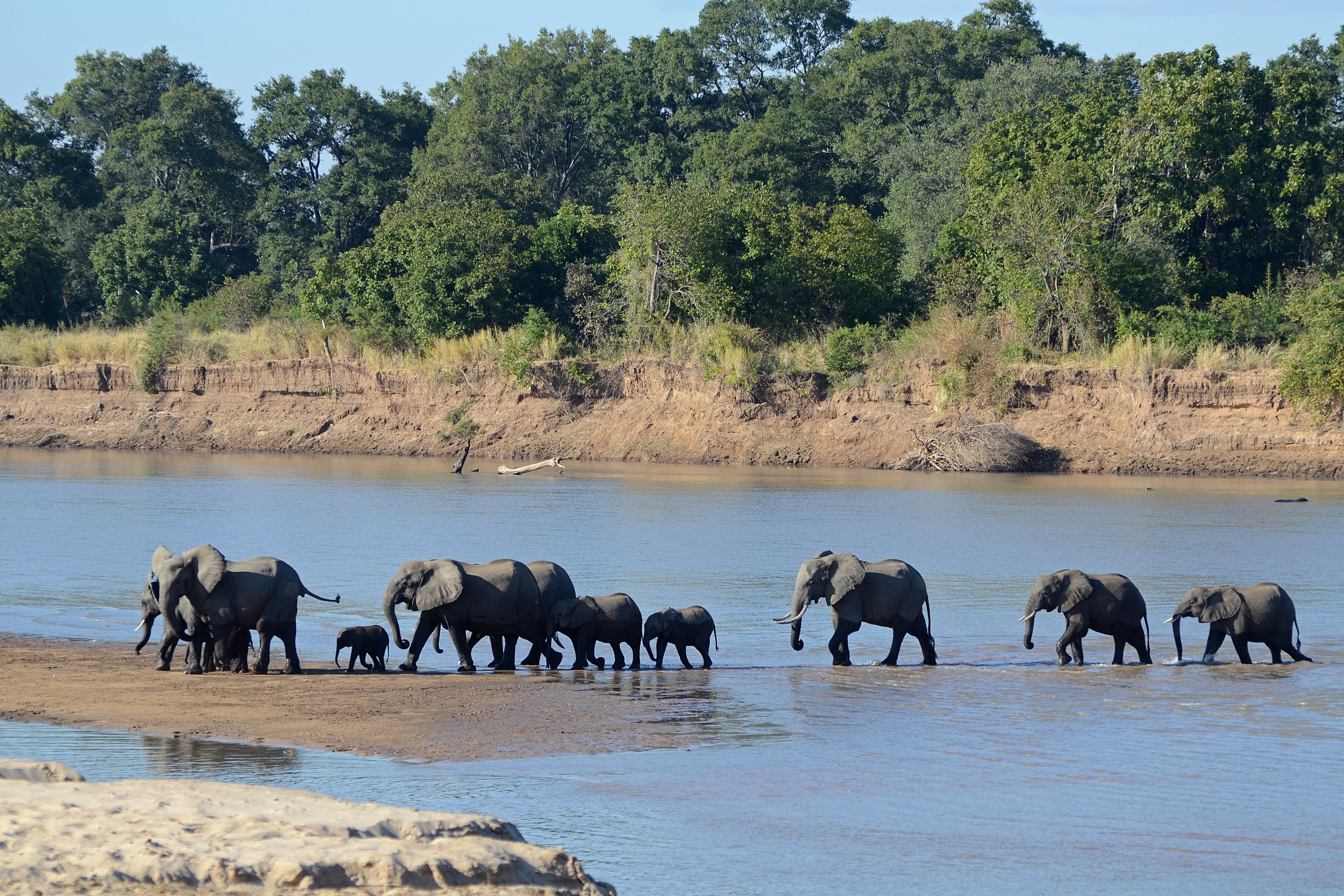
South Luangwa National Park
Two subspecies exist here and almost nowhere else. Thornicroft's giraffe, with white legs and a pale face, browses the mopane woodland. Crawshay's zebra, lacking the brownish shadow-stripe of its Burchell's cousin, grazes the floodplains. Both are endemic to the Luangwa Valley, and both are reasons South Luangwa National Park has earned a reputation that extends well beyond Zambia. This is one of the few major African parks that permits night safaris — spotlights sweeping the bush to catch the reflective eyes of leopards, hyenas, and civets — and that distinction alone sets it apart from the more famous reserves to which it is increasingly compared.
Where the River Wanders
The Luangwa River is the spine of the park, a meandering waterway that carves oxbow lakes as it shifts course across a broad valley floor. During the dry season — May through October — the river contracts and the surrounding mopane woodland shrivels. Wildlife concentrates around the shrinking water sources, and the viewing becomes extraordinary. Hippos pack the shallows so densely they resemble boulders. Crocodiles line the banks. Elephants file down well-worn paths to drink at dusk. Stately baobabs punctuate the landscape, their thick trunks storing water against the months of drought. When the rains arrive in November, the valley greens almost overnight, the river swells, and the animals disperse into a landscape that suddenly seems twice its dry-season size.
Predators in the Spotlight
South Luangwa harbors one of the highest leopard densities in Africa, though seeing them takes patience and a willingness to stay out after dark. Night drives are the park's signature experience: guides steer open vehicles along dirt tracks while a spotter sweeps a handheld light across the treeline. A pair of glowing eyes in a sausage tree might be a leopard draped over a branch, its kill wedged in a fork above. Lions are easier — several prides hunt the floodplains, and buffalo herds of several hundred provide steady quarry. The elusive African wild dog appears most reliably between March and June, traveling in painted, rangey packs that cover enormous distances. Over 400 bird species have been recorded, making the park a serious destination for birders, particularly in the transitional months when migrants arrive and the bush is lush.
On Foot Through the Bush
South Luangwa pioneered the walking safari concept, and some of the operators running them today trace their lineage to Norman Carr, the conservationist who first introduced the idea here in the 1950s. Walking changes everything about a safari. You move slowly, reading tracks in the dust — the drag marks of a crocodile's belly, the neat paired prints of an impala, the enormous saucer of an elephant's forefoot. Armed scouts walk point and rear. Multi-day treks connect remote bushcamps scattered through the park, each more comfortable than the name suggests, with proper beds, hot showers, and meals prepared over open flame. A four-hour walk covers ground a vehicle would cross in minutes, but the details you absorb on foot — the termite engineering, the dung beetle's labor, the alarm call of a baboon that tells you a predator is near — make the pace worthwhile.
Getting There Before the Crowds
Mfuwe International Airport, about thirty minutes by car from the park's main gate, connects to Lusaka, Livingstone, and Lilongwe in Malawi. In high season, flights run twice daily to the capital. In the green season, schedules thin out and some lodges close entirely, though those that remain offer steep discounts and the birding is at its best. The road from Chipata — 123 kilometers of mostly paved surface — takes two to three hours in the dry season; in the wet, it can become impassable. South Luangwa remains one of the few major African parks accessible by public transport: a daily minibus from Chipata delivers visitors to Mfuwe village, the loose settlement of shops and bars that serves as the park's unofficial front door. The combination of world-class wildlife, limited visitor numbers, and genuine difficulty of access is precisely what makes this park exceptional. That balance will not last forever.
From the Air
South Luangwa National Park is centered at approximately 13.00°S, 31.50°E in eastern Zambia. Mfuwe International Airport (FLMF) lies about 25 km from the park's main bridge entrance and is the primary access point by air, with scheduled flights to Lusaka (FLLS) and seasonal connections to Livingstone (FLHN) and Lilongwe, Malawi (FLLW). From 5,000–8,000 feet AGL, the meandering Luangwa River and its oxbow lakes are clearly visible, winding through dry woodland. The Muchinga Escarpment rises to the west. Terrain elevation is approximately 1,600–2,000 feet AMSL. Expect hot, dry conditions May–October and seasonal thunderstorms November–April.