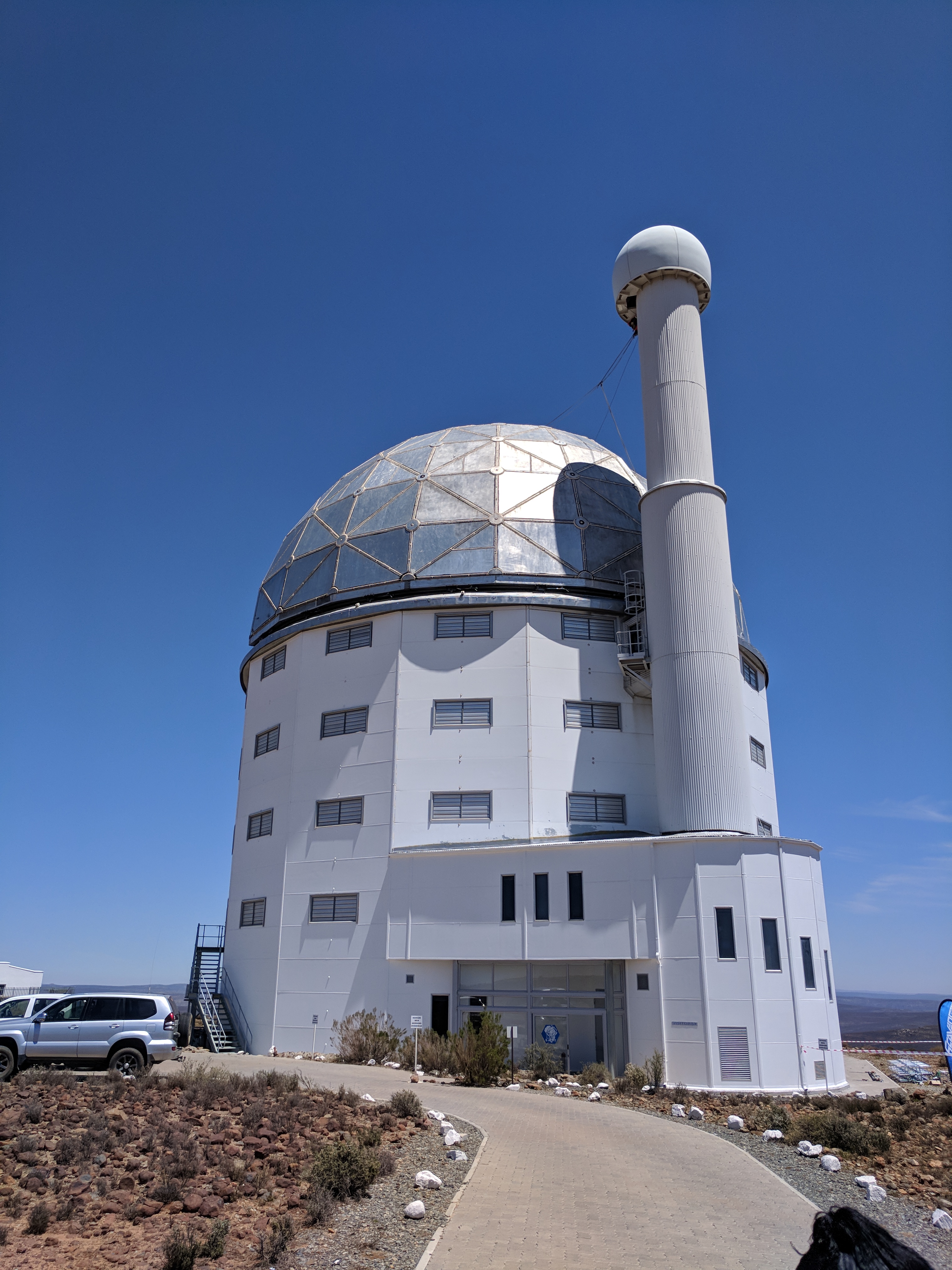
Southern African Large Telescope
Ninety-one hexagonal mirrors, each one metre across, fitted together like a honeycomb on a remote hilltop in the Karoo semi-desert. Together they form the Southern African Large Telescope, or SALT, the largest optical telescope in the Southern Hemisphere. The instrument sits 1,837 metres above sea level near the small town of Sutherland, 370 kilometres northeast of Cape Town, in a landscape chosen precisely because almost nothing happens there: no city lights, minimal atmospheric disturbance, and skies so dark that the Milky Way casts shadows on the ground.
A Mirror Built from Pieces
SALT's primary mirror spans 11.1 by 9.8 metres, yet no single piece of glass could be made that large and that precise. Instead, the telescope uses an array of 91 identical hexagonal segments made from low-expansion Sitall glass, each adjustable in tip, tilt, and piston to align them into a single coherent surface. The design draws on the Hobby-Eberly Telescope at McDonald Observatory in Texas, but with a key improvement: a four-mirror spherical aberration corrector that provides a wider field of view of 8 arcminutes at prime focus. Unlike conventional telescopes that track objects by moving their entire mirror, SALT keeps its mirror fixed at a constant altitude and azimuth. A smaller 'payload' at the prime focus tracks targets as they drift across the sky, similar in concept to how the Arecibo Radio Telescope once operated. This fixed-mirror approach dramatically reduced construction costs while transferring the engineering complexity to a lighter, more manageable tracking system.
First Light Over the Karoo
Installation of the mirror segments began in March 2004, and the last hexagon was set in place in May 2005. First light came on 1 September 2005, when SALT captured 1-arc-second resolution images of the globular cluster 47 Tucanae, the open cluster NGC 6152, the spiral galaxy NGC 6744, and the Lagoon Nebula. President Thabo Mbeki officially opened the telescope on 10 November 2005. The total cost for the first decade of operations came to US$36 million, split among an international consortium. South Africa contributed roughly a third, with the rest funded by partners from Germany, Poland, the United States, the United Kingdom, and New Zealand. By 2007, the American Museum of Natural History and India's Inter-University Centre for Astronomy and Astrophysics had joined the consortium, widening the telescope's reach and its scientific program.
Hunting the Invisible
SALT was designed primarily for spectroscopy, the analysis of light broken into its component wavelengths, which reveals the composition, temperature, and motion of distant objects. It can observe stars and galaxies a billion times too faint for the human eye. Its instruments include SALTICAM, a $600,000 digital imaging camera built by the South African Astronomical Observatory, and the Robert Stobie Spectrograph, a multi-purpose instrument designed by teams at the University of Wisconsin-Madison, Rutgers University, and the SAAO. A fiber-fed High Resolution Spectrograph, designed by the University of Canterbury in New Zealand, rounds out the suite. Together these instruments have enabled astronomers to study rapidly changing compact stars as they pull gas from companion stars, providing indirect evidence for black holes. SALT has also contributed to research on Type Ia supernovae, the standard candles used to demonstrate that the expansion of the universe is accelerating.
Stargazing Changes a Town
Sutherland, population roughly 5,000, was a quiet Karoo town before SALT arrived. The telescope has drawn about 14,000 visitors annually, falling short of the 30,000 initially projected but still enough to create at least 300 jobs in a community with few other economic drivers. Korea, Japan, Poland, and Google all operate telescopes at the Sutherland site alongside South Africa's own instruments, and the University of Birmingham maintains a solar telescope there. The site's concentration of astronomical infrastructure has turned a remote stretch of semi-desert into one of the southern world's premier observing platforms. At the telescope's fixed zenith angle of 37 degrees, optimized for the Magellanic Clouds, SALT has access to a broad swath of the southern sky that northern observatories cannot reach, making its science complementary rather than competitive with the giant telescopes of Hawaii and Chile.
From the Air
Coordinates: 32.38S, 20.81E. SALT is located on a hilltop near Sutherland in the Northern Cape Karoo. The dome is visible from moderate altitude against the barren semi-desert terrain. The nearest significant airport is Cape Town International (FACT), approximately 370 km to the southwest. No nearby ICAO-coded fields; the Sutherland area has limited aviation infrastructure. Best seen in clear conditions; the region's low humidity and minimal cloud cover are what make it ideal for astronomy.