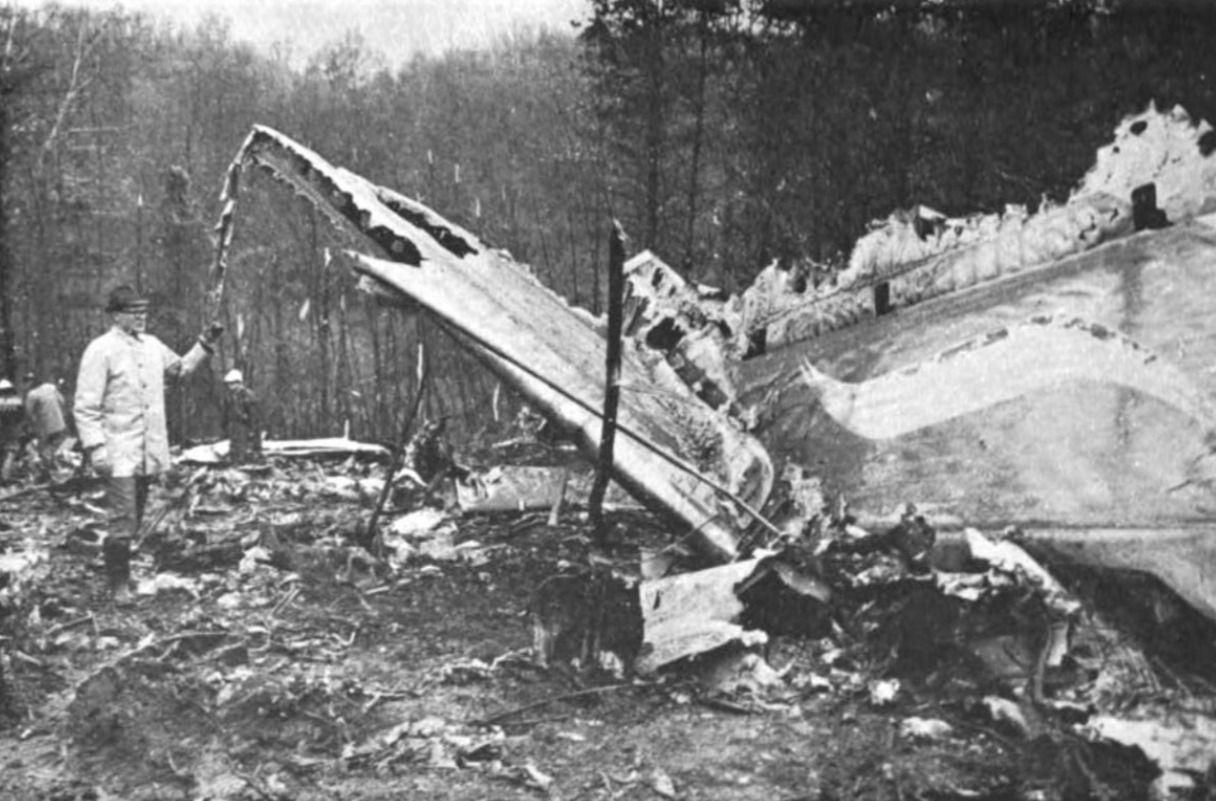
Southern Airways Flight 932
Seventy children lost a parent that night. Eighteen were left with no parents at all. At 7:36 p.m. on November 14, 1970, Southern Airways Flight 932 -- a chartered Douglas DC-9 carrying the Marshall University Thundering Herd football team home from a 17-14 loss at East Carolina -- struck a hillside just short of Tri-State Airport near Ceredo, West Virginia. All 75 people on board were killed: 37 players, five coaches, seven staff members, 21 boosters, two pilots, two flight attendants, and a charter coordinator. It remains the deadliest tragedy involving a sports team in United States history, and the wound it opened in Huntington, West Virginia, has never fully closed.
The Only Charter of the Season
The 1970 Marshall Thundering Herd had chartered only one flight that entire season. The original proposal had been refused because it would exceed the DC-9's takeoff weight limitations at Stallings Field in Kinston, North Carolina. Negotiations trimmed the passenger and baggage count until the charter was approved. The aircraft -- a 95-seat Douglas DC-9-30, tail number N97S -- was crewed by Captain Frank Abbott, age 47, and First Officer Jerry Smith, age 28. The flight from Kinston proceeded without incident. At 7:23 p.m., the crew contacted air traffic controllers and received descent instructions. Thirteen minutes later, in rain and fog, the jet struck a ridge. Because this was the Herd's only charter of the year, some of Huntington's most prominent citizens were aboard -- a city councilman, a state legislator, and four physicians among them.
The Night Huntington Died
The crash devastated a city far beyond its university campus. It was the second college football team plane crash in barely six weeks -- on October 2, a Wichita State charter had killed 31 people, including 14 players and head coach Ben Wilson. The loss at Marshall cut deeper into civic life because the charter carried not just athletes but community leaders, parents, and friends. Receivers' coach Red Dawson survived only because he had driven back from the game instead of flying. He and freshman coach Gail Parker were buying boiled peanuts at a country store in rural Virginia when the news came over the radio. Coach Deke Brackett, who had switched places with Parker on the flight, was among the dead. In the days that followed, the enormity became clearer: 70 children had lost at least one parent, and 18 had been orphaned entirely.
Building Something from Nothing
On St. Patrick's Day, 1971, Jack Lengyel was introduced as Marshall's new head coach. He was the third choice -- Penn State assistant Bob Phillips declined, and Georgia Tech assistant Dick Bestwick accepted on February 28 before backing out days later. Lengyel came from the College of Wooster, hired by new athletic director Joe McMullen, under whom he had previously worked at the University of Akron. With Red Dawson's help, Lengyel assembled a team from junior varsity players, students from other sports, and walk-ons. The 1971 Thundering Herd won just two games -- against Xavier and Bowling Green -- but every victory felt like a resurrection. The National Transportation Safety Board's investigation led to three safety recommendations that would reshape aviation: heads-up displays for pilots, ground proximity warning systems, and enhanced surveillance of charter flight operations.
Names Carved in Stone and Bronze
Marshall's acting president Donald Dedmon appointed a memorial committee within days of the crash. They commissioned a granite cenotaph at Spring Hill Cemetery, where many victims are buried in a shared grave site. On November 12, 1972, the Marshall University Memorial Fountain was dedicated at the entrance of the new Memorial Student Center, its waters designed to represent upward growth and immortality. Between the cemetery and Joan C. Edwards Stadium, 20th Street was renamed Marshall Memorial Boulevard. In November 2000, the "We Are Marshall" Memorial Bronze -- a 17-by-23-foot statue created by Burl Jones of Sissonville, West Virginia -- was unveiled on the stadium's west facade before thousands of fans, 90 minutes before a home game against Miami University. A memorial plaque was dedicated at the crash site itself in December 2006, with Red Dawson among the speakers. Each November 14, the fountain flows and the university pauses to remember.
From the Air
The crash site is located at approximately 38.374N, 82.578W, on a hillside near Tri-State Airport (KHTS) outside Ceredo, West Virginia. The approach terrain rises steeply west of the runway -- the ridge the aircraft struck is visible from the air at 1,500-2,500 feet AGL. Huntington's Marshall University campus and the memorial sites along Marshall Memorial Boulevard are about 10 nautical miles northeast. Yeager Airport (KCRW) in Charleston is approximately 40 nautical miles to the east. The Ohio River is the dominant visual landmark, running just north of the crash area. Low ceilings and fog are common in this valley during November, conditions similar to those on the night of the crash.