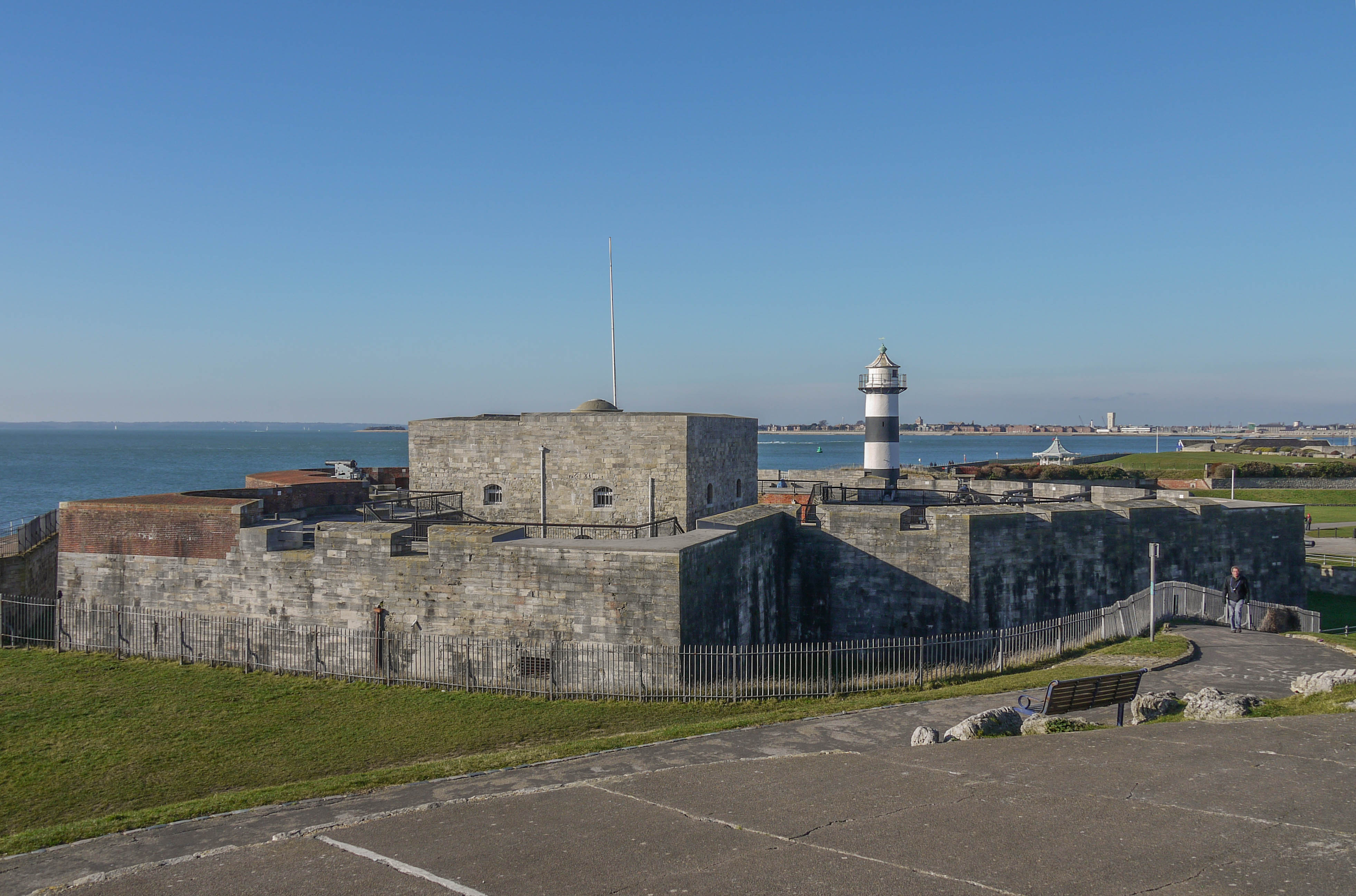
Southsea Castle
On 23 June 1940, with France falling to the Germans, a gun at Southsea Castle was levelled at the French destroyer Leopard anchored in Portsmouth harbour. The warship aimed its own guns right back. Nobody fired. Ten days later, under Operation Grasp, British forces boarded and seized the French ships instead. It was a tense standoff at a coastal fortress that Henry VIII had built four centuries earlier for exactly this kind of moment -- guarding the Solent against foreign threats.
The Device Fort
Southsea Castle was part of Henry VIII's "Device" program of 1539, a chain of coastal forts built to defend England against potential invasion by France and the Holy Roman Empire after Henry's break with Rome. Positioned on the shoreline south of Portsmouth, the castle guarded the eastern approaches to the Solent and the naval base beyond. By 1785, the government had taken possession of Southsea Common, the marshland surrounding the castle, to keep it open for the fort's fields of fire. When the railway arrived from London, the settlement that grew up around the common took its name from the castle, transforming into the prosperous resort of Southsea.
Fortress Portsmouth
At the start of the 20th century, Southsea Castle formed part of the "Fortress Portsmouth" defense plan. The east battery mounted two massive 9.2-inch Mark X guns and two 6-inch Mark VII guns; the west battery carried three 12-pounders and a 4.7-inch quick-firing gun. During the First World War, the Royal Garrison Artillery manned the castle before being transferred to France, replaced by Hampshire Territorial volunteers. Even as the military retained the site, tourism crept in -- by 1929, visitors could watch the garrison carry out practice firings out to sea. The west battery was disarmed in 1927, and Southsea Common was purchased by Portsmouth City Council in 1922 and converted into a public park.
The Second World War and After
During the Second World War, the Hampshire Heavy Regiment occupied Southsea Castle as Headquarters Portsmouth Fixed Defences. Living conditions were grim; one member of the Auxiliary Territorial Service described the keep as "cold and wet and horrible." Barrage balloons protected the site, though at least two incendiary bombs struck the castle with little damage. The most dramatic moment came not from German attack but from the crisis with France. After the Fall of France in June 1940, the castle was ordered to prevent French warships from leaving Portsmouth -- leading to the tense standoff with the Leopard. The crisis was resolved by boarding rather than bombardment.
Cannons and Common
Southsea Castle became obsolete in the post-war years. In 1960, Portsmouth City Council purchased it for 35,000 pounds. The council partially demolished the east and west batteries in the 1960s, but the core castle survives as a museum and tourist attraction, drawing over 90,000 visitors between 2011 and 2012. The collection includes artillery spanning centuries: a 24-pounder salvaged from HMS Royal George, which sank at Spithead in 1782; a Victorian 68-pounder; and two hexagonally rifled Whitworth breech-loaders dating from 1876. The castle is protected as a Scheduled Ancient Monument, a relic of Henry VIII's coastal defense strategy that served continuously for over four hundred years -- longer than almost any other English fortification.
From the Air
Located at 50.78N, 1.09W on the Portsmouth seafront, directly on the Solent shoreline. The castle is visible from the water and low-altitude approaches. HMS Victory and the Historic Dockyard are approximately 1nm north. Nearest airport is Solent Airport (EGHF) at Lee-on-the-Solent. Best viewed at 1,000-2,000 ft AGL on approaches along the Solent.