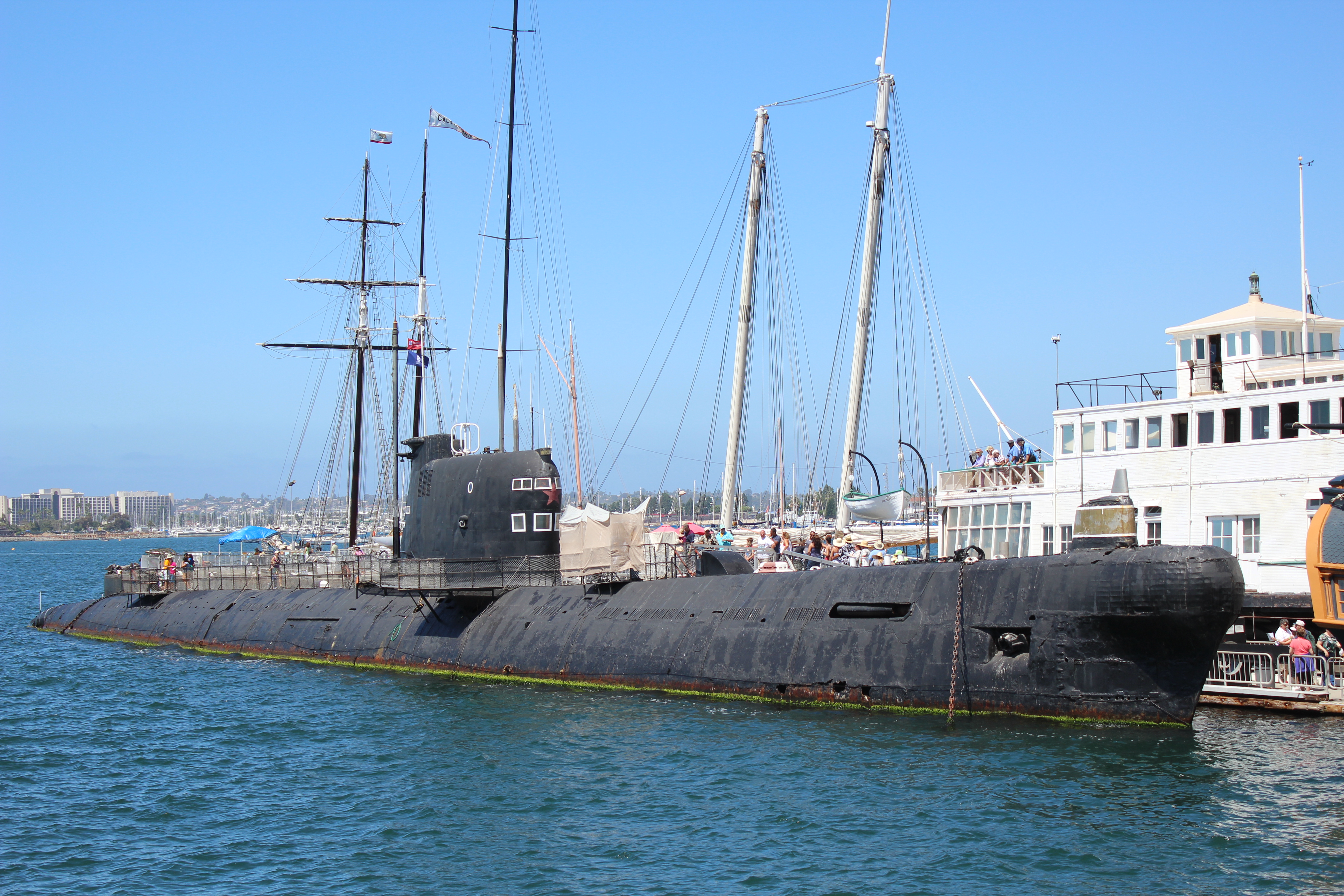
Soviet Submarine B-39
In 1989, in the Sea of Japan, a Soviet submarine surfaced to charge its batteries. A United States Navy vessel happened by. Both crews, finding themselves 500 yards apart with their Cold War adversary fully visible, did what humans often do when armed confrontation gives way to mere proximity: they took photographs of each other. The Soviet submarine was B-39, a Project 641 Foxtrot-class boat — the Soviet Navy's largest non-nuclear submarine — and it had spent its career threading through the Pacific, the Indian Ocean, and the Arctic, shadowing American warships, making port visits to Danang after the Vietnam War, trailing a Canadian frigate through the Strait of Juan de Fuca. Fifteen years after that photograph was taken, B-39 was a museum exhibit in San Diego.
The Patrol Years
B-39 was commissioned in 1967 and assigned to the 9th Submarine Squadron of the Soviet Pacific Fleet, homeported in Vladivostok. Her patrol routes ranged widely: the North Pacific, the coast of the United States and Canada, the Indian Ocean, the Arctic. In the early 1970s, she tracked a Canadian frigate from the Strait of Juan de Fuca all the way to Vancouver Island — a routine Cold War shadow mission conducted by a vessel that the Canadians may or may not have known was there. The 'B' in her designation stood for the Russian word for 'large,' and Foxtrot-class submarines earned their size. Running on three diesel engines and three electric motors, they were long-range boats designed for extended patrols far from Soviet ports.
From Vladivostok to San Diego
B-39 was decommissioned on April 1, 1994. The Soviet Union had already dissolved, and the Pacific Fleet was selling off what it could. B-39 was sold to Finland, then moved through a series of private owners — acquiring the nicknames 'Black Widow' and 'Cobra' along the way, names she never carried during her commissioned service. By 1996, she had reached Vancouver Island. By 2002, she was on display in Seattle at Pier 48 in Elliott Bay. On April 22, 2005, after an eventful tow through harsh winds and storms, she arrived in San Diego and became an exhibit at the Maritime Museum of San Diego. She had traveled a long way from Vladivostok.
Museum Life and a Quiet Problem
As a museum ship, B-39 presented certain challenges. Foxtrot-class submarines are designed so that the periscopes are only accessible from the conning tower — an area off-limits to museum visitors. When the ship was converted for public display, the shroud around the attack periscope was cut away where it passed through the control room, allowing tourists to look through it. The modification gave a false impression that the periscope could be operated from the control room. It was a small deception in service of a larger truth: getting visitors close to the machinery of the Cold War, to feel the cramped quarters where Soviet sailors lived for months at a time, listening through hydrophones for the propeller sounds of American ships.
The End of B-39
Rust is patient. By the 2010s, B-39's outer hull was showing large holes and the submarine was deteriorating visibly. She had appeared in a 2000 episode of Stargate SG-1 and served as a set for the 2013 film Phantom. In 2010, there was talk of sinking her offshore to create a diving reef — teachers and enthusiasts protested, and she stayed on display. But the rust kept working. In October 2021, the Maritime Museum of San Diego decided she had to go. On February 7, 2022, B-39 left San Diego for the last time, heading south to Ensenada, Mexico, where she was scrapped. The photographs that the Soviet and American sailors took of each other in the Sea of Japan, in 1989, may be the most human document she left behind.
From the Air
Located at 32.720°N, 117.174°W along San Diego's North Embarcadero, adjacent to the Maritime Museum of San Diego. The museum's collection of historic ships — including the Star of India — is visible just south of San Diego International Airport (KSAN). Best viewed at 1,000-2,000 feet approaching from the bay.