Soviet Union
On December 25, 1991, the hammer-and-sickle flag was lowered over the Kremlin for the last time. The Union of Soviet Socialist Republics, which had covered more than one-sixth of the Earth's land surface and stretched across eleven time zones, ceased to exist. What remained was not a clean break but a continent-sized palimpsest: fifteen new nations, each carrying Soviet imprints in their architecture, their languages, their borders, and their unhealed wounds. To travel the former Soviet Union today is to read those layers, from the monumental metro stations of Moscow to the rusting shipyards of the Aral Sea.
Forged in Revolution, Tempered by Terror
The Soviet Union emerged from the chaos of 1917, when the Bolsheviks under Vladimir Lenin overthrew centuries of tsarist rule. What followed was not liberation for all but a new kind of authority. Lenin signed Russia out of World War I with the Treaty of Brest-Litovsk in 1918, ceding the Baltic States, only to reclaim them decades later. After Lenin's death in 1924, Joseph Stalin consolidated power through industrialization drives and the forced collectivization of farms that triggered famine across Ukraine, where the catastrophe is remembered as the Holodomor. Stalin's gulag system imprisoned millions of dissidents, intellectuals, and prisoners of war in forced labor camps scattered from the Arctic to Siberia. The Soviet nuclear program carved out entire closed cities whose residents could neither leave nor receive outside visitors. Many of these places, like the uranium-enrichment towns of the Urals, still bear the marks of their sealed-off existence.
The Great Patriotic War and Its Shadows
World War II reshaped the Soviet Union more profoundly than any other event in its history. The 1939 non-aggression pact with Nazi Germany bought time but not safety; when Operation Barbarossa began in June 1941, the German war of extermination pushed deep into Soviet territory. More than 25 million Soviet citizens died, a toll exceeding the combined losses of all other European and American nations. The sieges of Leningrad and Stalingrad became defining chapters of endurance and horror. Victory in 1945 made the USSR a superpower, but the cost was staggering. Entire cities had been reduced to rubble, and the scorched-earth retreats had consumed crops, factories, and villages. The war's legacy still permeates Russian identity today, visible in the eternal flames that burn at memorials from Volgograd to Vladivostok.
Superpower Standoff
From 1945 until its dissolution, the Soviet Union locked into a rivalry with the United States that defined global politics. Satellite states stretched across Eastern Europe: East Germany, Poland, Czechoslovakia, Hungary, Romania, and Bulgaria all fell within Moscow's orbit. The space race produced the first artificial satellite, Sputnik, in 1957 and put Yuri Gagarin into orbit in 1961. The nuclear arms race produced enough warheads to destroy civilization several times over. Soviet athletes dominated Olympic competition so thoroughly that Moscow hosted the 1980 Summer Games, though many Western nations boycotted them over the invasion of Afghanistan. By the 1970s, stagnation had set in. The failed Afghan war, the Chernobyl disaster of 1986, and Mikhail Gorbachev's reforms of glasnost and perestroika loosened the grip Moscow held on its republics, unleashing revolutions across the Eastern Bloc beginning in 1989.
Fracture Lines Still Visible
The Soviet collapse left behind not just independent nations but a web of unresolved conflicts. The Baltic states pivoted swiftly toward Western Europe and now hold EU and NATO membership, their economies classified as advanced by the International Monetary Fund. But elsewhere, the transition proved devastating. Civil wars erupted in Chechnya, Georgia, and Tajikistan. Ethnic cleansing scarred Abkhazia. The frozen conflicts of South Ossetia, Nagorno-Karabakh, and Transnistria persist as reminders that the Soviet map was drawn with little regard for ethnic realities. Russia's annexation of Crimea in 2014 and full-scale invasion of Ukraine in 2022 demonstrated that the Soviet dissolution remains an unfinished story. Large ethnic Russian minorities in the Baltic states, Kazakhstan, and Moldova continue to complicate domestic politics in ways that trace directly back to Soviet-era population transfers.
Ghosts of an Empire in Concrete and Chrome
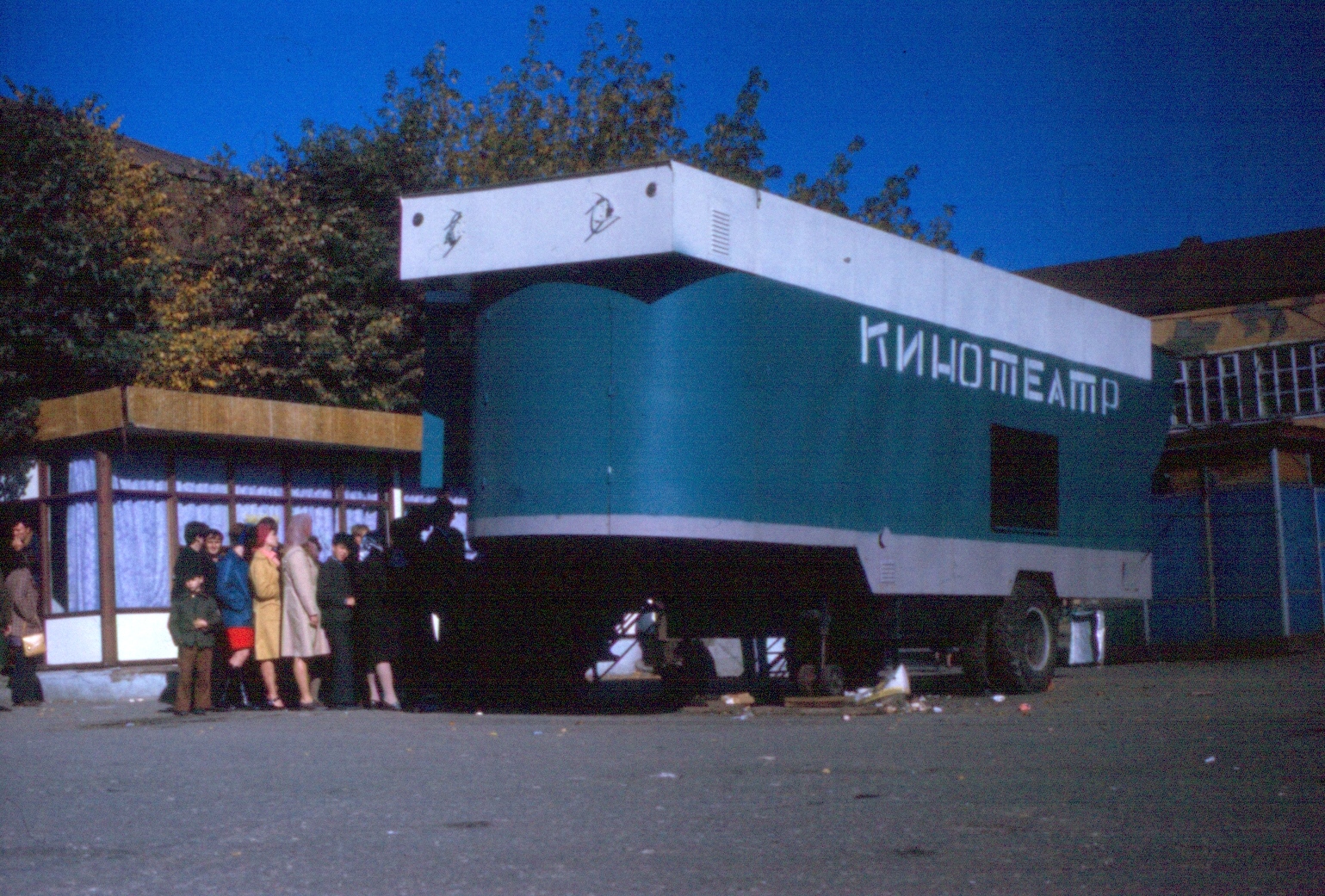
Travelers crossing the former Soviet space encounter the physical residue of a vanished superpower at every turn. The Moscow Metro's chandeliered stations remain among the most beautiful underground spaces on Earth. Stalinist wedding-cake towers punctuate skylines from Warsaw to Riga. Monolithic apartment blocks march across the outskirts of every post-Soviet city, their uniformity a testament to central planning's indifference to local character. In the countryside, abandoned Pioneer camps and derelict Palaces of Culture decay slowly in forest clearings. The Baikonur Cosmodrome in Kazakhstan still launches rockets. The Trans-Siberian Railway still crosses seven time zones. And in the stolovayas of Russian cities, workers still eat the same hearty, inexpensive meals that Soviet canteens once provided, a quiet persistence of daily life outlasting the ideology that created it.
From the Air
Centered at 65.0°N, 90.0°E in central Siberia, the former Soviet Union spanned from Kaliningrad (54.7°N, 20.5°E) to Vladivostok (43.1°N, 131.9°E). Key visual landmarks include the Ural Mountains marking the Europe-Asia divide, the vast Siberian taiga, and Lake Baikal. Nearest major airports include Moscow Sheremetyevo (UUEE), Novosibirsk Tolmachevo (UNNT), and Krasnoyarsk Yemelyanovo (UNKL). Best viewed at cruising altitude where the sheer scale of the territory becomes apparent.