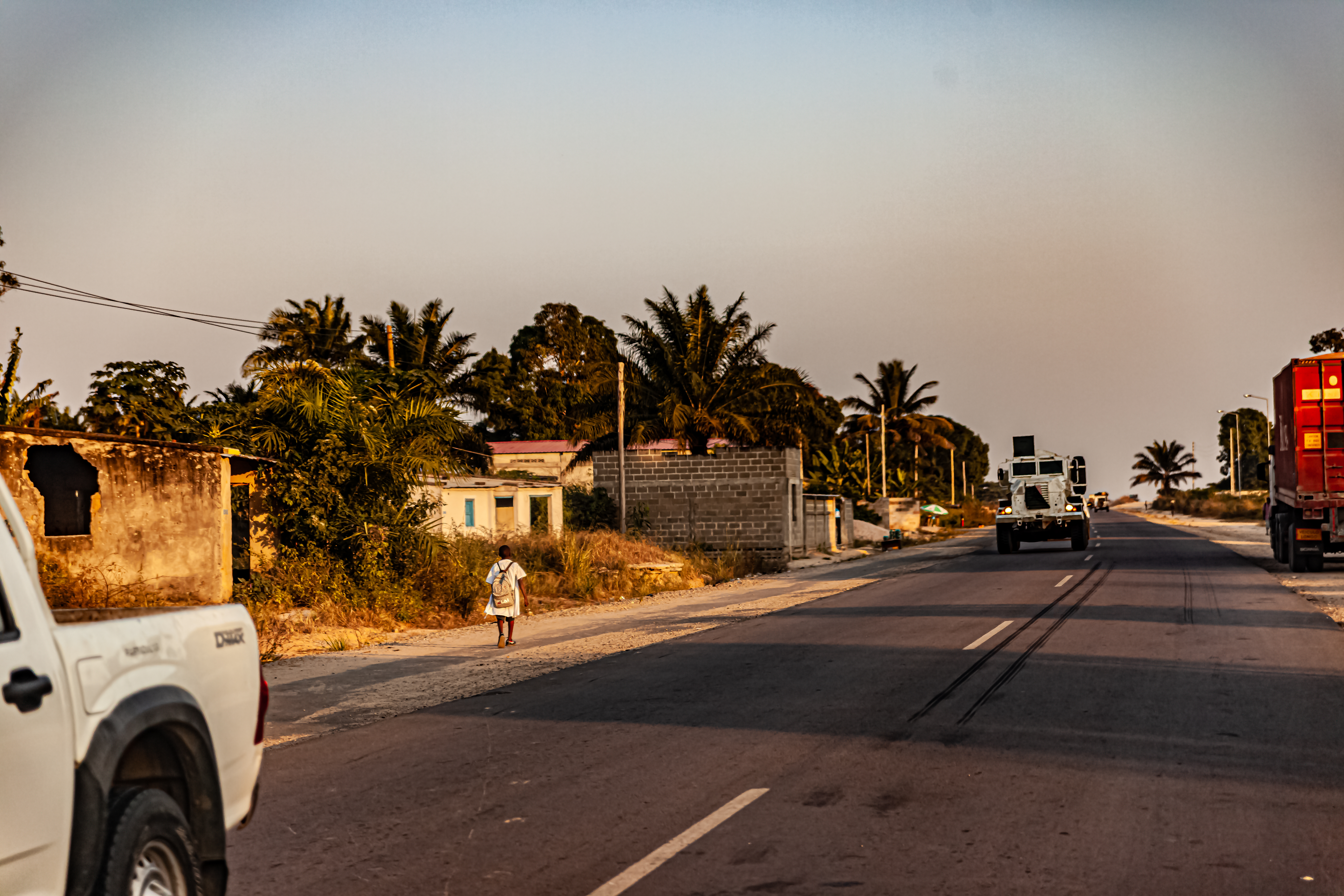
Soyo
Four thousand enslaved people passed through Soyo's port of Mpinda every year in the mid-sixteenth century, bound for the sugar plantations of Sao Tome and Brazil. That single statistic, drawn from a Kongo royal inquest of 1548, captures the brutal commerce that made this stretch of coast at the mouth of the Congo River one of the most contested places in Central Africa. Soyo was a province of the Kingdom of Kongo long before the Portuguese arrived in 1482, and its story -- of calculated defiance, military victory, and strategic reinvention -- stretches from medieval African statecraft to modern petroleum economics.
The Lord of Soyo
When the Portuguese first encountered Soyo, it was already an established administrative province of the Kingdom of Kongo, ruled by a governor bearing the title mwene Soyo -- "lord of Soyo." The province stretched south from the mouth of the Congo River to the River Loze and about a hundred kilometers inland. Its ruler in 1491 was the first Kongo lord to accept Christian baptism when missionaries arrived in the kingdom. Baptized as Manuel, he was said to be the uncle of the reigning king, Nzinga a Nkuwu. In exchange for accepting Christianity, the king permitted Soyo to expand its territory, absorbing sub-provinces including Pambala, Kimi, and Tubii along the Congo River, and Lovata along the Atlantic coast. Soyo's port of Mpinda, near the river's mouth, became the commercial gateway to the entire kingdom -- a place where Portuguese traders settled and conducted a thriving business in enslaved people, ivory, and copper.
The Count Who Said No
For most of the sixteenth century, Soyo's rulers were appointed by the king in the capital of Sao Salvador. But the relationship was never entirely comfortable. In the 1590s, when King Alvaro II introduced European-style titles of nobility, Soyo's ruler Miguel was designated a Count -- yet he was far from a loyal vassal. Tensions simmered for decades. The decisive break came in 1641, when Daniel da Silva took power in Soyo and was immediately challenged by the newly crowned King Garcia II, who wanted to install his own candidate. Count Daniel refused, asserting that the counts of Soyo had the right to be chosen by election among their own nobles. Garcia launched four separate military campaigns against Soyo -- in 1641, 1643, 1645, and 1656 -- and lost every one of them. His armies could not penetrate the fortified woodland called Nfinda Ngula near Soyo's capital. Independence, once unthinkable for a Kongo province, became a fact enforced by repeated military victory.
The Battle That Broke Portuguese Ambitions
Soyo's finest military hour came in 1670. The Portuguese governor, seeing Kongo weakened by civil war, attempted to take over both Kongo and Soyo by force. A Portuguese army invaded and won an initial engagement. But then Soyo's forces drew the invaders into Nfinda Ngula and destroyed them at the Battle of Kitombo on 18 October 1670 -- St. Luke's Day. The Portuguese were not merely defeated; they were utterly routed. The victory secured Soyo's independence for generations and made October 18 an important local holiday. At the time of the battle, the city of Soyo had approximately 30,000 residents. Its rulers soon elevated their title from Count to Prince, and eventually Grand Prince, reflecting the territory's growing autonomy. Soyo became a power broker in Kongo's fractured politics, sheltering the Kimpanzu branch of the royal family and intervening in succession disputes. After 1708, Soyo stopped participating in the election of Kongo's kings altogether.
From Slave Port to Oil Capital
The centuries between Soyo's political peak and the present day brought colonial subjugation under Portugal, incorporation into independent Angola in 1975, and decades of civil war. But geography has a way of reasserting itself. Soyo sits at the mouth of Central Africa's mightiest river, and its location has made it valuable to every power that has sought to control the region. Today, with a municipal population of over 221,000, Soyo has become Angola's largest oil-producing region, with an estimated output of 1.2 million barrels per day from offshore fields. The city has an airport and a seaport, and the Angolan government has planned the construction of an oil refinery there. The commerce has changed -- from enslaved human beings to petroleum -- but the strategic logic of Soyo's position at the Congo's mouth remains the same. The river still flows. The port still matters.
From the Air
Located at 6.13S, 12.37E at the mouth of the Congo River on Angola's northern coast. The Congo River estuary is one of the most dramatic geographic features visible from altitude in West Central Africa -- the river's immense discharge creates a visible plume extending far into the Atlantic. Soyo sits on the southern bank. Offshore oil platforms are visible in clear conditions. Nearest airport: Soyo Airport (FNSO). The border with the Democratic Republic of the Congo runs along the river's northern bank.