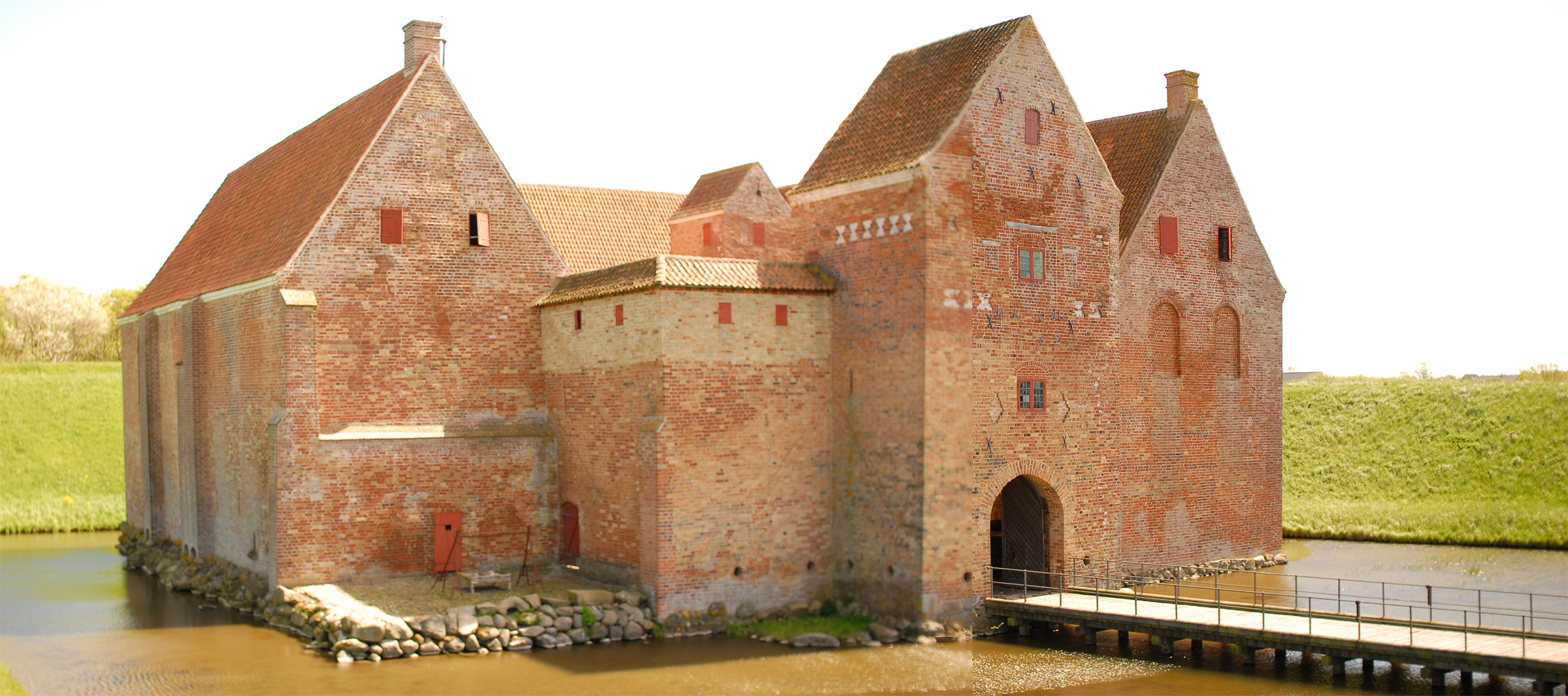
Spottrup Castle
A tidal wave destroyed the western end of the north wing in 1534. Rather than rebuild the elegant arched windows, the owners walled them shut, leaving only narrow sighting slits in the stone. That decision tells you everything about Spottrup Castle's history: beauty sacrificed for survival, over and over again, across six centuries on the flat, exposed shores of the Limfjord in western Jutland.
Bishops, Crowns, and Noblemen
The estate first entered the historical record in 1404, when it was transferred to the Diocese of Viborg. The oldest surviving structure, the south wing, dates to around 1521, with the east and north wings following between 1525 and 1530. Below the living quarters lies the castle's oldest feature: a cellar with cross vaults supported by heavy pillars, built to endure whatever the centuries threw above. When the Danish Crown seized church properties during the Reformation in 1536, Spottrup passed to the state and was soon sold to Henrik Below, a nobleman at the Danish court. Below transformed the fortress into a family home, adding towers and a ballroom. But with the Reformation's upheaval, the castle lost its strategic importance and sat uninhabited for an extended period, its ramparts and double moat guarding nothing but silence.
Centuries of Passing Hands
In 1702, Axel Rosenkrantz acquired the dilapidated property and began renovations. His son Mogens took over after Axel's death in 1724. Then the castle changed character entirely: in 1784, Peder Nissen, a wealthy farmer from Ribe, bought it. When Nissen died just four years later, his 17-year-old son Nis inherited the estate. After Nis's death in 1849, Spottrup passed through a succession of owners, none of whom could afford the repairs it desperately needed. The castle slowly crumbled, its medieval walls softening under Jutland's relentless rain and wind. From bishops to kings to noblemen to farmers to absentee owners, Spottrup's story mirrors the shifting tides of Danish society itself, each era leaving its mark in the stonework before moving on.
Rescued by Fire
Paradoxically, it took a disaster to save Spottrup. A fire in 1937 forced the question that decades of neglect had deferred: was this place worth keeping? The Danish state decided it was. The government acquired the castle and its 338-hectare estate, and restoration work began in earnest. By 15 June 1941, the painstaking effort was complete, and the building opened as a museum. What visitors encounter today is remarkable for what it is not. Spottrup was never modernized, never adapted to later architectural fashions. The ramparts still encircle the castle. The double moat, once designed to absorb cannon fire, still holds water. The narrow sighting slits that replaced those lost arched windows still stare outward, as if watching for threats that stopped coming centuries ago.
A Castle at the Water's Edge
Spottrup sits on the eastern shore of Spottrup Lake, a small body of water just east of the Limfjord, 18 kilometers northwest of the town of Skive. The landscape around it is quintessentially Jutland: flat, windswept, and sparse. There are no dramatic cliffs or hilltop vistas here. The castle's power comes from its solidity, from the way it hunkers against the earth rather than rising above it. Open to visitors from mid-April through the end of October, the museum offers something increasingly rare among European castles: an unaltered medieval interior that has not been dressed up for tourists or softened with gift shops. The cross-vaulted cellar, the bricked-up windows, the moat that still functions as a moat, all of it remains as it was, a defensive structure that finally has nothing left to defend against except forgetting.
From the Air
Located at 56.64N, 8.78E in western Jutland, Denmark. The castle is visible as a compact rectangular structure beside Spottrup Lake near the Limfjord. Nearest airport is Karup Airport (EKKA), approximately 45 km to the south. Best viewed at 2,000-4,000 feet to see the double moat and the relationship between castle, lake, and the Limfjord coastline.