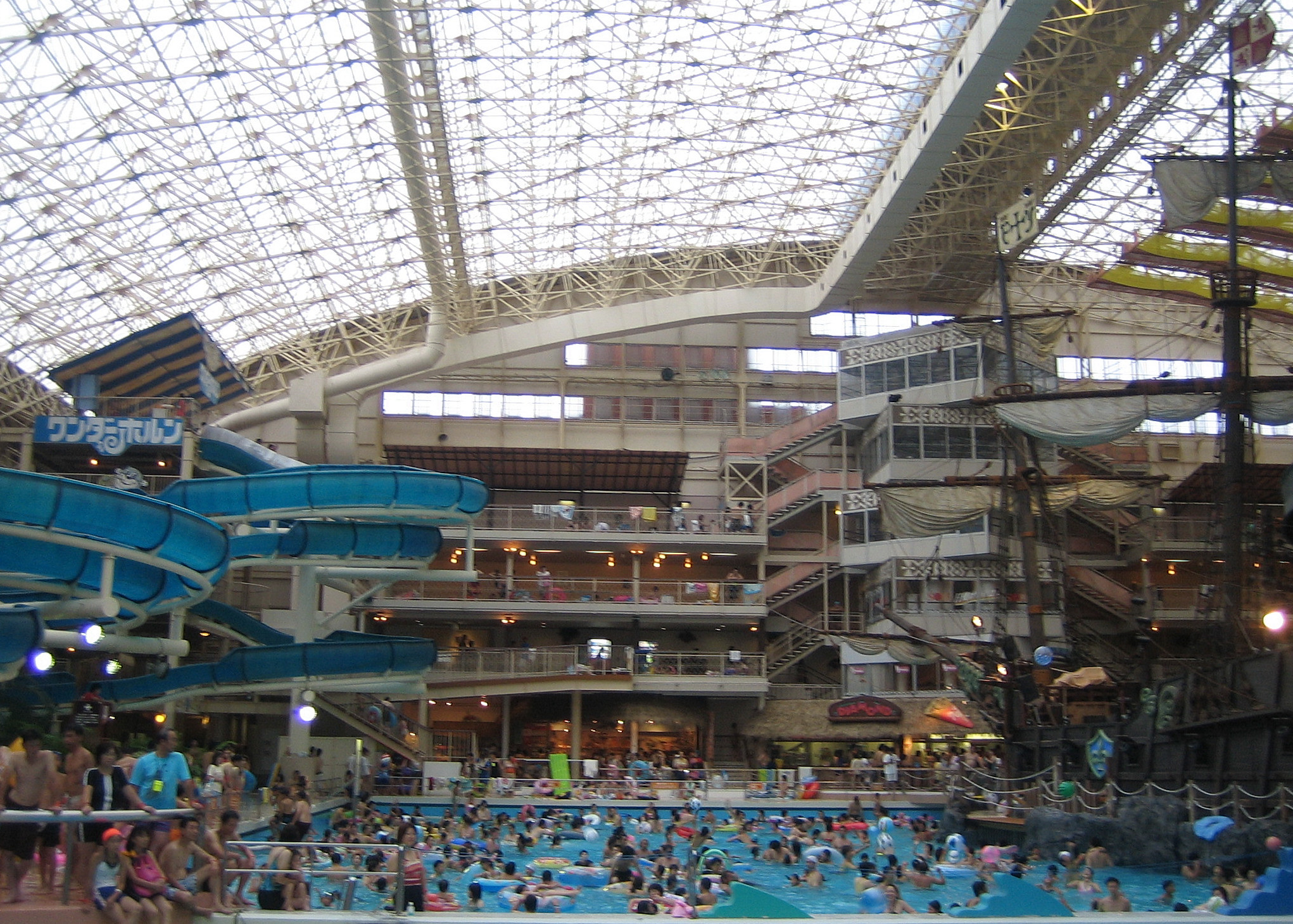
Spa Resort Hawaiians
The hot springs were a nuisance. For decades, the miners of the Joban coal field in Iwaki, Fukushima Prefecture, cursed the scalding water that seeped into their tunnels from deep underground. By the 1960s, with Japan's economy pivoting from coal to oil, the mine's vice president Yutaka Nakamura stared at a dying industry and saw, in those unwanted hot springs, a second life. He would build a tropical resort -- in northeastern Japan, on the grounds of a coal mine, themed after Hawaii. The Joban Hawaiian Center opened on January 15, 1966, and became the first themed resort of its kind in the country. It was audacious, improbable, and an immediate sensation.
From Coal Dust to Coconut Palms
Modern coal mining in the Joban coal field began near the foot of the Abukuma mountains in 1883. By 1944, wartime demand -- fueled in part by the forced labor of Allied prisoners of war -- had made the Joban Mine the largest in Japan. The Joban Tanko coal company flourished through the 1950s, but the writing was on the wall. Japan was industrializing rapidly, and petroleum was displacing coal as the nation's primary energy source. Nakamura's gambit to repurpose the mine's underground hot springs into a Hawaiian paradise was not merely creative -- it was an act of economic survival for an entire community whose livelihood was vanishing. He recruited young women from local mining families and trained them as hula dancers. The resort's popularity peaked in 1970-71, when attendance surpassed 1.55 million visitors a year.
The Hula Girls
The dancers became the resort's soul. Drawn from the coal-mining families of Iwaki, they learned a Hawaiian art form thousands of miles from its origin and made it authentically their own. Their story captured Japan's imagination so completely that the 2006 film Hula Girls dramatized the resort's founding, becoming a box office hit and cultural touchstone. In 1989, the resort received the Deming Application Prize -- Japan's prestigious quality control award -- making it the first leisure-industry company ever to win. A year later, the Joban Hawaiian Center rebranded as Spa Resort Hawaiians, shifting its identity to emphasize the therapeutic hot spring facilities alongside the entertainment. But the hula girls remained the heart of the operation, and their greatest performance was still decades away.
Dancing Through Disaster
The magnitude 9.0 Tohoku earthquake struck on March 11, 2011. Iwaki lost 277 people to the earthquake and tsunami. Spa Resort Hawaiians, situated farther from the coast, escaped the initial devastation but suffered serious damage from a powerful aftershock a month later. Then came a wound harder to heal than cracked concrete: the explosions at the Fukushima Daiichi nuclear plant, just 40 miles to the north, made visitors afraid to come anywhere near the region. Radiation fears emptied the resort more effectively than any earthquake could. Rather than wait in the ruins, the hula girls took to the road. They toured Japan, performing at earthquake refugee shelters and community centers, bringing a piece of tropical warmth to people who had lost everything. It was a revival of the very first promotional tours from the 1960s, when dancers had traveled the country to convince skeptical Japanese that a Hawaiian resort in a coal town was worth visiting.
Fukushima's Resilience, in Grass Skirts
Earthquake repairs and renovations were completed in early 2012. On February 8, Spa Resort Hawaiians reopened fully, with reinforced structural support and a bigger stage for the hula show. The resort became a symbol of Fukushima's recovery -- proof that the region was not merely a disaster zone but a living community rebuilding itself with stubborn optimism. The 2021 anime film Hula Fulla Dance, produced to mark the tenth anniversary of the earthquake and tsunami, returned to the resort's story as a vehicle for resilience. Former Iwaki hula girls organized the Japan Hula High School Girls Competition, bringing 13 high school teams together in a fundraising campaign that itself became an act of community healing. From coal mine to tropical resort to earthquake recovery symbol, Spa Resort Hawaiians has reinvented itself with each crisis -- always with hula dancers leading the way.
From the Air
Located at 36.994N, 140.817E in Iwaki, Fukushima Prefecture, Japan. The resort complex features large indoor pool buildings and tropical-themed structures visible from altitude against the surrounding forested hills and suburban areas. Look for the distinctive dome and greenhouse-style rooflines. Nearest major airport: Fukushima Airport (RJSF), approximately 55nm west-northwest. The resort sits inland from the coast, roughly 45nm south of the Fukushima Daiichi exclusion zone. The Abukuma mountain foothills rise to the west. Summer conditions are warm and humid; autumn offers clearer skies and excellent visibility.