Space Mirror Memorial
The names glow. That is the first thing visitors notice about the Space Mirror Memorial at Kennedy Space Center -- twenty-five names cut completely through panels of polished black granite, filled with translucent acrylic, and backlit so they seem to float against the reflected sky. The memorial stands 42.5 feet high and 50 feet wide, its surface divided into 90 smaller panels of stone so dark it mirrors the clouds and palms of Merritt Island. Designed by architect Wes Jones of Holt Hinshaw Pfau Jones after he won an international competition, the memorial was dedicated on May 9, 1991, and designated by the U.S. Congress as the national memorial to astronauts who die in the line of duty. It is a place where the cost of exploration is measured not in dollars but in names.
Names Grouped by Grief
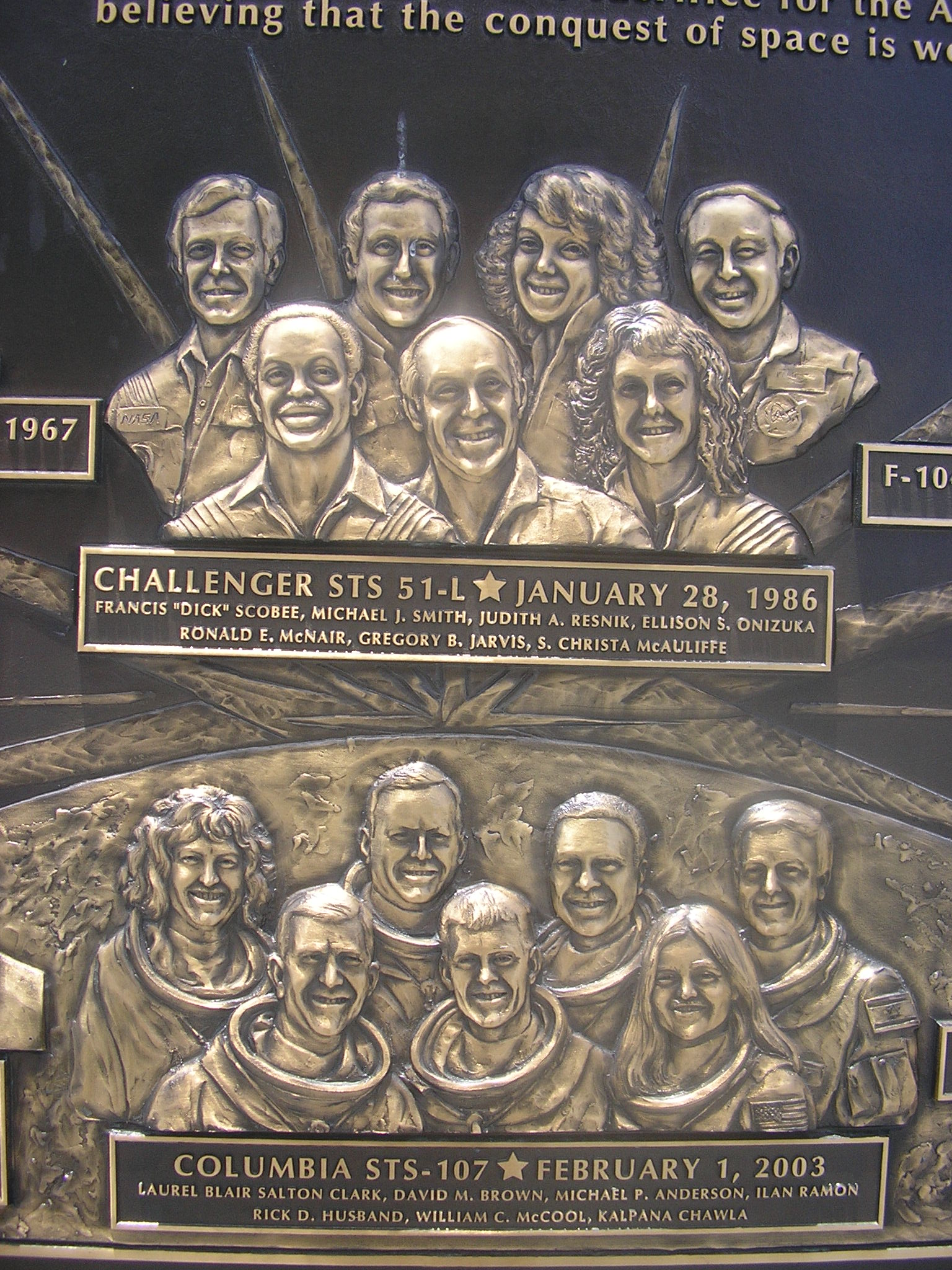
The arrangement of names tells its own story. Astronauts who died in the same incident are grouped together on the same panel or on adjacent panels, so the eye reads not just individual losses but collective ones. The seven names of the Challenger crew -- Scobee, Smith, McNair, Jarvis, Resnik, Onizuka, McAuliffe -- occupy one cluster. The seven from Columbia -- Husband, McCool, Brown, Chawla, Anderson, Clark, Ramon -- occupy another. Scattered among them are earlier losses: Gus Grissom, Ed White, and Roger Chaffee, who died in the Apollo 1 fire on January 27, 1967, when a short circuit ignited flammable materials in a pressurized pure-oxygen atmosphere. Theodore Freeman, Elliot See, Charles Bassett, and Clifton Williams, all killed in training aircraft accidents in the 1960s. Robert Lawrence, an Air Force pilot in the classified Manned Orbiting Laboratory program, who might have become one of America's first Black astronauts.
A Machine That Followed the Sun
The memorial was originally designed to move. Motors and jackscrews built into the structure were supposed to track the sun across the sky in both pan and tilt, directing sunlight through parabolic reflectors on the back of the granite panels and through the translucent acrylic inserts to illuminate the names with natural light. It was an elegant engineering concept: the names of the fallen would glow with sunlight itself. But in 1997, the tracking mechanism failed, and part of the monument struck a steel beam on an adjacent platform. Insurance paid $375,000 for repairs, but the mechanism later seized again due to problems with the slewing ring. With the estimated repair cost at $700,000, the Astronauts Memorial Foundation made a deliberate choice -- spend the money on educational programs instead. Floodlights were repositioned and now shine 24 hours a day, so the names glow constantly, day and night, in every kind of weather.
Challenger, Columbia, and the Cost of Going
Two disasters dominate the memorial's presence. On January 28, 1986, Space Shuttle Challenger broke apart 73 seconds after liftoff when a defective O-ring in a solid rocket booster allowed hot gas to breach the external tank. All seven crew members died, including Christa McAuliffe, a schoolteacher from New Hampshire who was to teach lessons from orbit as part of the Teacher in Space Project. Judith Resnik, among the crew, had been the second American woman in space. Seventeen years later, on February 1, 2003, Columbia disintegrated during reentry when a piece of foam insulation that had broken off during launch had damaged the wing's heat shield. The crew of seven, including Israeli Air Force pilot Ilan Ramon, never made it home. The memorial does not editorialize about these losses. It simply holds the names, grouped together, reflecting the sky.
Beyond NASA's Ranks
In 2019, the Astronauts Memorial Foundation voted unanimously to expand the memorial's scope to include private astronauts who died in the pursuit of spaceflight. The first name added under this new policy was Michael Alsbury, a Scaled Composites test pilot killed on October 31, 2014, when SpaceShipTwo broke apart during its fourth powered flight over the Mojave Desert. His name was inscribed on January 25, 2020. The memorial is funded in part by Florida's Challenger/Columbia specialty license plate, which was the first specialty plate the state ever issued, beginning in 1987. Revenue from the plates brought in $377,000 in 2009 alone. A quarter of the proceeds from the Apollo 11 Fiftieth Anniversary commemorative coins also supports the foundation. Near the mirror, a granite wall bears photographs and brief biographies of each honoree, grounding the luminous names in the particular lives they represent.
From the Air
The Space Mirror Memorial is located within the Kennedy Space Center Visitor Complex on Merritt Island, Florida, at approximately 28.525N, 80.682W. The memorial itself is not individually distinguishable from the air, but the Visitor Complex campus is clearly visible adjacent to the massive Vehicle Assembly Building. The complex sits between the Banana River to the west and the Atlantic Ocean to the east. Nearest airports: NASA Shuttle Landing Facility (KTTS) immediately adjacent, Space Coast Regional / Titusville (KTIX) 8nm northwest, Merritt Island Airport (KCOI) 10nm south, Melbourne Orlando International (KMLB) 25nm south. Best approach from the west for full view of the spaceport layout.