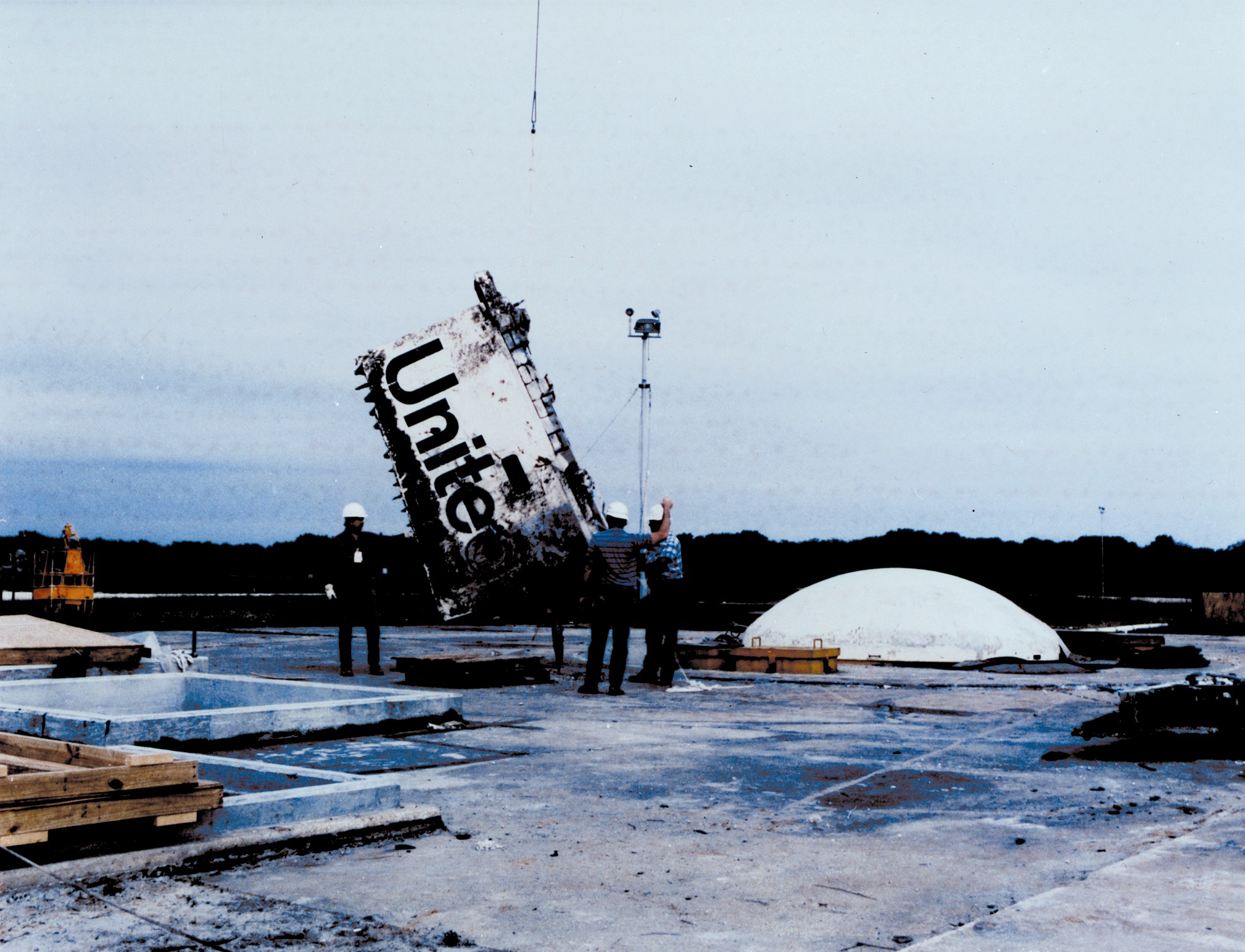
Space Shuttle Challenger Disaster
The night before the launch, engineers begged not to fly. On January 27, 1986, a three-way conference call connected Morton Thiokol in Utah, the Marshall Space Flight Center in Alabama, and Kennedy Space Center in Florida. The topic was rubber O-rings and freezing weather. Thiokol engineers Roger Boisjoly and Allan McDonald argued that the record-low temperatures forecast for the next morning would stiffen the O-ring seals in the solid rocket boosters, potentially allowing hot gas to burn through. NASA manager Lawrence Mulloy pushed back, demanding to know if they expected him to wait until April. Under pressure, Thiokol management reversed their engineers' recommendation. The next morning, at 11:38 a.m. on January 28, 1986, Space Shuttle Challenger launched from Kennedy Space Center. Seventy-three seconds later, it broke apart above the Atlantic Ocean, killing all seven people aboard.
Seven Who Flew
Commander Dick Scobee and pilot Michael Smith sat in the flight deck. Mission specialists Ellison Onizuka, Judith Resnik, and Ronald McNair occupied the mid-deck alongside payload specialists Gregory Jarvis and Christa McAuliffe. McAuliffe was a high school teacher from Concord, New Hampshire, selected from over 11,000 applicants for NASA's Teacher in Space Project. Her presence had drawn enormous media attention and ensured that classrooms across the country were tuned in live. The mission, designated STS-51-L, was the 25th Space Shuttle flight and Challenger's tenth. The crew was scheduled to deploy a communications satellite and study Halley's Comet.
Seventy-Three Seconds
Within the first three seconds after liftoff, cameras captured nine puffs of dark gray smoke escaping from the right solid rocket booster near its aft attachment strut. The cold had prevented the O-rings from sealing, and hot gas was already burning through. Molten aluminum oxide from the burning propellant temporarily plugged the breach, but aerodynamic forces at high speed broke that fragile seal. A plume of flame burned through the strut connecting the booster to the external fuel tank, then into the tank itself. The shuttle stack, traveling at Mach 1.92, was torn apart by aerodynamic forces. The crew compartment remained largely intact during the breakup and traveled in a ballistic arc, reaching an altitude of approximately 65,000 feet before falling to the ocean. The last recorded words from the cockpit were pilot Mike Smith saying, "Uh-oh."
A Decade of Warnings
The O-ring problem was not new. A 1977 test had shown dangerous joint rotation under simulated launch pressure. The first in-flight O-ring erosion occurred in November 1981. By December 1982, the secondary O-ring was reclassified from a backup to a non-redundant component, meaning a single O-ring failure could destroy the vehicle. O-ring erosion occurred on nearly every flight in 1985. Engineers at Morton Thiokol had already proposed a redesigned field joint and ordered new casings, but the fix was not scheduled to arrive until 1987. When Thiokol engineer Allan McDonald refused to sign the launch recommendation from his position at Kennedy Space Center, his management in Utah signed it instead and faxed it to NASA. The critical O-ring discussion was never communicated to NASA's Mission Management Team Leader, Arnold Aldrich, who cleared the launch.
Feynman's Glass of Ice Water
President Ronald Reagan formed the Rogers Commission to investigate, assembling a panel that included Neil Armstrong, Sally Ride, and Chuck Yeager. Over four months, the commission interviewed more than 160 individuals and involved over 6,000 NASA personnel. During a televised hearing on February 11, physicist Richard Feynman demonstrated the core problem with a glass of cold water and a piece of O-ring rubber, showing how cold temperatures destroyed the material's elasticity. The commission's report, published June 6, 1986, determined that the failed field joint was the sole cause, and blamed both NASA and Morton Thiokol for ignoring years of evidence. Feynman threatened to remove his name from the report unless it included his personal appendix, which argued that NASA's own reliability estimates were dangerously optimistic.
After the Silence
The Space Shuttle fleet was grounded for 32 months. NASA created a new Office of Safety, Reliability, and Quality Assurance. The solid rocket boosters were redesigned with a capture feature that reduced joint rotation to 15 percent of pre-disaster levels, plus heaters to maintain O-ring temperature. Crews began wearing pressurized suits during ascent and reentry. A new orbiter, Endeavour, was authorized in 1987 to replace Challenger and flew its first mission in 1992. Almost all recovered debris from the shuttle is buried in decommissioned missile silos at Cape Canaveral. In 2004, all seven crew members received posthumous Congressional Space Medals of Honor. Seven asteroids and seven lunar craters bear their names. The crew's families established the Challenger Center for Space Science Education, turning catastrophe into a living legacy of scientific learning.
From the Air
The Challenger disaster occurred off the coast of Cape Canaveral at approximately 28.64N, 80.28W. Kennedy Space Center Launch Complex 39B, the launch site, is visible from the air along with the Vehicle Assembly Building and the two launch pads. The debris field was in the Atlantic Ocean east of the Cape. The 'Forever Remembered' exhibit at KSC Visitor Complex includes recovered fuselage. Best viewed at 3,000-5,000 feet. Nearest airports: Space Coast Regional Airport (KTIX) 8nm west, NASA Shuttle Landing Facility (KTTS) on-site, Patrick Space Force Base (KCOF) 15nm south, Orlando Melbourne International (KMLB) 30nm south. Note: airspace may be restricted around KSC (TFRs during launches).