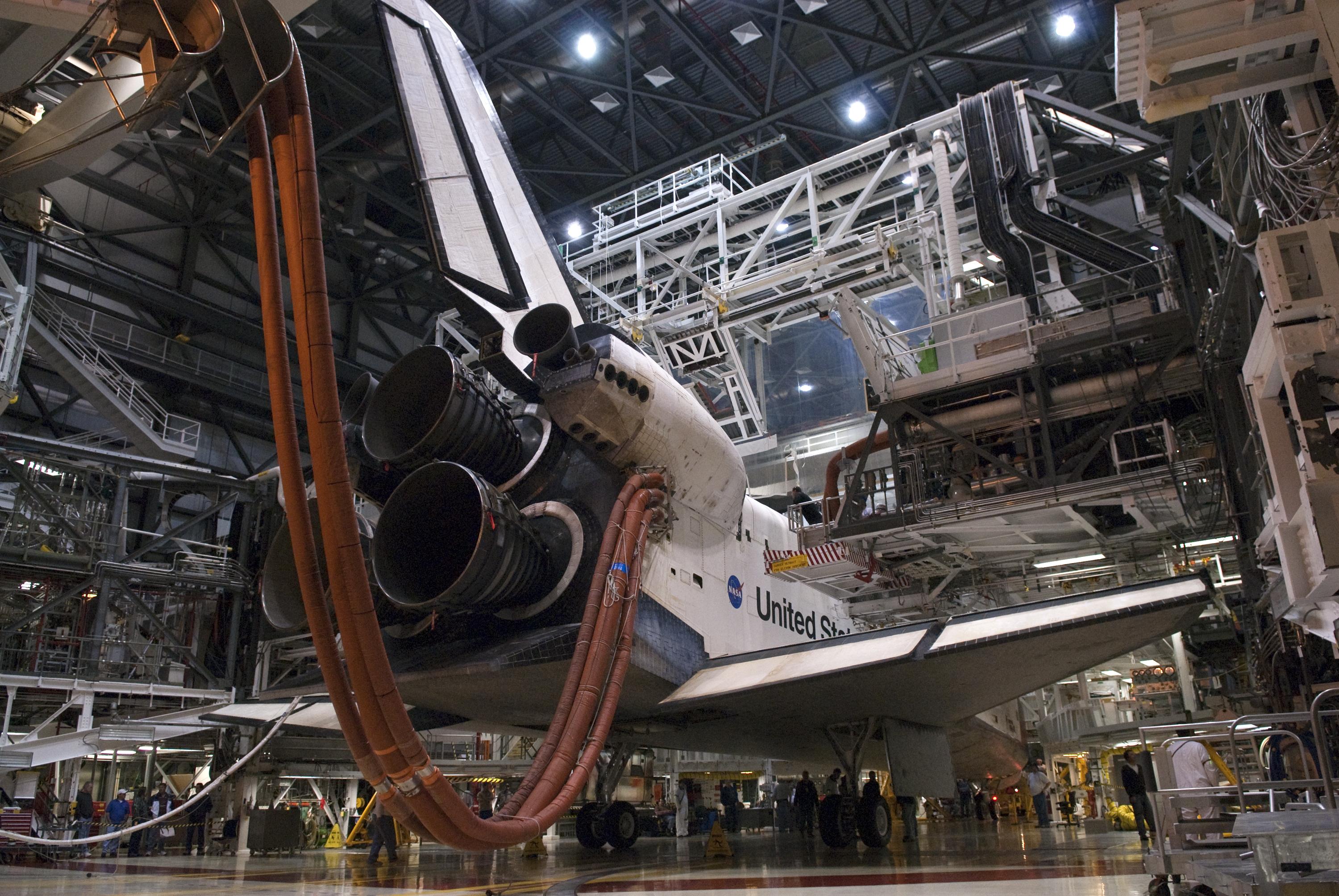
Space Shuttle Endeavour
It took two days for the Space Shuttle Endeavour to travel from Los Angeles International Airport to its permanent home at the California Science Center. The distance was twelve miles. The spacecraft that had circled the Earth at 17,500 miles per hour needed a police escort, 400 tree removals, and the careful navigation of intersections that its 78-foot wingspan could barely clear. The journey through the streets of South Los Angeles in October 2012 drew hundreds of thousands of people, many of whom had never seen a space shuttle in person and would never again. The homecoming was a kind of memorial.
Built from Spare Parts to Replace the Unthinkable
Congress authorized the construction of Endeavour in 1987, the year after the Space Shuttle Challenger disintegrated 73 seconds after launch on January 28, 1986, killing all seven crew members. The decision to build a replacement rather than retrofit the prototype Enterprise reflected cost considerations: NASA had accumulated structural spares during the construction of Discovery and Atlantis, and building Endeavour from those components was cheaper than bringing Enterprise up to operational standard.
Endeavour was designated OV-105 and incorporated new hardware that improved on its older sisters. A 40-foot drag chute reduced landing distance. Improved orbital maneuvering system pods extended operational range. These additions were later retrofitted to the other orbiters, meaning that the youngest shuttle helped define the mature configuration of the entire fleet. Endeavour flew its first mission, STS-49, in May 1992.
Twenty-Five Missions
Across 25 missions between 1992 and 2011, Endeavour traveled nearly 123 million miles. The missions included the first servicing mission to the Hubble Space Telescope in 1993 — a mission that corrected the optical flaw that had threatened to make Hubble useless — and multiple missions to the International Space Station as that structure was assembled in orbit. The crew manifests included astronauts from the United States, Japan, Canada, Italy, Switzerland, Sweden, Russia, and Israel.
Endeavour's final mission, STS-134, launched on May 16, 2011. It delivered the Alpha Magnetic Spectrometer — a cosmic ray detector designed to search for dark matter and antimatter — to the International Space Station. The launch was watched by President Barack Obama, former president George W. Bush, and their families, the kind of institutional attention that marked the occasion as more than a routine mission: it was the end of an era.
The City That Won the Shuttle
After more than twenty organizations submitted proposals to house an orbiter, NASA announced on April 12, 2011, that Endeavour would go to the California Science Center in Los Angeles. The decision placed the shuttle in a science museum in a predominantly Black and Latino neighborhood in South Los Angeles — a choice that carried deliberate symbolism in a program whose history of diversity had been complicated.
The transport from Kennedy Space Center to Los Angeles required mounting Endeavour atop a Boeing 747 Shuttle Carrier Aircraft and flying it across the country, with a flyover of San Francisco that produced some of the most widely shared photographs of the shuttle program's final days. The low-altitude pass over the Golden Gate Bridge, the Bay Bridge, and the city's landmarks was both a tribute and a public spectacle — the shuttle as artifact, already becoming museum piece while still in the air.
Standing Vertical at Last
For years after its arrival at the California Science Center, Endeavour was displayed horizontally in a temporary facility. The shuttle's permanent home is the Samuel Oschin Air and Space Center, a new building designed to display it as it was never displayed in service: mounted vertically in launch position, attached to the external tank and solid rocket boosters, as it would have stood on the pad at Kennedy Space Center before launch.
The Samuel Oschin Air and Space Center, which completed construction in April 2026, is the only place in the world where a space shuttle is displayed in vertical launch configuration. Visitors see the machine as it appeared to the workers who prepared it for flight — not as a relic laid on its side, but as it was meant to stand, pointing at the sky it spent two decades trying to reach.
From the Air
The California Science Center, Endeavour's home, sits at approximately 34.016207 N, 118.287425 W, near the intersection of Exposition Boulevard and Figueroa Street in South Los Angeles. The natural approach to Los Angeles International Airport (KLAX) from the northeast passes almost directly over this location, making the Science Center one of the first urban landmarks visible on final approach. The USC campus is immediately to the north.