Space Shuttle Enterprise
Hundreds of thousands of letters did it. When NASA prepared to roll out its first space shuttle orbiter in 1976, the vehicle was slated to be named Constitution. But Star Trek fans mounted one of the first great fan campaigns in American history, flooding the White House with mail demanding the shuttle be named Enterprise. President Gerald Ford, who said he was "partial to the name," overruled NASA. On September 17, 1976, the shuttle emerged from its hangar in Palmdale, California, with Gene Roddenberry and most of the Star Trek cast watching from the crowd. Enterprise would never reach orbit -- it was built without engines or a functional heat shield -- but its story is no less remarkable for staying within the atmosphere.
Built to Fall, Not to Fly
Enterprise was a test vehicle from the start, designated OV-101 and constructed to validate the shuttle's aerodynamic design during atmospheric approach and landing. Its surface was covered not with the ceramic tiles that would protect later orbiters during reentry, but with polyurethane foam simulations. Fiberglass replaced the reinforced carbon-carbon panels on the wing leading edges. The landing gear lacked hydraulic mechanisms -- explosive bolts simply blew the doors open, and the wheels dropped by gravity alone. NASA originally intended to retrofit Enterprise for spaceflight after testing, but design changes between its rollout and the completion of Columbia made that prohibitively expensive. Instead, NASA converted an incomplete structural test article, STA-099, into the orbiter that became Challenger. Enterprise's destiny was the ground and the lower atmosphere.
Riding a 747
The Approach and Landing Tests began in February 1977 at Edwards Air Force Base. Enterprise was mounted atop a specially modified Boeing 747 Shuttle Carrier Aircraft and taken aloft to measure how the mated pair handled structurally and aerodynamically. Astronauts Fred Haise and Gordon Fullerton rode in the cockpit for the crewed captive flights, breathing through oxygen masks as the 747 climbed to release altitude. On August 12, 1977, Enterprise separated from the carrier aircraft for the first time, glided five minutes through the desert sky, and touched down on the dry lakebed at Edwards. Four more free flights followed, each testing different aerodynamic configurations and weight distributions. The tests proved that a spacecraft shaped like a stubby-winged airplane could land like one -- a crucial validation for the entire shuttle program.
The Understudy's Career
After the landing tests, Enterprise became a fitting tool and display piece. It was ferried to Kennedy Space Center in 1979 and mated with an external tank and solid rocket boosters in a boilerplate configuration for facility fit checks at Launch Complex 39A. Between 1983 and 1984, it toured Europe -- France, West Germany, Italy, the United Kingdom, and Canada -- and appeared at the 1984 Louisiana World Exposition in New Orleans. After the Challenger disaster in 1986, NASA briefly considered retrofitting Enterprise as a replacement, but ultimately decided it was cheaper to build a new orbiter from spare parts, which became Endeavour. Enterprise's leading-edge panels did serve one final investigative purpose: after the Columbia disaster in 2003, engineers tested foam impacts against Enterprise's wing sections to understand how debris could penetrate the thermal protection system.
A Final Flight Over Manhattan
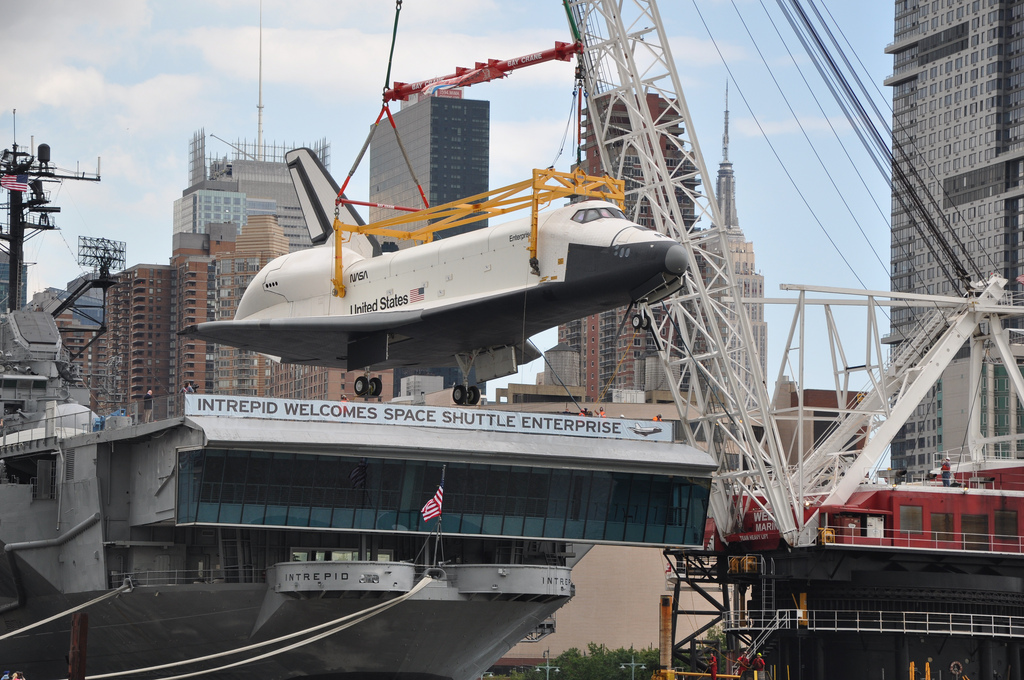
On April 27, 2012, Enterprise took off from Dulles International Airport for the last time, riding piggyback on the 747 for a 45-minute farewell tour over New York City. The shuttle passed low over the Hudson River, circled the Statue of Liberty, flew between the George Washington and Verrazano-Narrows Bridges, and touched down at JFK International Airport. From there, it traveled by barge to the Intrepid Sea, Air & Space Museum at Pier 86 on Manhattan's west side. A gust of wind blew the barge into a piling during the Hudson crossing, nicking a wingtip -- a fitting final indignity for a vehicle that had survived everything except actual spaceflight. Enterprise was hoisted onto the carrier's flight deck on June 6, 2012, and opened to the public on July 19.
Weathering the Storm
Enterprise's time on the Intrepid has not been without drama. On October 29, 2012, Hurricane Sandy's storm surge flooded Pier 86, knocked out the museum's electrical power and both backup generators, and deflated the pressurized fabric pavilion sheltering the orbiter. High winds tore the fabric and collapsed it around Enterprise, breaking a section of the vertical stabilizer's tail fin. Museum staff recovered the broken piece and erected scaffolding to protect the shuttle from the elements until a new pavilion could be built. By April 2013, the damage was fully repaired, and the exhibit reopened that July. Enterprise was listed on the National Register of Historic Places on March 13, 2013, in recognition of its role in the development of the Space Shuttle Program. The shuttle that never left Earth is now, officially, a landmark on it.
From the Air
Located at 40.765N, 74.002W at the Intrepid Sea, Air & Space Museum, Pier 86, on Manhattan's west side along the Hudson River at West 46th Street. The USS Intrepid aircraft carrier is clearly visible from the air as a large vessel docked at the pier, with Enterprise's distinctive shuttle shape visible on the flight deck. Nearby landmarks include the Hudson River waterfront, Times Square (6 blocks east), and the Lincoln Tunnel entrance. Closest airports: Teterboro (KTEB, 9 nm northwest), LaGuardia (KLGA, 8 nm northeast), JFK International (KJFK, 15 nm southeast). Best viewed at 1,500-2,500 ft AGL along the Hudson River corridor.