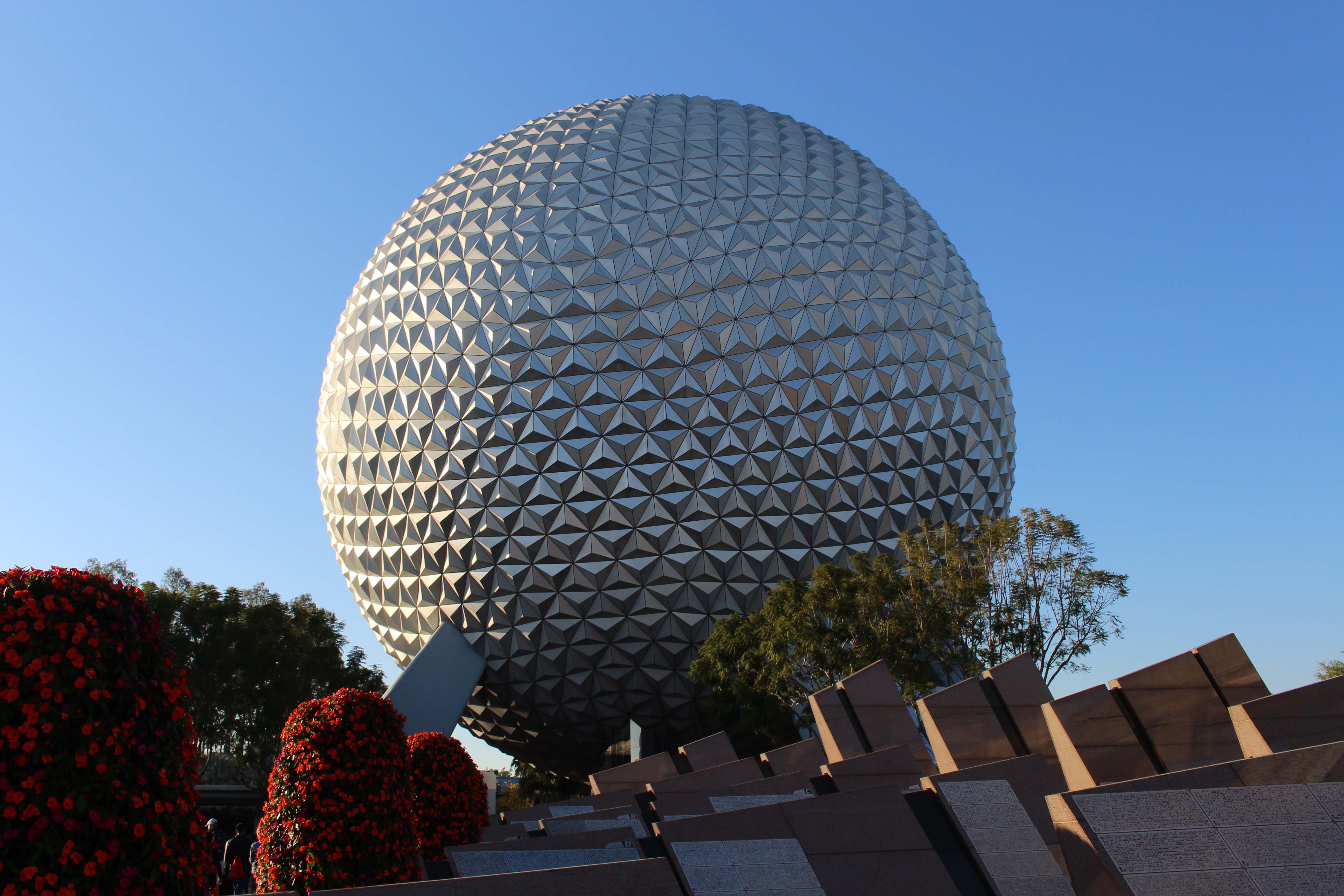
Spaceship Earth (Epcot)
When it rains on Spaceship Earth, not a single drop runs off the sphere onto the ground below. Water slips through one-inch gaps between 11,324 silvered Alucobond panels into a hidden gutter system that channels it all into the World Showcase Lagoon. This invisible trick captures something essential about the structure itself: a feat of engineering disguised as an icon, designed to look effortless while solving problems most visitors never think to ask about. Since EPCOT Center opened on October 1, 1982, the 180-foot geodesic sphere has defined the park's skyline and housed a dark ride that traces humanity's long struggle to communicate, from grunting at mammoths to scrolling through the internet.
Two Domes and a Trick
Spaceship Earth is not actually one sphere. It is two structural domes joined at a steel ring, topped by a separate cladding shell mounted three feet off the inner surface. Six legs, driven deep into Central Florida's soft earth on pile groups, support a box-shaped steel ring at the sphere's equator. The upper dome sits on this ring; the lower dome hangs from it, completing the spherical illusion. Inside the ring, a grid of trusses supports the helical track of the ride system, which spirals up and down through the interior. The structure is derived from a Class 2 geodesic polyhedron with a frequency of 8, producing 3,840 points formed by isosceles triangles. In the interstitial space between the structural domes and the outer cladding, a small service car carries a prone technician along the curved surface to reach repair locations. The architectural design was conceived by Wallace Floyd Design Group, and the structural engineering was completed by Simpson Gumpertz & Heger of Boston, the same firm that engineered the United States pavilion at Expo 67 in Montreal.
Bradbury's Time Machine
The original storyline for the ride was co-written by Ray Bradbury, the science fiction author whose name lent the attraction an intellectual credibility unusual for a theme park. The ride's premise is a journey through time, demonstrating how advances in human communication built the modern world one breakthrough at a time. Omnimover-type vehicles spiral up through audio-animatronic scenes: cavemen painting on walls, Egyptians recording hieroglyphs on papyrus, Phoenician traders inventing a common alphabet, Greek mathematicians teaching in a piazza, Roman chariots carrying news along an empire of roads. Then comes the fall of Rome, complete with the smell of burning wood fired from "smellitzers," a scent-distribution system invented by Imagineer Bob McCarthy in 1981, named after the Howitzer cannon for its ability to shoot puffs of odor. Islamic and Jewish scholars preserve knowledge through the Dark Ages. Gutenberg works his printing press. Michelangelo paints the Sistine Chapel overhead. The 15-minute ride condenses 40,000 years of history into a spiral ascent through a golf ball visible from orbit.
Four Voices, Four Eras
The ride has been narrated by four voices across four versions, each reflecting the sensibilities of its time. Vic Perrin guided the original 1982 ride, which climaxed with a lighted space station and astronauts at the top of the sphere. Walter Cronkite took over in 1986, lending the gravitas of network news to scenes of home computers and paperless offices, set to a theme song called "Tomorrow's Child." Jeremy Irons arrived in 1994 with an orchestral score based on Bach's Sinfonia No. 2 in C Minor, replacing the space station with a video call between a boy in America and a girl in Japan. The current version, which soft-opened in December 2007, features Dame Judi Dench narrating over a Bruce Broughton score, with interactive touchscreens in each vehicle that let riders design their own vision of the future. A camera takes each rider's photo using facial recognition, which appears later in a personalized cartoon during the descent.
The Sphere Endures
Sponsorship has come and gone: the Bell System from 1982, AT&T after the Bell breakup in 1984, Siemens AG from 2005 until 2017. A 25-story "magic wand" held by Mickey Mouse's hand stood beside the sphere from 1999 to 2007, initially displaying "2000" for the Millennium Celebration, then swapped to read "Epcot" before being dismantled when Siemens reportedly found it inconsistent with their corporate image. A major fifth update, to be called Spaceship Earth: Our Shared Story, was announced in 2019 and would have introduced an ethereal "story light" guiding guests through reimagined scenes. It was scheduled to begin in May 2020 but was indefinitely postponed when the COVID-19 pandemic shuttered Walt Disney World. The sphere itself remains unchanged, its silvered facets catching the Florida sun, its hidden gutters channeling rain into the lagoon, its ride still spiraling visitors from cave paintings to computers in a structure that Buckminster Fuller, who popularized both the geodesic dome and the phrase "Spaceship Earth," would have appreciated for its elegant union of form and purpose.
From the Air
Located at 28.375N, 81.549W within EPCOT at Walt Disney World Resort, Bay Lake, Florida. The 180-foot geodesic sphere is the single most recognizable structure in the Disney complex from the air, visible well before the park's other features resolve. It sits at the park entrance, with the World Showcase Lagoon stretching behind it to the south. The Walt Disney World Monorail beam passes directly alongside the sphere. Best viewed below 5,000 feet AGL for full structural detail. Nearby airports: Orlando International Airport (KMCO) approximately 18nm east, Kissimmee Gateway Airport (KISM) approximately 10nm south.