.png)
Spaghetti Junction
The headline ran across the front page of the Birmingham Evening Mail on 1 June 1965, and it changed the language of highway engineering forever: Spaghetti Junction. The journalist Roy Smith had described the planned Gravelly Hill Interchange as "like a cross between a plate of spaghetti and an unsuccessful attempt at a Staffordshire knot." Sub-editor Alan Eaglesfield distilled that simile to two words. Sixty years later, those two words have travelled the world.
The Birmingham Original
The thing that gave the world its name sits north of central Birmingham, where the M6 motorway crosses Junction 6. Officially, it is the Gravelly Hill Interchange. Unofficially, it is the only Spaghetti Junction that matters. Five levels of road ramp twist above and below one another, carrying the M6, the A38(M) Aston Expressway, the A38 trunk road, and the A5127. Beneath the whole tangle run a railway line, three canals, and the River Tame. From the air the structure looks less like infrastructure than a knot somebody started untying and gave up on. When Roy Smith reached for a metaphor in 1965, he reached for the kitchen — and for the heraldic Staffordshire knot — because no engineering vocabulary yet existed for what Birmingham was about to build. The interchange opened to traffic in May 1972.
How a Word Travels
The phrase did not stay in the West Midlands. Across North America, complex urban interchanges acquired the same nickname, often pluralised or shortened — the Spaghetti Bowl, the Mixing Bowl, the Maze, the Knot. The American use of the term predates Birmingham's, in fact: a 1959 description of a planned Louisville interchange called itself Spaghetti Junction first. But it was the Birmingham coinage that spread, partly because the Gravelly Hill design was so visually extreme that photographs of it became newspaper shorthand for the absurdity of post-war traffic engineering. Today the label clings to interchanges from Sydney's Light Horse and Rozelle, to Calgary's Deerfoot tangle, to the EB Cloete in Durban, to the Kew Gardens cluster in Queens. Each one inherits a nickname coined by a sub-editor working to a deadline.
Atlanta's Tangle
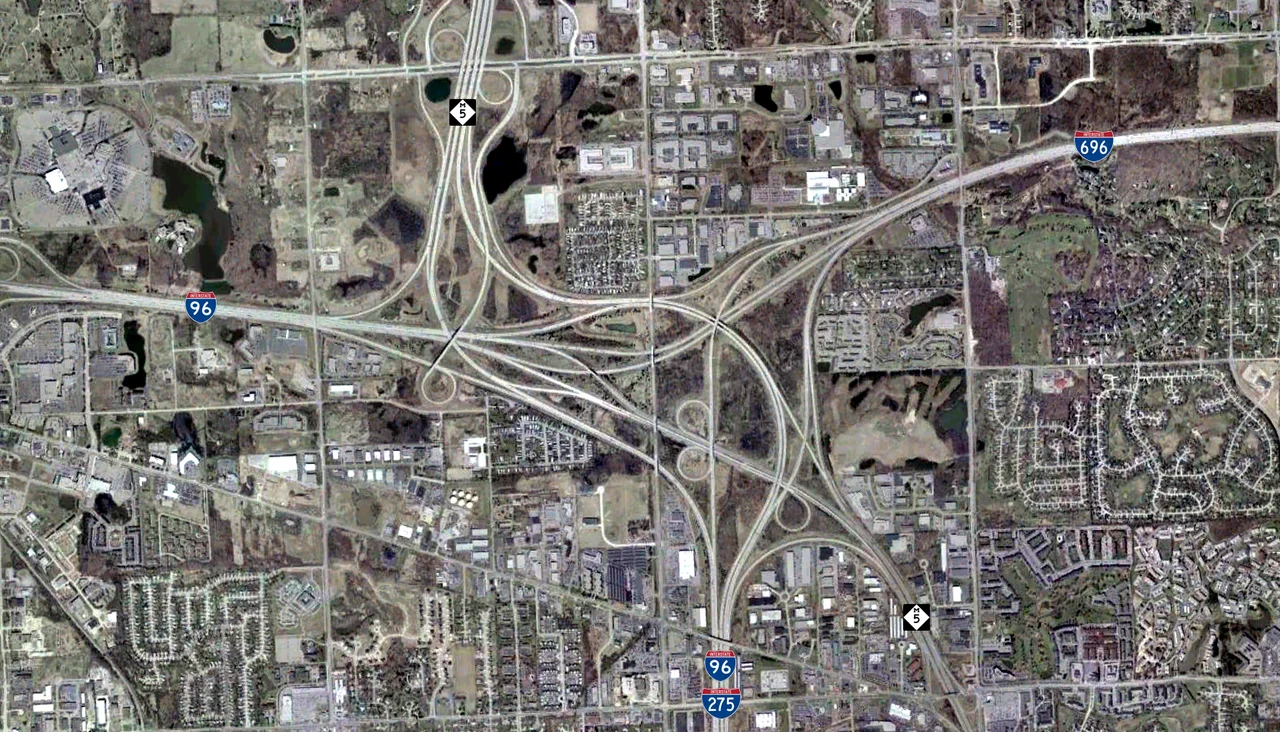
The interchange Qualla flies you over here is the American one most often called Spaghetti Junction by locals — the meeting of I-85 and I-285 in DeKalb County, just outside Atlanta. Its formal name is the Tom Moreland Interchange, after the Georgia transportation commissioner who oversaw its construction. It is a five-level stack, the same category as Birmingham's, with frontage roads sliding alongside the main ramps. Together with US 23 and SR 13, plus Chamblee-Tucker Road and Northcrest Road, the interchange threads sixteen lanes of traffic through the air at once. In 2018 a federal study named it the worst freight bottleneck in the United States. From an aeroplane it looks placid: graceful loops of pale concrete laid out across the red-clay Georgia earth like the cursive of a giant practising letters.
Why Engineers Build These
A stack interchange exists because two interstate-grade highways cannot share a single intersection without one of them having to stop. The cost of stopping highway traffic, even briefly, is enormous; the solution is to lift each direction of each road onto its own ramp and let them pass each other in three dimensions instead of two. The result is a structure that is functionally elegant — every movement is preserved, no traffic light is needed — and visually baffling. A driver inside sees only the next sign. A pilot above sees the whole logic at once: every ramp justified, every curve necessary, every level doing work. Spaghetti, as it turns out, is a misleading name. Spaghetti tangles by accident. These tangle on purpose.
The Sub-Editor's Legacy
Alan Eaglesfield is not famous. He does not have a Wikipedia page of his own. He spent his career writing headlines for a regional English newspaper, and one Tuesday in 1965 he wrote two words above a story about a road junction that did not yet exist. Those two words now describe interchanges on five continents. The lesson Spaghetti Junction quietly teaches is that infrastructure, however massive, needs language before it can enter public imagination — and that language is often supplied by people whose names the infrastructure will outlive. The Gravelly Hill Interchange still works as designed. So does its nickname.
From the Air
Coordinates 33.892°N, 84.259°W mark the Tom Moreland Interchange (the Atlanta Spaghetti Junction) in DeKalb County, Georgia. Best viewed from 3,000-5,000 ft AGL where the full stack geometry is legible. Nearest airport: DeKalb-Peachtree (KPDK) immediately west; Hartsfield-Jackson (KATL) approximately 20 nm southwest. The original Gravelly Hill Interchange that gave the world its name sits at 52.510°N, 1.860°W in Birmingham, UK (nearest ICAO: EGBB, Birmingham Airport).
Nearby Stories
- Etowah Indian Mounds 7.9 km away
- 1987 Forsyth County Protests 13 km away
- Camp Creek Train Wreck 13 km away
- Battle of Pickett's Mill 16 km away
- Lynching of Sam Hose 21 km away
- Tree That Owns Itself 30 km away
- Andalusia 63 km away
- Georgia Guidestones 73 km away