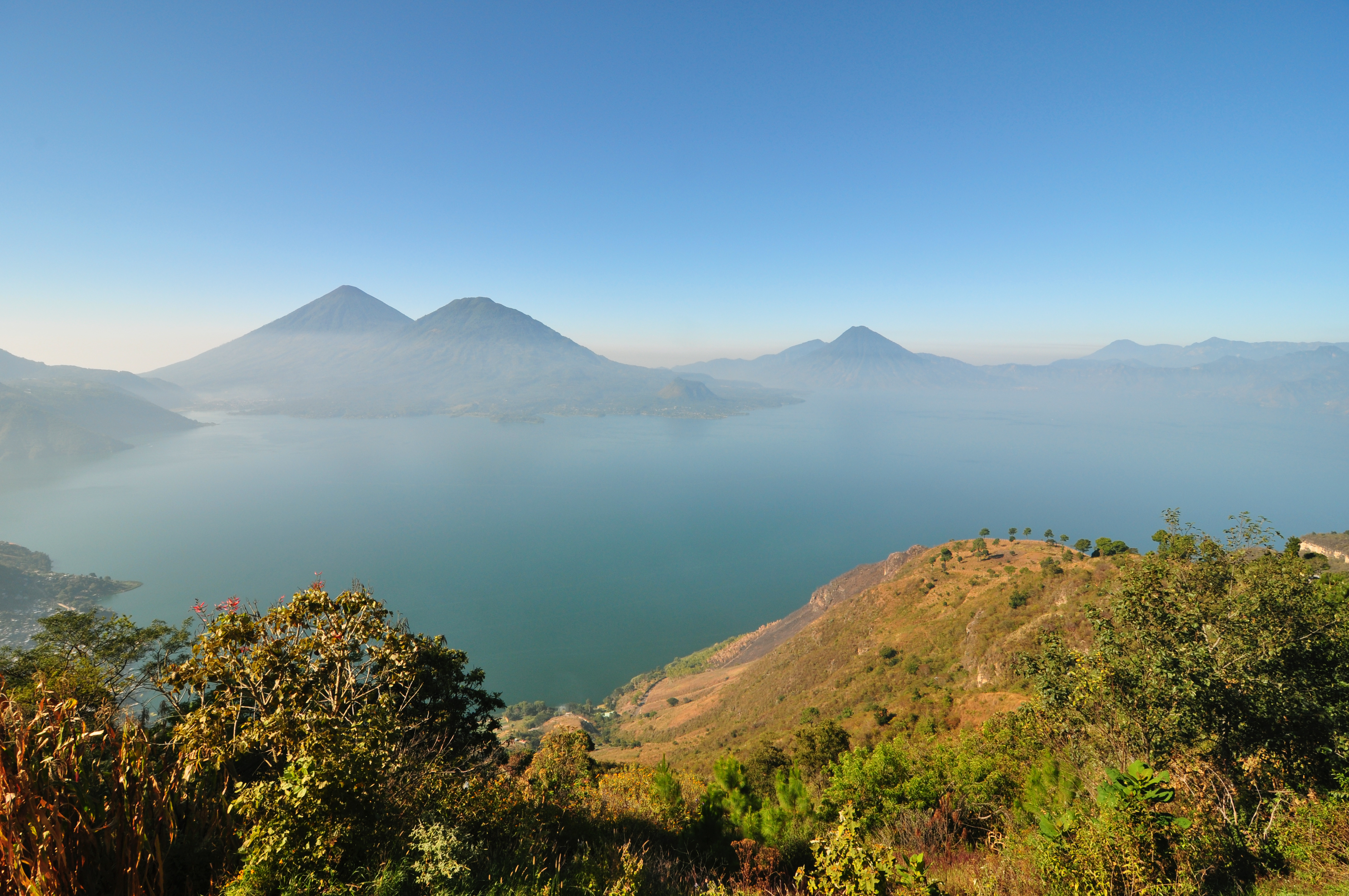
Spanish Conquest of Guatemala
The last independent Maya kingdom did not fall until 1697 -- more than 170 years after the Spanish first set foot on Guatemalan soil. That fact alone distinguishes Guatemala's conquest from the swift collapses of the Aztec and Inca empires. Here, resistance was not a single dramatic stand but a slow, grinding centuries-long refusal to submit. The Itza Maya held their island capital of Nojpeten on Lake Peten Itza while the Spanish encircled them, cut their trade routes, and tried to manipulate their own calendar prophecies against them. When the end came, it came by cannon fire from an oar-powered warship built on the lakeshore.
First Contact on the Caribbean Shore
Gil Gonzalez Davila sailed from Hispaniola in early 1524, aiming for the Caribbean coast of Nicaragua. His course took him instead to Honduras, where he founded Puerto de Caballos, then west along the coast to Amatique Bay. Somewhere near the Dulce River, within modern Guatemala, he planted a settlement called San Gil de Buena Vista and left men to hold it. They could not. The colonists abandoned San Gil and resettled at the indigenous town of Nito near the river's mouth. This pattern -- arrival, failure, relocation -- would repeat across Guatemala's lowlands for decades. The Dominicans established a foothold at Xocolo on the shore of Lake Izabal by mid-century, a post that became infamous among missionaries for the locals' practice of what the Spaniards called witchcraft. By 1574 Xocolo was the most important staging point for expeditions into the interior, a role it held until it was finally abandoned in 1631.
The Shrinking World of the Maya
From 1527 onward, Spanish activity in the Yucatan Peninsula steadily tightened the noose. Invasion, epidemic disease, and the enslavement of as many as 50,000 Maya in the north drove refugees southward to join the Itza around Lake Peten Itza. The Spanish recognized that the Itza had become the center of anti-colonial resistance and spent nearly two centuries encircling them, cutting trade routes, and attempting to peel away their allies. Dominican missionaries worked Verapaz and the southern Peten through the late sixteenth and seventeenth centuries, trying nonviolent conversion with limited results. The Franciscans eventually concluded that no lasting peace was possible while the Itza held out -- the constant flow of escapees from Spanish-held territories to the Itza kingdom drained the encomienda labor system. In 1695, Franciscan friar Andres de Avendano tried to convince the Itza king that the K'atun 8 Ajaw, a twenty-year Maya calendrical cycle beginning around 1696, made this the prophesied moment to accept Christianity. The Itza priesthood read the same prophecies differently, and Avendano was fortunate to escape with his life.
The Fall of Nojpeten
Martin de Ursua y Arizmendi arrived on the western shore of Lake Peten Itza with his soldiers on February 26, 1697. On the lakeshore, his men built a galeota -- a large, heavily armed, oar-powered attack boat. On March 13, 1697, the Spanish launched a waterborne assault on the Itza capital. The bombardment was devastating. Many Itza who tried to escape by swimming across the lake were killed in the water. Nojpeten fell in a single day. Catholic priests from Yucatan founded mission towns around the lake in 1702-1703, and surviving Itza and Kowoj people were resettled in them through a mixture of persuasion and force. When Kowoj and Itza leaders rebelled against their Spanish overlords in 1704, the revolt was swiftly crushed and its leaders executed. By 1708, only about 6,000 Maya remained in central Peten -- one-tenth the population of just eleven years earlier.
Verapaz and the Experiment in Peaceful Conversion
Not all conquest came by the sword. In the highlands around what is now Coban, Bartolome de las Casas persuaded the Spanish crown to try a different approach. The Dominican friar secured written guarantees that indigenous people in the Tezulutlan region would not be parceled out as encomienda labor. He recruited Christian Maya converts, taught them hymns that encoded Gospel principles, and sent them as evangelists into territory that had resisted every military campaign. A local cacique converted and helped broker peace with neighboring leaders. The region was renamed Verapaz -- "true peace" -- in 1547. Las Casas himself was later instrumental in the passage of the New Laws of 1542, which attempted to curb the worst abuses of the encomienda system across the Americas. His experiment in Verapaz was imperfect and incomplete, but it stood in stark contrast to the violence that defined the conquest everywhere else.
What the Conquest Left Behind
The immediate aftermath was brutal. Indigenous peoples -- allies and enemies alike -- were subjected to decades of heavy exploitation. The civil government was run by Spaniards and their criollo descendants. Catholicism became the primary vehicle for cultural change, producing a deep religious syncretism that persists today. Old World technology replaced Neolithic tools; cattle, pigs, and chickens supplanted the hunting of game. The marimba, an instrument of African origin, was adopted so thoroughly by Maya communities that it became Guatemala's national instrument. Sugarcane and coffee created plantation economies that exploited indigenous labor for centuries. Today, an estimated sixty percent of Guatemala's population is Maya, concentrated in the central and western highlands. Some indigenous elites, such as the Kaqchikel Xajil family, managed to maintain a degree of status into the colonial period and chronicled their region's history -- one of the few indigenous accounts of the conquest that survives.
From the Air
The story of the Spanish conquest spans all of Guatemala, but the article's coordinates center at 15.50N, 90.25W, near the Alta Verapaz highlands. Key locations include Lake Peten Itza (MGFL/Flores airport) to the north, Lake Izabal and the Caribbean coast to the east, and the western highlands. From altitude, the contrast between the dense Peten jungle to the north and the cultivated highland valleys to the south traces the geographic boundary that shaped the conquest's pace. La Aurora International Airport (MGGT) in Guatemala City is the primary regional hub.