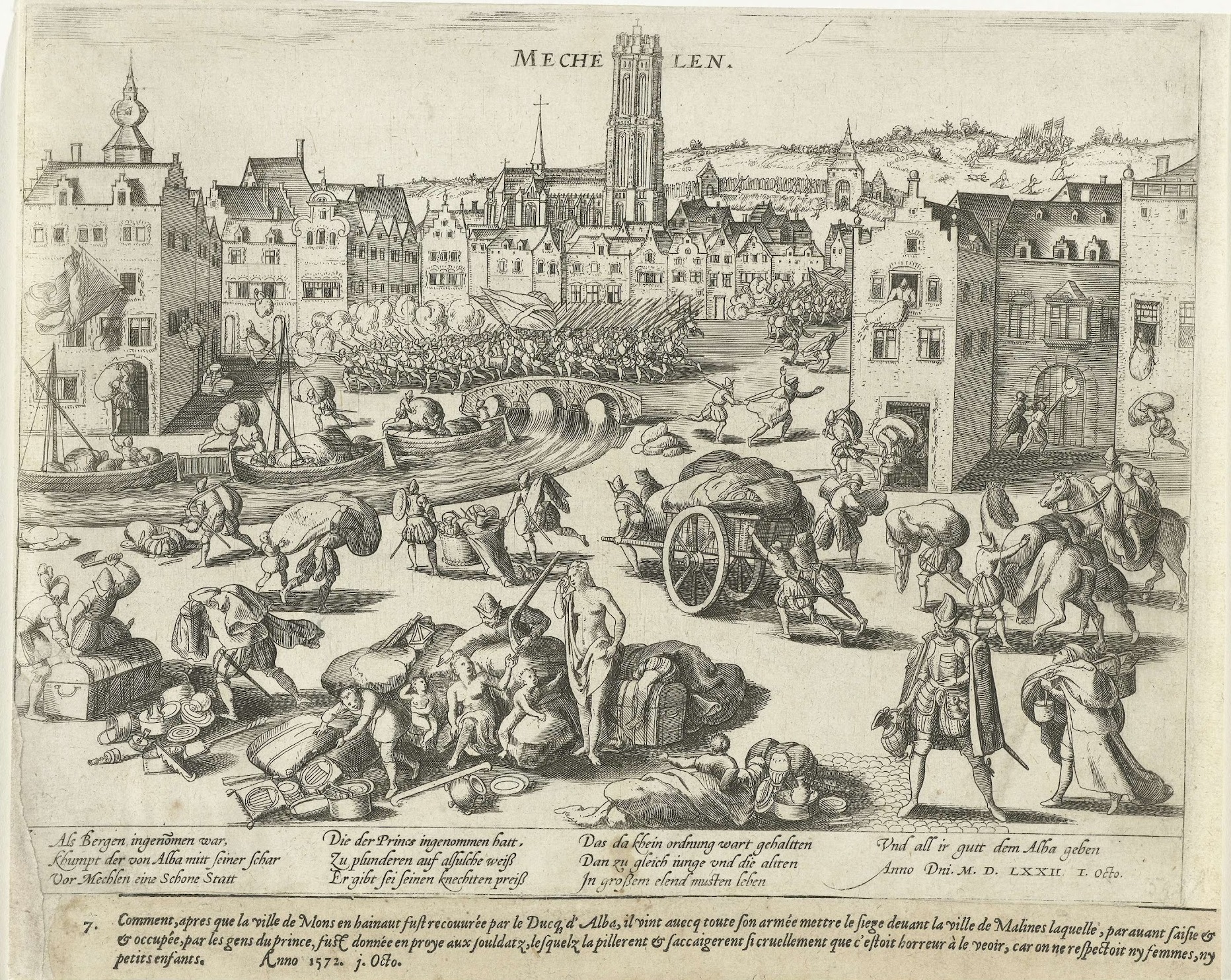
Spanish Fury at Mechelen
The citizens of Mechelen sang psalms of penitence as the Spanish soldiers approached on October 2, 1572. It was a gesture of surrender, a plea for mercy from a Catholic population that had never truly embraced the Protestant rebellion. The garrison had already fled. The gates stood open. But the Duke of Alba had already given his orders: his troops had not been paid in months, and Mechelen would serve as both reward and warning. For three days, the soldiers took everything, leaving what Alba himself described to King Philip II as a city where 'no nail was left in the wall.'
A City Between Powers
The summer of 1572 had been turbulent across the Low Countries. William of Orange, leading the Dutch revolt against Spanish Habsburg rule, had brought city after city under rebel control. Some embraced the cause enthusiastically; others, like Mechelen, simply opened their gates when rebel forces arrived. On August 31, Mechelen admitted William's troops, and the prince continued his advance toward Mons, leaving a garrison under Bernard van Merode. It was a strategic calculation that would prove catastrophic for the city. When William was forced to withdraw to Holland on September 21, Mechelen found itself exposed, a city that had tolerated rebels now facing the wrath of the most powerful military commander in Europe.
The Duke's Calculation
Fernando Alvarez de Toledo, the Duke of Alba, understood the power of terror. His unpaid troops were restless, and the rebellious cities of the south needed a demonstration of what defiance would cost. Mechelen was wealthy. Mechelen had harbored rebels. Mechelen would burn. Alba ordered his son, Fadrique Alvarez de Toledo, to punish the city. The plundering would serve two purposes: it would satisfy troops owed months of wages, and it would show every other city in Alba's path what awaited them. Bernard van Merode, learning of the approaching Spanish force, made a soldier's calculation and fled with his men. The citizens of Mechelen were left to face the consequences alone.
Three Days of Fury
The sack began on October 2, 1572. Despite the city's peaceful surrender, despite the psalms and the open gates, Fadrique unleashed his soldiers for three days of systematic destruction. Protestant theologian Jean Leclerc, writing decades later, recorded accounts of slaughter, rape, and pillaging that stripped the city bare. Every house was entered. Every valuable taken. The violence was not spontaneous; it was policy. Alba's letter to Philip II expressed satisfaction that his message had been delivered. The Spanish Fury, as such episodes came to be known, was not the chaos of battle but the calculated deployment of terror as a political tool.
The Price of an Example
In the immediate aftermath, Alba's strategy succeeded. Every city in his path surrendered without resistance. Mechelen's suffering had purchased their obedience. Six weeks later, on November 15, Spanish troops repeated the performance at Zutphen. But terror, once unleashed, is difficult to control. Four years later, in 1576, unpaid Spanish soldiers would sack Antwerp without orders from any commander, killing thousands in what became the most infamous of the Spanish Furies. The distinction mattered: Mechelen and Zutphen were commanded atrocities; Antwerp was mutiny. Yet for the dead, for the survivors who watched their city burned, such distinctions meant nothing. The violence that served Alba's purposes in 1572 would ultimately help turn the entire Netherlands against Spanish rule.
From the Air
Located at 51.02N, 4.47E in central Belgium. Mechelen's historic center, dominated by the unfinished tower of St. Rumbold's Cathedral, is clearly visible from altitude. The city lies between Brussels (25km south) and Antwerp (25km north). Nearest airports: Brussels Airport (EBBR) 15km southeast, Antwerp Airport (EBAW) 20km north.