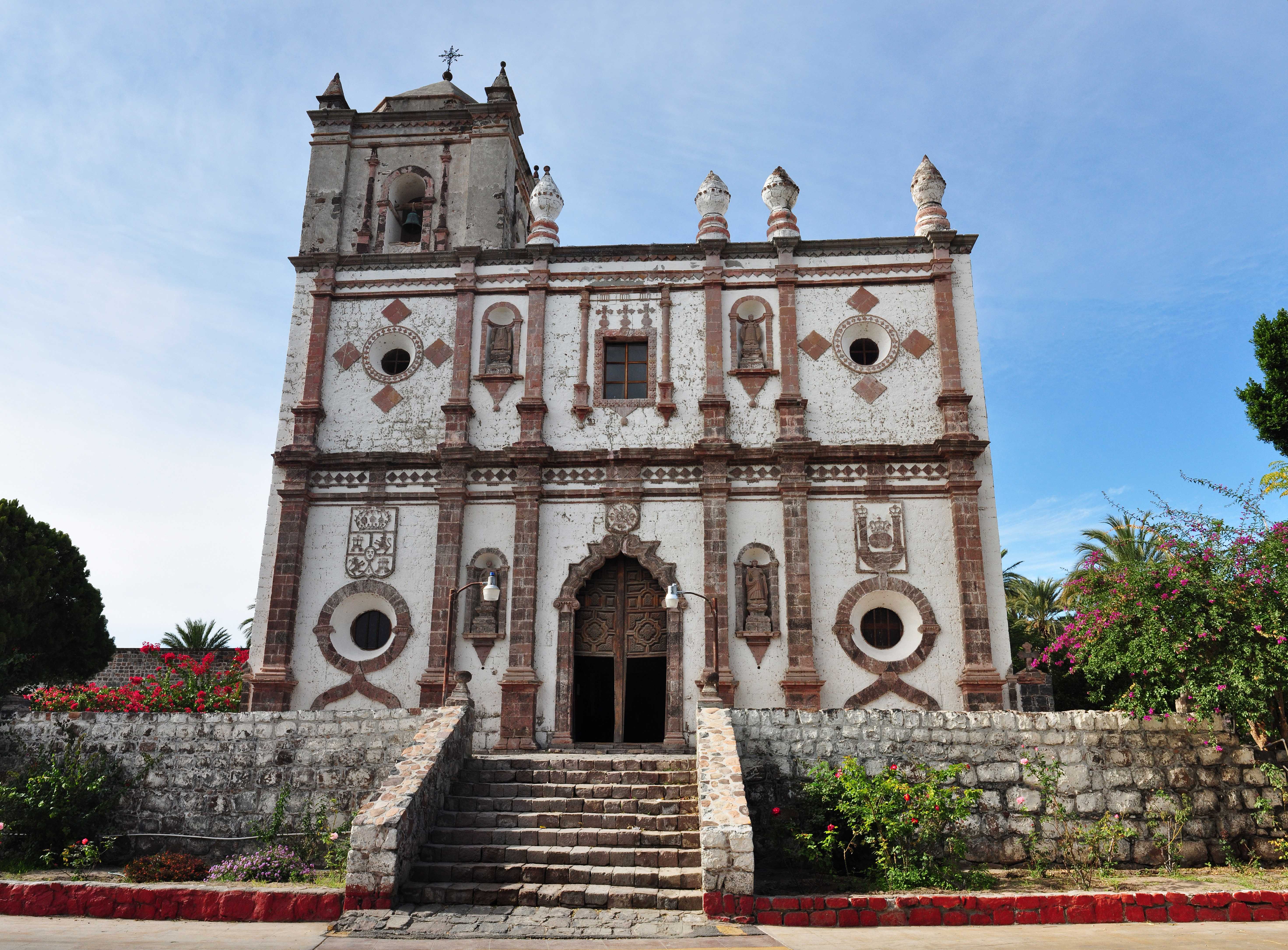
Spanish Missions in Baja California
When Juan Maria Salvatierra stepped ashore on October 19, 1697, he began an enterprise that would reshape the Baja California peninsula for 137 years. Six days later, on October 25, he formally founded Mission Loreto. Before him, the Jesuit Eusebio Kino had tried and failed to sustain a mission here. After him, three religious orders would establish 30 missions and 11 visitas from San Jose del Cabo to the present U.S. border. They brought European livestock, fruits, and tools. They also brought smallpox, measles, and typhus. The indigenous population of 60,000 would collapse to 5,900 by 1800.
The Pious Fund and the Jesuit Century
The mission system depended on money from Mexico City. In 1696, the Pious Fund of the Californias was established at Jesuit headquarters: for every 10,000 Spanish dollars donated by wealthy merchants, a missionary received 500 dollars annually to support himself and his indigenous congregants. The Manila galleon stopped regularly at Cabo San Lucas between 1734 and 1767, providing supplies. From Loreto, Jesuits spread across the peninsula's lower two-thirds, founding 17 missions and several visitas. During 60 years of work, 56 Jesuits came to Baja California, 16 died at their posts, and two became martyrs.
Eight Peoples, One Fate
The Kumeyaay, Cocopah, Pai Pai, Kiliwa, Cochimi, Monqui, Guaycura, and Pericu lived on this desert peninsula before the Spanish arrived. Most were nomadic hunter-gatherers surviving under harsh conditions. The missionaries concentrated them near settlements through a policy called reductions, teaching farming and stock herding while enforcing Catholic conversion. Resistance flared: the Pericu revolt of 1734-1737 shook the southern missions, and runaways and sabotage plagued the system throughout the colonial era. But disease killed more effectively than any rebellion. By the early 19th century, only the Kumeyaay, Cocopah, and Pai Pai survived as distinct cultures.
Expulsion and Transition
Rumors swirled that the Jesuits had amassed secret fortunes. On February 3, 1768, King Carlos III ordered them expelled from the Americas. Gaspar de Portola arrived as governor to oversee the removal and install Franciscan replacements. Junipero Serra took charge of the missions, but his order's tenure lasted only five years. In 1769, Serra and Portola marched north to found San Diego and Monterey, leaving Francisco Palou to manage Baja California. The Dominicans arrived in 1772 and would establish nine more northern missions by 1800 while administering the former Jesuit sites.
From Missions to Parishes
Mexico gained independence in 1821, and in 1833 the secularization act converted all missions to parish churches. The last missionaries departed in 1840. Native congregations lost their communal land rights, completing a transformation that had begun with first contact. Some mission churches survive and remain in use today. The ruins of others dot the peninsula, stone foundations marking where padres once taught and indigenous people once labored. Many Baja Californians today carry indigenous heritage, living proof that total extinction never came, even as distinct tribal cultures largely vanished.
The Mission Trail
The missions stretched from Playas de Rosarito in the north to San Jose del Cabo at the peninsula's southern tip. Jesuit foundations from the 1680s-1760s include Loreto, San Javier, Santa Gertrudis, and San Ignacio Kadakaaman. The Franciscans added San Fernando de Velicata in 1769 before heading north. Dominican establishments like Santo Domingo, San Vicente Ferrer, and Santa Catalina pushed the frontier toward what would become the U.S. border. Together these sites trace the path of Spanish colonization through some of North America's harshest terrain.
From the Air
The mission chain runs the length of Baja California, from approximately 32.2N at the northern missions to 23.0N at San Jose del Cabo. Mission Loreto (26.01N, 111.35W) served as the original administrative center. Flight routes along the peninsula pass over numerous mission sites. Nearest major airports include Tijuana (MMTJ), La Paz (MMLP), and Loreto (MMLT).