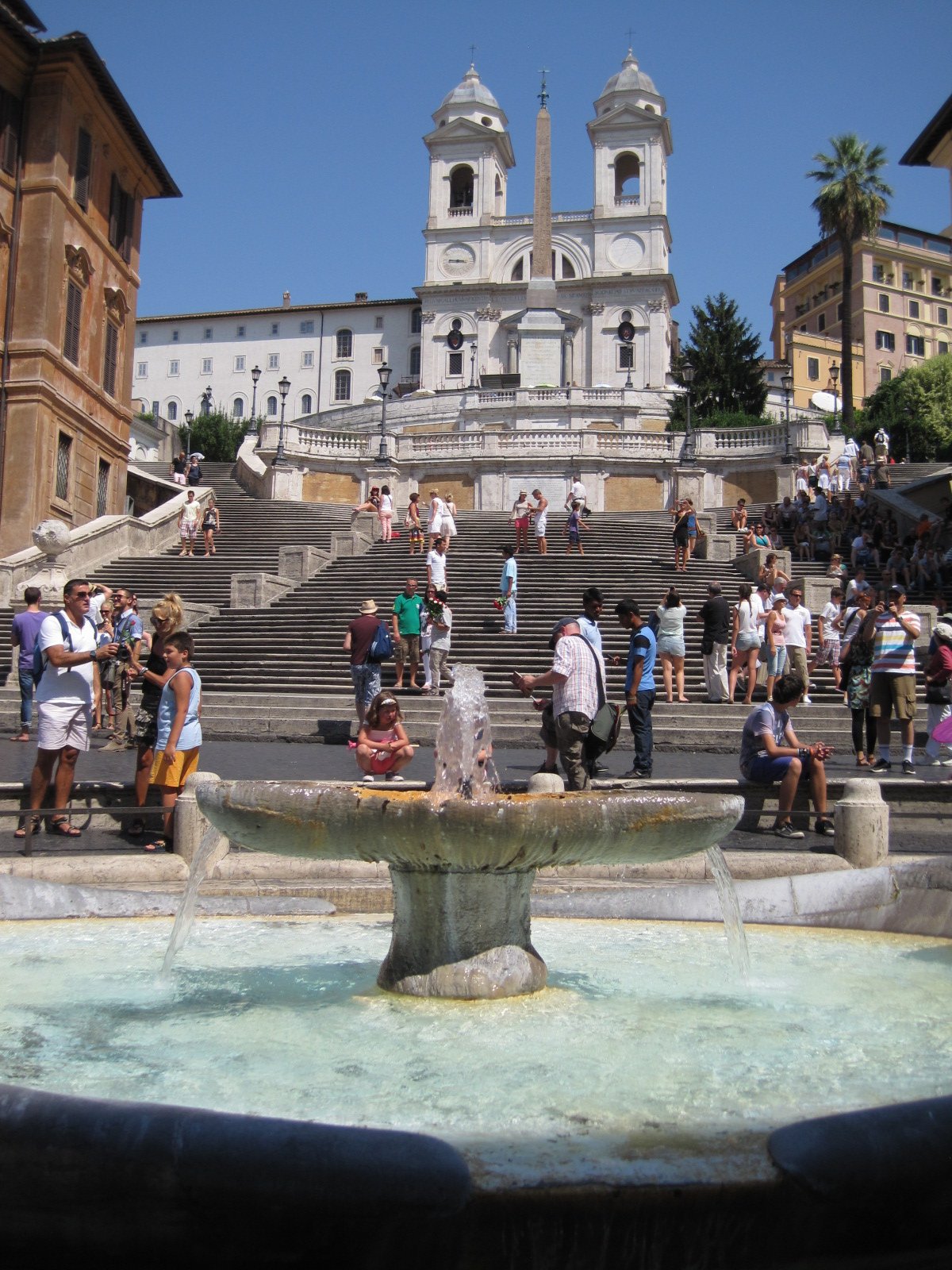
Spanish Steps
The Spanish Steps are neither entirely Spanish nor entirely steps. The 135-step stairway in Rome connects the Piazza di Spagna at the bottom, named for the Spanish Embassy to the Holy See, to the French church of Trinita dei Monti at the top, built under the patronage of the Bourbon kings of France. What connects these two rival powers is a monumental piece of Baroque urban design that took over a century of diplomatic squabbling to build, cost a dead French diplomat's contested fortune, and has since endured everything from Audrey Hepburn eating gelato on its treads to a Saudi national driving a Maserati down its flights.
A Stairway That Almost Wasn't
The hill was always the problem. A steep 29-meter slope separated the French church from the piazza below, and from the 1580s onward, popes kept trying to figure out how to urbanize it. The French diplomat Etienne Gueffier died in 1660 and left part of his fortune for the stairway's construction, but Cardinal Mazarin complicated matters by insisting the design include an equestrian monument to Louis XIV. Papal Rome found this unacceptable. Mazarin died in 1661, the pope in 1667, and Gueffier's nephew successfully claimed half the bequest. The project went dormant for decades. It took until the early 18th century for Pope Clement XI to revive it, and a 1717 competition awarded the commission to the little-known architect Francesco de Sanctis. His drawing was engraved by Girolamo Rossi in 1726 with a long dedication to Louis XV, a diplomatic nod that satisfied the French.
The Geometry of Compromise
De Sanctis solved the slope with a design that inflated the conventions of terraced garden stairs to monumental scale. The precedents were distinguished: Bramante had devised the first divided and symmetrical stairs for the Belvedere Courtyard, and Michelangelo had introduced shaped and angled steps in the Laurentian Library vestibule. De Sanctis merged these ideas into a composition that divides, converges, and divides again as it ascends, creating terraces where the city opens up in unexpected ways. The Bourbon fleur-de-lys and Pope Innocent XIII's eagle and crown appear in careful balance throughout the sculptural details, a diplomatic handshake frozen in stone. The steps were built from travertine, the same creamy limestone that gives much of Rome its warm color. By the mid-18th century, writers were already complaining the steps were in poor condition.
The Piazza Below
At the base sits the Fontana della Barcaccia, the Fountain of the Longboat, built between 1627 and 1629. It is credited to Pietro Bernini, though his more famous son Gian Lorenzo likely collaborated on the decoration. Legend holds that Pope Urban VIII commissioned it after a Tiber flood deposited a boat in the square. The fountain sits low because the Acqua Vergine aqueduct that feeds it provides low water pressure, and Pietro Bernini turned this limitation into the design itself, sinking the boat-shaped basin below street level. At the corner where the steps begin their climb stands the house where the English poet John Keats lived his final months. He died there in 1821 at age 25, and the building is now the Keats-Shelley Memorial House, filled with memorabilia of the English Romantic poets who were drawn to Rome.
Modern Misadventures
The steps have become a magnet for the kind of tourist behavior that exasperates Romans. In 2019, the city imposed fines of 250 euros for sitting on the steps and up to 400 euros for damaging them, part of Mayor Virginia Raggi's campaign to enforce decorum at heritage sites. The ordinances became necessary after escalating incidents: in May 2022, a man drove a rented Maserati down the first flight before stopping, cracking the 16th and 29th steps. A month later, two American tourists launched a scooter down the steps three times, dislodging a piece of marble that cost 25,000 euros to repair. In June 2025, a man in his 80s drove a Mercedes halfway down the steps and got stuck. He told police he was on his way to work. The Vigili del Fuoco removed the car with a crane while archaeologists inspected the damage.
Slow Food and Fast Movies
In 1986, the opening of Italy's first McDonald's near the Spanish Steps provoked an unexpected cultural response. Carlo Petrini and friends formed Arcigola, the organization that became the international Slow Food movement, a direct reaction to American fast food arriving at one of Rome's most iconic spots. The steps have fared better in cinema. Audrey Hepburn and Gregory Peck made them a symbol of Roman romance in Roman Holiday in 1953. They appeared in The Talented Mr. Ripley, Fast X, and Mission: Impossible, though the franchise's end credits assured viewers that a studio replica was used for the car chase. Every spring, the steps are covered with pots of azaleas in the weeks before Rome's founding anniversary on April 21. During Christmas, a 19th-century nativity scene occupies the first landing. The steps belong to everyone and to no one, which is perhaps why they keep getting driven on.
From the Air
The Spanish Steps (41.91N, 12.48E) are located in central Rome between Piazza di Spagna and the Trinita dei Monti church on the Pincian Hill. The stairway is difficult to distinguish from altitude but the church's twin bell towers at the top are a useful landmark. Rome Fiumicino (LIRF) is 30km southwest; Ciampino (LIRA) is 15km southeast. The Villa Medici and Villa Borghese gardens are nearby to the northeast.