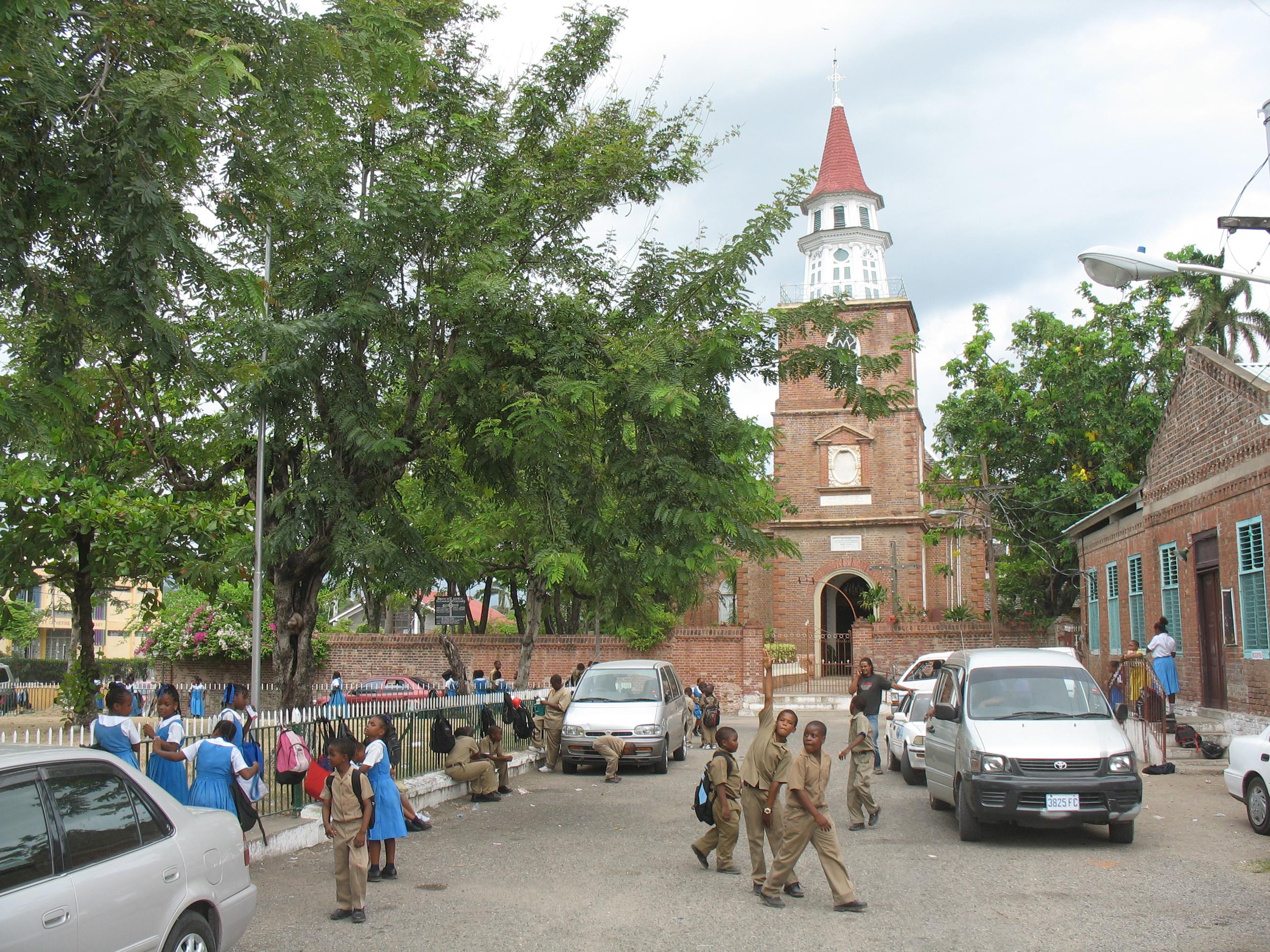
Spanish Town
Jamaicans call it "Spain." Not because they confuse their island with the Iberian Peninsula, but because Spanish Town -- Villa de la Vega, as its founders named it in 1534 -- was the capital of Jamaica for 338 years, longer than most nations have existed. The Taino people had lived here along the Rio Cobre for roughly a millennium before the Spanish arrived, but European ambition reshaped the land into something new: a colonial seat that would serve two empires before being discarded by both. Today the town's Georgian facades and crumbling iron bridge tell the story of a place that once held power and then watched it walk away.
Two Flags, One Capital
The Spanish founded Villa de la Vega as the colony's capital, and it remained so even after the English conquest of 1655. The transition was violent -- the town was badly damaged during the invasion, and for a time the notorious Port Royal served as Jamaica's unofficial administrative center. But when an earthquake obliterated Port Royal in 1692, Spanish Town had already rebuilt itself and reclaimed its role. The English renamed it, keeping the Spanish heritage in the very syllables. For nearly two more centuries, governors ruled from the King's House on the town's central square, and on August 1, 1838, Governor Lionel Smith stood on those steps alongside Reverend James Phillippo to proclaim the abolition of slavery in Jamaica. That single moment -- freedom declared from a building named for a king, in a town named for its colonizers -- captures the layered contradictions embedded in every stone here.
Streets That Remember
Walk Spanish Town's streets and you read its history underfoot. Red Church and White Church streets recall the Spanish chapels of the red and white cross. Monk Street marks where a monastery once stood. Nugent and Manchester streets honor British colonial governors, while King Street runs past the King's House itself. Constitution Street, near the town square, points toward the administrative center that once governed the entire island. In the square, Regency-era buildings still stand: the Rodney Memorial, flanked by two cannons captured from the French warship Ville de Paris in 1782, and the facade of the Old King's House. One of the earliest Spanish cathedrals built in the New World rose here around 1525, later taken over by the Anglican Church -- making it one of the oldest Anglican churches outside England, alongside those in Virginia, Maryland, and Bermuda.
The Bridge That Nearly Vanished
Spanning the Rio Cobre since 1801, Spanish Town's cast-iron bridge is an engineering relic from another era. Designed by Thomas Wilson and manufactured by Walker and Company of Rotherham, England, the bridge cost 4,000 pounds -- a substantial sum when Jamaica's sugar economy was still booming. Its four arched ribs rest on massive masonry abutments that, over two centuries, slowly deteriorated until the structure was endangered. The World Monuments Fund placed it on its 1998 Watch list. Restoration began in 2004 with American Express funding, stalled, resumed in 2008, and reached a first milestone in April 2010 when repaired abutments allowed the bridge to reopen. Yet violence in the surrounding area has prevented the bridge from achieving UNESCO World Heritage status -- a reminder that Spanish Town's present sometimes works against preserving its past.
A Capital Loses Its Crown
By 1755, lobbyists were already questioning whether Spanish Town deserved to remain Jamaica's capital. Kingston, founded after the 1692 earthquake as a refugee settlement, had grown into the island's commercial engine. Governor Lionel Smith's grim 1836 assessment of Spanish Town -- "the capital was in ruins, with no commercial, manufacturing and agricultural concern in operation" -- sealed a slow decline. The Morant Bay Rebellion of 1865 provided the final push: Sir John Peter Grant ordered the capital's removal to Kingston in 1872. With the seat of government gone, Spanish Town's economic and cultural vitality drained away. The population, estimated at about 160,000 by 2009, has been growing again, but the town's identity remains shaped by what it lost. Locals sometimes call it "Prison Oval," after the cricket pitch beside the St. Catherine District Prison, where inmates catch glimpses of matches through their cell windows.
Rhythms From the Old Capital
If Spanish Town's political influence faded after 1872, its cultural influence only grew louder. The town has produced an extraordinary roster of musicians, athletes, and public figures. Grace Jones, the singer and actress whose androgynous style redefined pop culture, was born here. So were reggae artists Prince Far I, Koffee, Chronixx, and Diana King, along with dancehall star Spice. Record producer Harry Mudie helped shape Jamaica's sound from his Spanish Town roots. Sprinter Yohan Blake attended school in town, and Andrew Holness -- Jamaica's Prime Minister -- claims it as home ground. The old capital may have surrendered governance to Kingston, but it never stopped producing the voices and talents that define Jamaica to the world.
From the Air
Spanish Town sits at 17.996N, 76.955W on the west bank of the Rio Cobre, approximately 13 miles west of Kingston. From altitude, look for the urban area nestled in the St. Catherine lowlands with the Rio Cobre winding through. The town square and its Regency-era buildings are at the historic center. Nearest major airport is Norman Manley International (MKJP) in Kingston. Tinson Pen Aerodrome (MKTP) is also nearby. Best viewed at 3,000-5,000 feet for the relationship between the old capital and Kingston along the A1 road corridor.