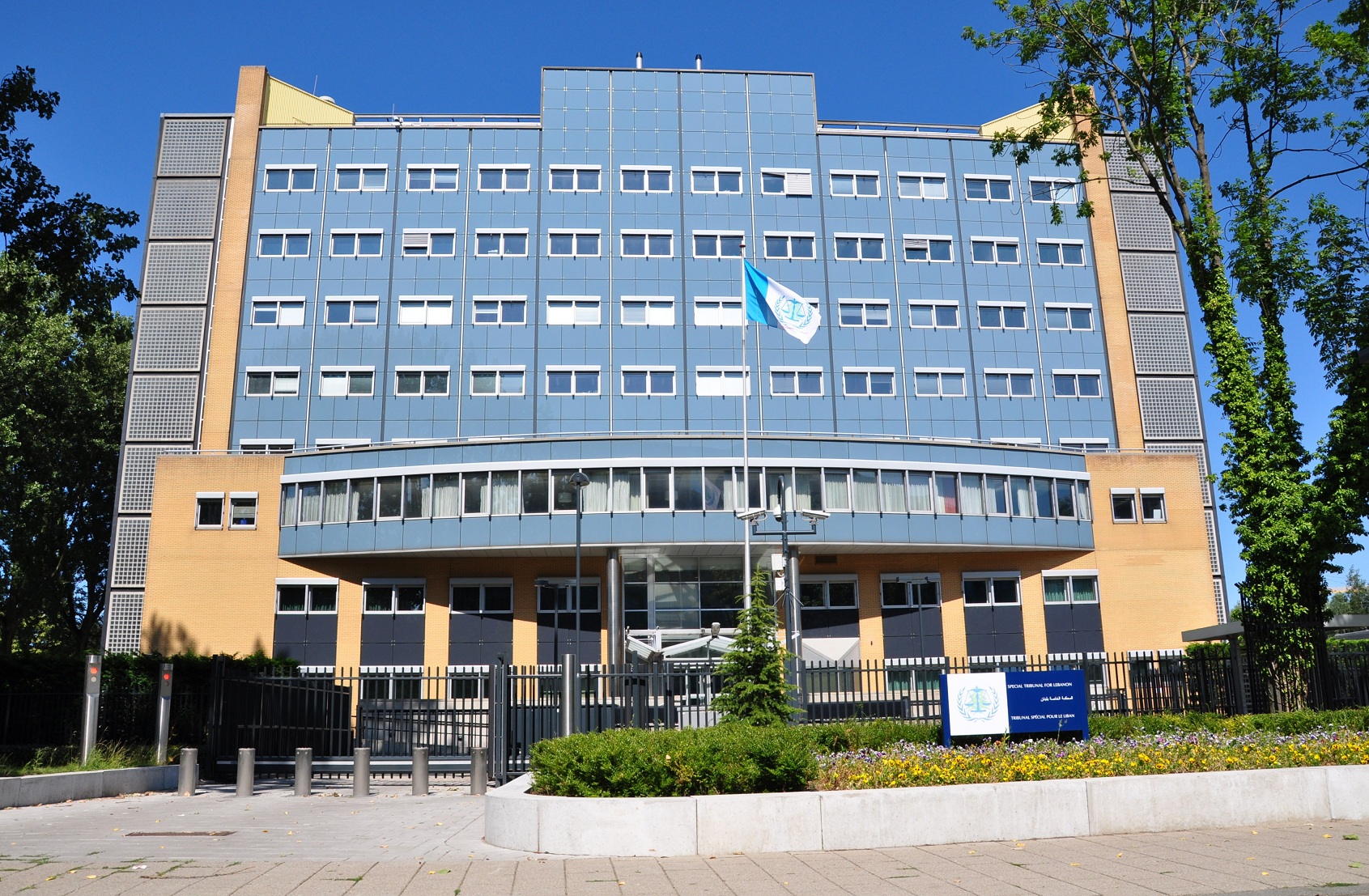
Special Tribunal for Lebanon
At 12:55 on the afternoon of 14 February 2005, a Mitsubishi van packed with roughly 1,800 kilograms of explosives detonated on the Beirut seafront as the motorcade of former Prime Minister Rafic Hariri passed by. The blast tore a crater nearly two meters deep into the road, threw cars into the air, and killed twenty-two people including Hariri himself. The Lebanese state, fractured along sectarian lines and shadowed by Syrian occupation, was in no condition to investigate the case. Four years and an ocean of international wrangling later, the answer would be sought 3,000 kilometers away, in a former intelligence-service building on the quiet edges of The Hague.
A Court for One Crime
The Special Tribunal for Lebanon was not like the other courts that ringed the Dutch capital. The International Criminal Court tried genocides; the Yugoslavia and Rwanda tribunals tried mass atrocities. The STL was built to try, in essence, a single bombing, and the chain of murders that followed in its wake. It was the first international court to treat terrorism as a discrete crime rather than as a species of war crime, and the first to admit the possibility of trying defendants who would never set foot in the courtroom. Established by UN Security Council Resolution 1757 in 2007 after the Lebanese parliament refused to ratify the treaty, the Tribunal opened its doors on 1 March 2009 in Leidschendam, just east of The Hague. Its judges were Lebanese and international, its languages Arabic, French and English.
The Evidence Was a Phone Network
There were no fingerprints to dust, no spent cartridges to match. The suicide bomber driving the Mitsubishi was obliterated, and the prosecution would ultimately concede it could not identify him. What survived the blast was a pattern of mobile-phone metadata: clusters of handsets that had shadowed Hariri's movements for months, switching on and off in synchronized rhythms, falling silent at the moment of the attack. Investigators traced these phones to four men they identified as members of Hezbollah's Unit 121. The lead suspect, Salim Ayyash, never appeared in court. None of them did. On 18 August 2020 the judges convicted Ayyash in absentia and acquitted the others for lack of evidence. The court could not say whether Hezbollah's leadership or the Syrian government had ordered the killing. It could only say that one man's phone had been in the right places at the wrong times.
The Twenty-One Others
Hariri is the name on the cases and the headlines, but he died with twenty-one other people that afternoon: bodyguards from his protection detail, drivers, a photographer, passers-by who happened to be walking on the Corniche. The Tribunal's Victims' Participation Unit treated their families not as spectators but as parties, with legal representatives who could speak in court, examine witnesses, and address the bench at sentencing. It was a quietly radical innovation for an international criminal court, an acknowledgment that the dead at a bombing are never abstractions. The lead representative, Peter Haynes, and his colleagues Mohammad Mattar and Nada Abd El Sater Abu Samra spent more than a decade carrying those voices into a courtroom in Leidschendam that most of the bereaved would never see in person.
An Ending Without an Answer
By 2021 Lebanon's currency had collapsed and the country could no longer pay its share of the Tribunal's budget, roughly forty-nine percent. UN Secretary-General Antonio Guterres appealed for emergency contributions, and donor states extended the Tribunal's life enough to hand down two more in-absentia life sentences, against Hassan Habib Merhi and Hussein Oneissi, in 2022. Then on 31 December 2023, UN spokesperson Stephane Dujarric announced what everyone in the building already knew: the Special Tribunal for Lebanon would close. Salim Ayyash had been sentenced to five concurrent life terms but was never arrested. In November 2024 he was reported killed by an Israeli strike in Syria. None of those convicted ever sat in a cell.
What Leidschendam Holds Now
The premises that housed the STL belonged originally to the Dutch General Intelligence and Security Service, and the building has returned to that orbit as a secondary office. The archives have moved to UN custody in New York, and the digitized public record now lives in the Stanford Virtual Tribunals project, alongside the records of the Sierra Leone and Yugoslavia courts. The STL's most lasting legacy may be procedural rather than punitive: it built the template for trying terrorism as a crime under international law, refined the rules for in-absentia proceedings, and made victim participation a working reality. Whether that is enough to honor twenty-two people who died on a Beirut afternoon is a question Lebanon, fifteen years later, is still trying to answer.
From the Air
The former STL premises lie at 52.09 N, 4.40 E in Leidschendam, on the northeastern outskirts of The Hague, just off the A12 motorway. Visible from cruising altitude in clear weather, the site is approximately 5 km east of the Peace Palace and the cluster of international courts in central Den Haag. Nearest airports: Rotterdam The Hague (EHRD, 18 km southwest) and Amsterdam Schiphol (EHAM, 35 km northeast).