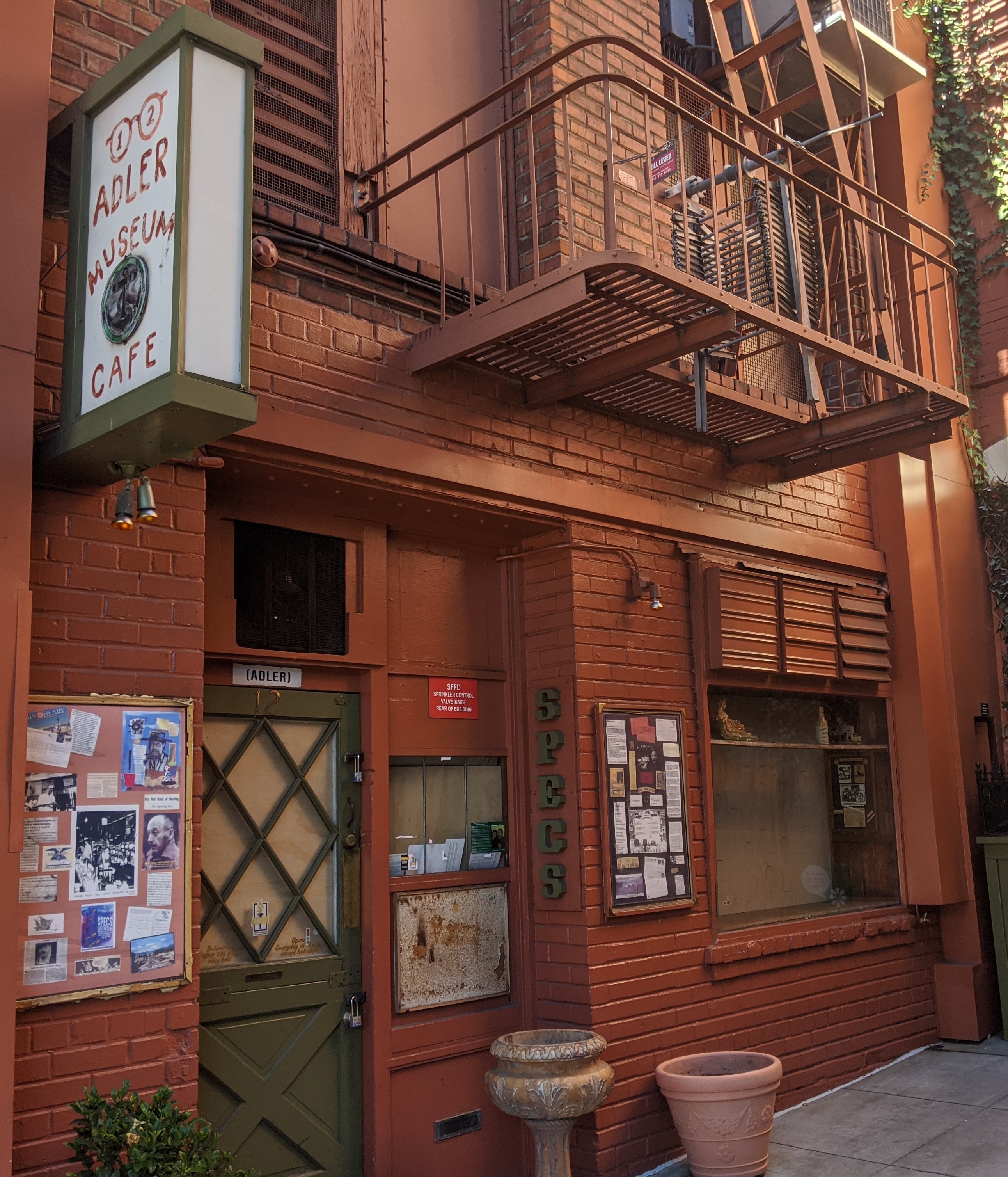
Specs' Twelve Adler Museum Cafe
The menu at Specs' offers exactly one food item: edam cheese, cut from a huge wheel, served with saltine crackers. That is it. If you want something else to eat, you go somewhere else. If you want a bar where Thelonious Monk once drank, where socialist poets hold Wednesday night meetings, where the bartenders are union members, and where half the regulars over the decades have had FBI files -- you stay right here, in this narrow room off a North Beach alley that used to be called Adler Place.
From Roxbury to the Waterfront
Richard "Specs" Simmons was born in 1928 in the Roxbury neighborhood of Boston, raised in a working-class Jewish family where his father and uncle worked sheet metal and occasionally ran book on the side. His left-wing politics made Boston feel small, so in 1948 he headed west. He swung a hammer in metalwork for 15 years -- earning his nickname "Specs" from construction coworkers who noticed his ever-present eyeglasses. By the late 1960s, he was tired of the physical labor and looking for a different kind of life. It is believed he opened the bar in 1968 with royalties from the Kingston Trio's chart-topping 1959 version of the "MTA" song, a connection that links one of America's most famous folk recordings to one of San Francisco's most storied dives.
The Alley's Many Lives
The address at 12 Adler Place -- now William Saroyan Place, an alley off Columbus Avenue -- had already seen its share of history before Specs arrived. In the early 1950s, it housed Tommy's Place, a lesbian bar. After that came Frank's, a nightclub owned by Frank Guidera that featured Middle Eastern music, jazz, and belly dancers. But by 1965, the North Beach nightlife landscape had shifted dramatically when San Francisco legalized topless dancing and figures like Carol Doda took the stage at the Condor Club. Simmons saw an opportunity in what the topless craze left behind. "By that time North Beach turned into this big topless thing," he explained. "There were only a few spots for locals to hang out. I was sick of swinging a hammer and I figured, maybe I'd find a joint."
Where Everyone Was Welcome
Specs' became a meeting ground for people who had nowhere else to mix: sailors from the nearby Port of San Francisco, poets workshopping verses, strippers from the club upstairs who used the bar's bathrooms via a connecting staircase, union organizers, neighborhood regulars, and the occasional musician of note. On Wednesday nights, the Revolutionary Poets Brigade -- a local group of radical and socialist poets -- held their meetings at the bar. The editor of the literary journal Left Curve was a Wednesday regular. Many customers, including Simmons himself, had accumulated FBI files through decades of left-wing political activity. The bar was a union shop from the start, with bartenders belonging to Local 2, the hospitality workers' union. Specs' could refuse service to anyone for any reason, and evidently did.
A Bar That Survives
When the COVID-19 pandemic forced Specs' to close along with countless other San Francisco bars, the possibility that it might not reopen felt real. A GoFundMe campaign helped cover rent, utilities, taxes, insurance, and union dues, and a PPP loan provided additional lifeline. The bar has survived because it never tried to be anything other than what it is -- a working-class establishment with cheap drinks, exactly one food option, and a clientele drawn from every corner of the city's bohemian, maritime, and radical traditions. Richard "Specs" Simmons died in 2016 at the age of 88, but the bar carries on under the stewardship of his family. The cheese wheel is still there. The union dues are still paid. The Wednesday poets still come.
From the Air
Located at 37.798N, 122.406W in San Francisco's North Beach district, on William Saroyan Place (formerly Adler Place), an alley off Columbus Avenue. Nearest airports: KSFO (11nm south), KOAK (10nm east). Best viewed at 1,500-2,500 ft AGL.