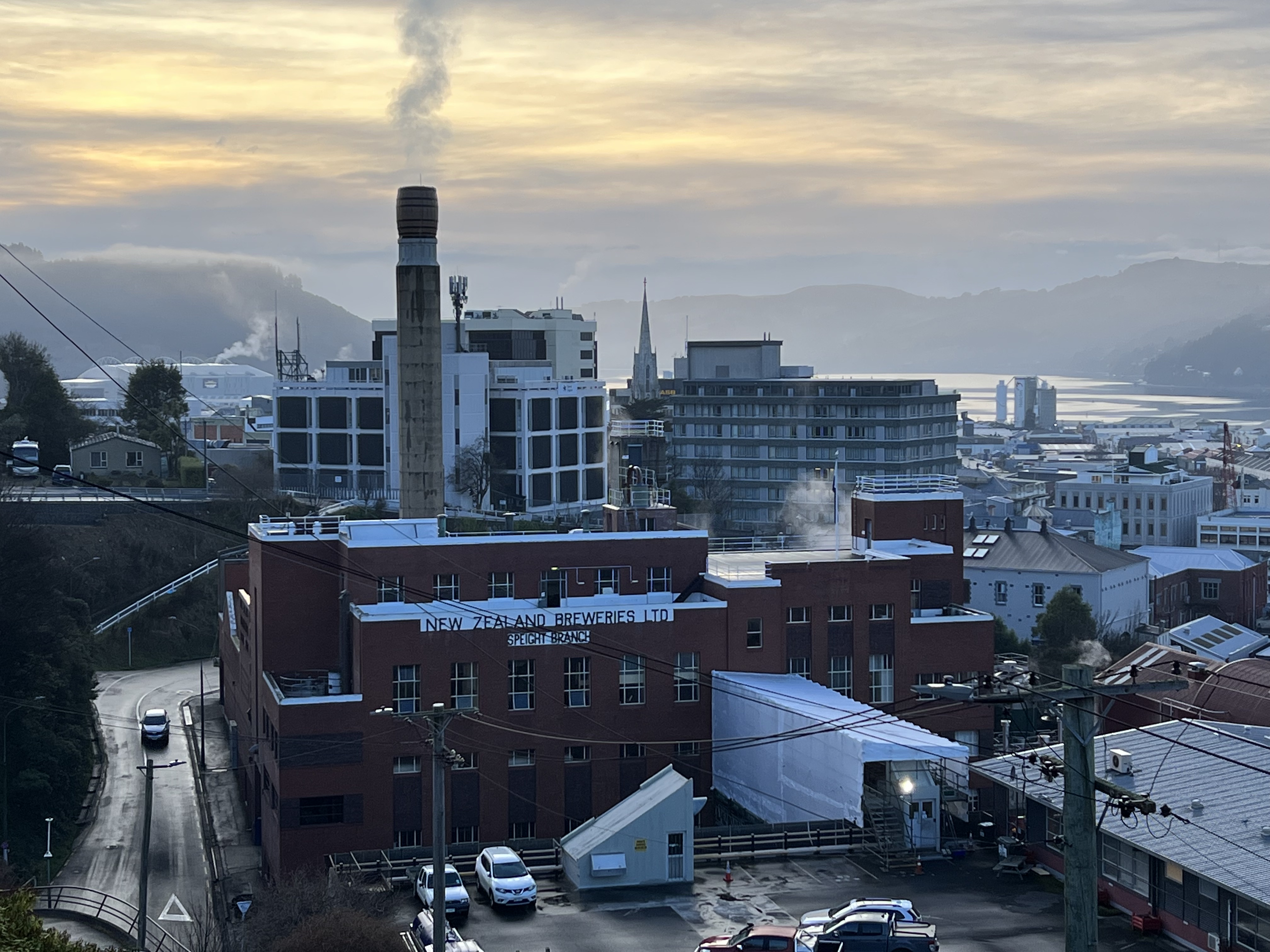
Speight's
On April Fool's Day 1998, the Otago Daily Times reported that Speight's beer would flow free of charge from the public tap outside the brewery. It was a joke, but only barely -- the tap is real. The company installed it over a natural spring deep beneath the Rattray Street site, and it dispenses fresh water around the clock, free to anyone who brings a bottle. It is a gesture that captures something essential about Speight's: a brewery that has been embedded in its city for so long that the boundary between commercial enterprise and civic institution has blurred completely.
Three Men from Wellpark
James Speight, Charles Greenslade, and William Dawson established the brewery on Rattray Street in Central Dunedin in 1876. All three had left their positions at Wellpark Brewery in Scotland -- known today as Tennent Caledonian -- to try their luck in New Zealand. Dunedin was then the country's wealthiest city, flush with Otago gold money and populated by thirsty Scots. The timing was right. By 1880, just four years after opening, Speight's had won a gold medal at the Melbourne International Exhibition, and the brewery adopted the name that stuck: Gold Medal Ale. By 1887, Speight's was the largest brewery in New Zealand, exporting beer to Australia and the Pacific Islands. The three eight-pointed stars that still appear on every Speight's label come from the provincial arms of Otago and from gold medals won at awards in three different countries in 1877.
Mergers, Missteps, and Survival
In 1923, Speight's merged with nine other breweries to form New Zealand Breweries. William Dawson, the last surviving founder, died that same year -- the end of one era and the beginning of another. The merged company tried to streamline its brands in 1960, rebranding Speight's as 'Lucky Beer.' The experiment lasted exactly two months. The backlash from Dunedin and the wider South Island was swift enough that the Speight's name was restored by October. It was a lesson in what happens when corporate rationality collides with regional identity. In 1977, Lion purchased New Zealand Breweries, and Speight's became part of a chain that is now owned by Japan's Kirin. Production expanded to Auckland in 2001, but the original Rattray Street brewery continues to operate, its brick buildings and tall chimney -- topped with a beer barrel -- still a landmark in central Dunedin.
The Building on the Corner
The Speight's brewery sits at the corner of Rattray and Maclaggan Streets, extending up the hill into City Rise. The oldest sections date to 1876, and the building has grown through several major renovations, most notably an expansion in 1938 designed by architect Harry Mandeno. The most recent work, completed between 2012 and 2014, provided earthquake strengthening -- a practical reminder that even beloved landmarks must reckon with geology. Regular guided tours take visitors through the brewing process and the building's history. The tours end, as they should, with a tasting. Outside, the spring-fed tap continues to run. It is not beer, but it is the same water that has been feeding the brewery since its founding -- drawn from deep underground, cold and clean.
Pride of the South
Speight's marketing leans hard on its southern identity, and the 'Southern Man' advertising campaign has been one of New Zealand's most recognizable for decades. The slogan 'Pride of the South' is not just branding; it reflects a genuine regional attachment. Speight's sponsors the Otago Highlanders, the Otago Rugby Football Union, and the Southland Rugby Football Union, binding the brewery to the sport that matters most in this part of the country. One popular advertisement featured the Cardrona Hotel, a remote Central Otago pub so iconic that Speight's built a replica in Auckland's Mt Eden suburb. As for the beer itself, Gold Medal Ale is marketed as an ale but is technically a New Zealand draught-style lager, brewed with lager yeast. The distinction matters to brewers. To the people drinking it at the rugby, it matters considerably less.
From the Air
Located at 45.88°S, 170.50°E in central Dunedin, at the corner of Rattray and Maclaggan Streets. The brewery complex is identifiable by its brick buildings and tall chimney topped with a distinctive beer barrel. It sits just west of The Exchange, Dunedin's historic commercial district. The Dunedin Chinese Garden and Railway Station are nearby landmarks to the east. Nearest airport: NZDN (Dunedin International), approximately 25 km to the southwest.