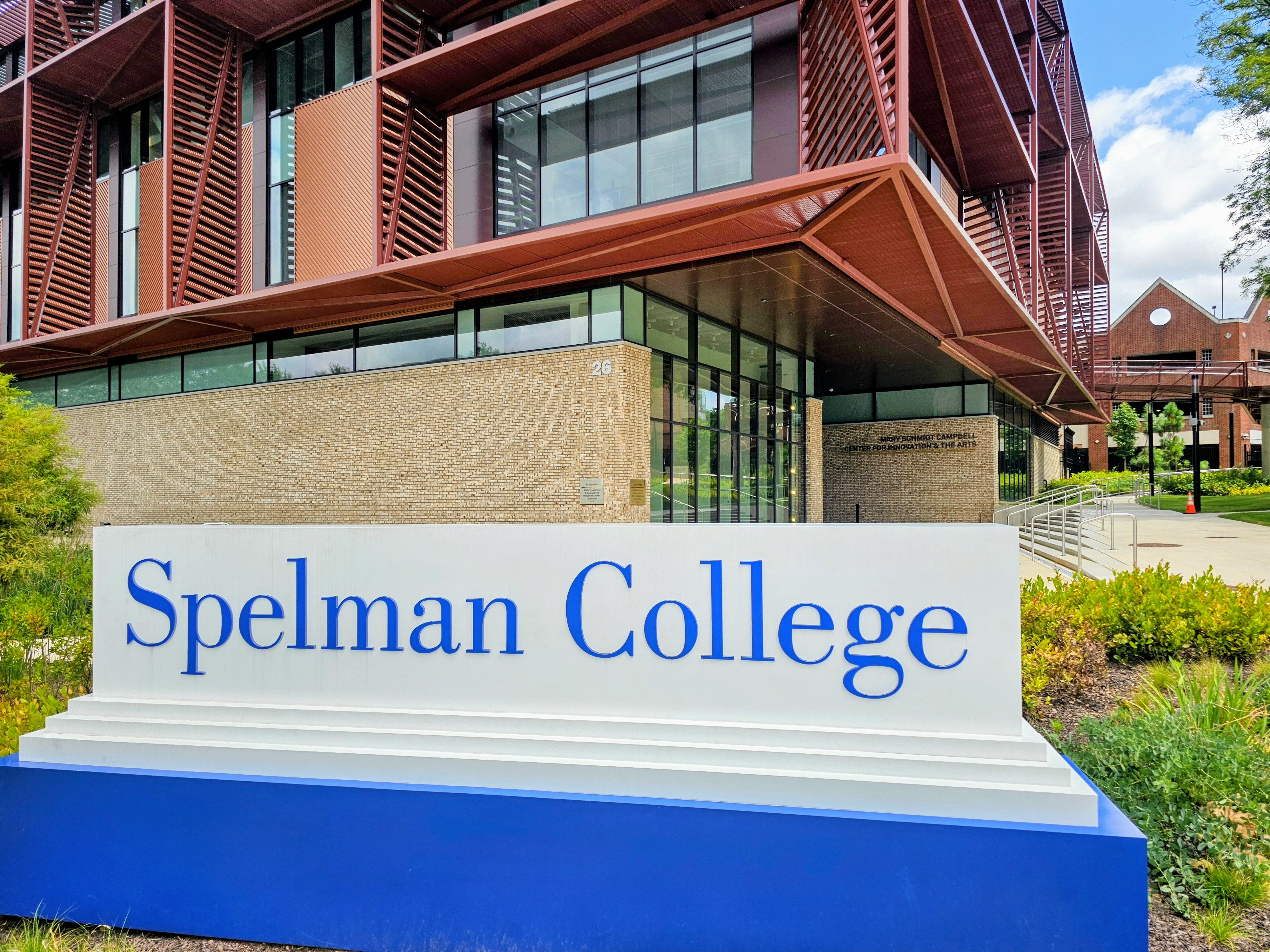
Spelman College
Eleven women and one hundred dollars. That is what Harriet E. Giles and Sophia B. Packard had when they opened the Atlanta Baptist Female Seminary on April 11, 1881, in the basement of Friendship Baptist Church. The two teachers from Massachusetts had traveled south with a single purpose: to build a school for Black freedwomen in the Reconstruction-era South. From that modest start, Spelman College grew into the oldest private historically Black liberal arts college for women in the United States, ranked first among HBCUs by U.S. News & World Report and producing an extraordinary line of leaders -- from Pulitzer Prize winner Alice Walker to politician Stacey Abrams to Children's Defense Fund founder Marian Wright Edelman.
From Basement to Rockefeller
Giles and Packard had met years earlier at the New Salem Academy in Massachusetts, where Giles was a student and Packard the preceptress, forging a lifelong partnership. In Atlanta, they found an ally in Frank Quarles, pastor of Friendship Baptist Church, who gave them his basement. The First Baptist Church of Medford, Massachusetts, contributed the initial $100. Growth came fast -- by 1882, the two women returned north to raise more money and were introduced to John D. Rockefeller at a Baptist church conference in Cleveland. His family's support would prove transformative. In 1927, the school officially became Spelman College, and that same year Sisters Chapel was dedicated, named for its primary benefactors: Laura Spelman Rockefeller and Lucy Maria Spelman, the wife and sister-in-law of the industrialist. The chapel remains one of the most important buildings on campus.
The Long Walk Toward Justice
Spelman's relationship with the civil rights movement was complex. In 1953, Albert E. Manley became the college's first Black and first male president. Under his leadership, the school expanded its study abroad programs and built new facilities. But when the sit-in movement swept southern campuses, Spelman's administration initially resisted. History professor Howard Zinn was dismissed from the college in 1963 for supporting students who fought segregation. Marian Wright Edelman, who attended during that era, recalled Spelman's reputation as "a tea-pouring, very strict school designed to turn Black girls into refined ladies and teachers." The tension between decorum and activism defined a generation. Spelman students who joined the movement helped bend the college's trajectory toward the engaged institution it became -- one that today ranks first among baccalaureate-origin institutions of African-American women who earn doctoral degrees in science, engineering, and mathematics.
Sisterhood in White
Some of Spelman's most distinctive traditions are also its quietest. Since the early 1900s, Spelmanites have worn "respectable and conservative" white attire to formal campus events. The custom began when white dresses were standard for women at formal occasions, but at Spelman it evolved into something deeper -- a visual expression of shared identity. Graduating seniors still wear white underneath their gowns for Class Day and Commencement. In 2009, the Student Government Association established My Sister's Closet, where alumnae and current students donate white attire so every student can participate. New students experience Spelman's culture from their first week through a mandatory six-day orientation led by Peer Assistant Leaders, or PALs, during which they remain on the gated 39-acre campus near downtown Atlanta, absorbing the history, mission, and sisterhood that define the institution.
A Campus of Firsts
Spelman's leadership has mirrored its mission of firsts. In 1987, Johnnetta Betsch Cole became the first Black female president of the college, launching its most successful capital campaign: $113.8 million raised between 1986 and 1996. In 1997, Audrey Forbes Manley became the first alumna to serve as president, securing a Phi Beta Kappa chapter -- a marker of academic prestige. In 2013, the college made a nationally discussed decision to drop NCAA Division III varsity athletics entirely, redirecting the budget into wellness programs available to all students. In 2017, Spelman voted to admit transgender women. The college has the highest graduation rate among HBCUs at 76 percent, with a 9:1 student-to-faculty ratio, and approximately two-thirds of its graduates go on to earn postgraduate degrees.
Hundred-Million-Dollar Confidence
The scale of investment in Spelman has accelerated dramatically. In 2018, trustee Ronda Stryker gave $30 million for a new campus building. In 2020, Reed Hastings and Patty Quillin donated $40 million for scholarships, and philanthropist MacKenzie Scott followed with a large undisclosed gift. Then in January 2024, Stryker and her husband William Johnston gave $100 million -- the largest single donation in Spelman's history and one of the largest ever to an HBCU. Seventy-five million went to endowed scholarships; the remaining $25 million funded public policy programs, student housing improvements, and strategic initiatives. From $100 in a church basement to a $100 million check, the arc is staggering -- but it tracks perfectly with what Giles and Packard set in motion 143 years ago.
From the Air
Located at 33.746N, 84.411W in Atlanta's West End, Spelman College's gated 39-acre campus sits adjacent to Morehouse College and Clark Atlanta University within the Atlanta University Center. Sisters Chapel is a prominent campus landmark. Nearby airports include Hartsfield-Jackson Atlanta International Airport (KATL) approximately 7 miles south, Fulton County Airport/Charlie Brown Field (KFTY) 8 miles northwest, and DeKalb-Peachtree Airport (KPDK) 12 miles northeast. Best viewed at 2,000-4,000 feet AGL alongside the broader AUC campus cluster southwest of the downtown Atlanta skyline.