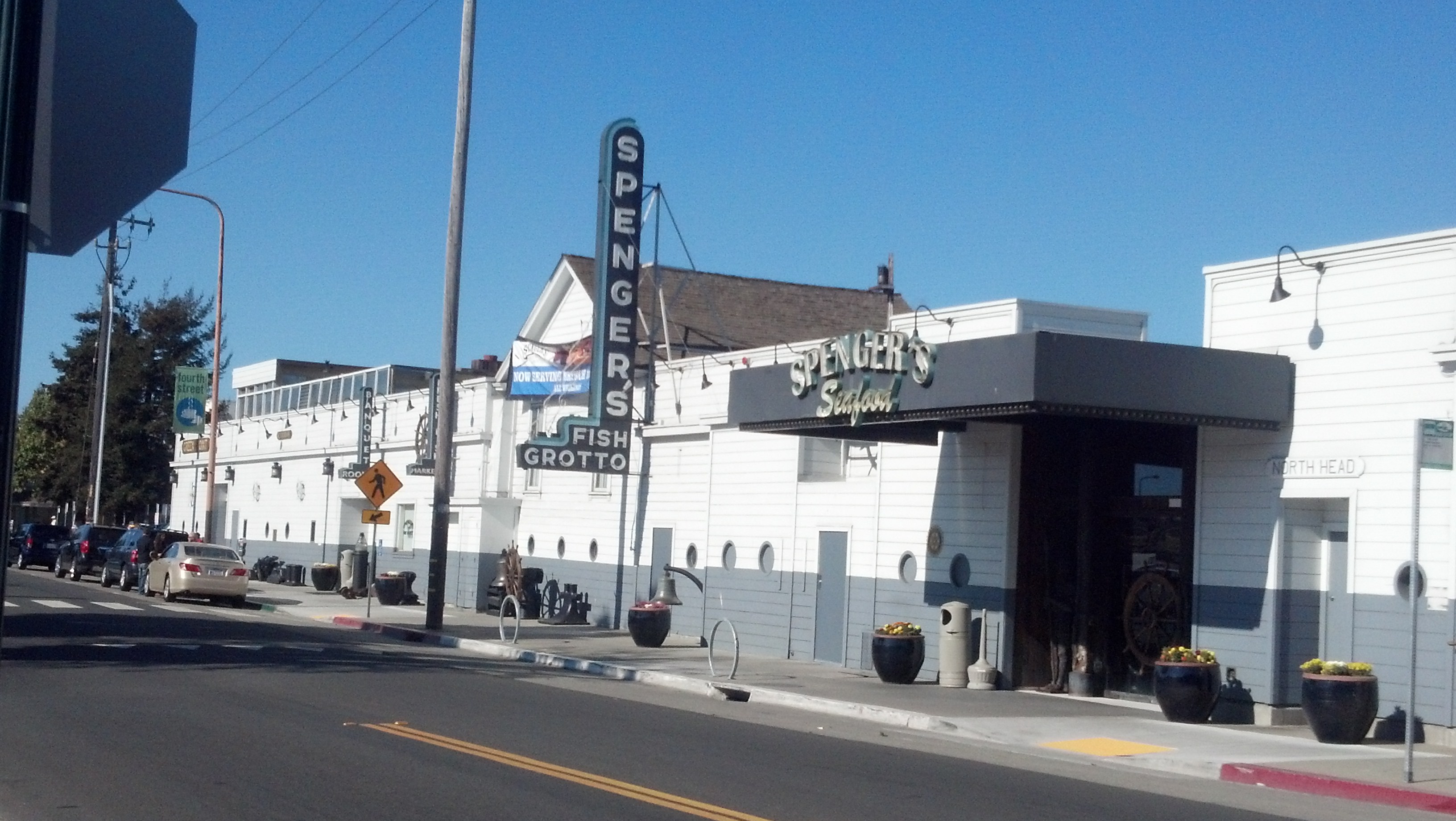
Spenger's Fresh Fish Grotto
Somewhere inside Spenger's Fresh Fish Grotto, among the ship wheels and mounted marlins and nets draped from the ceiling, there sat an eight-foot-tall Japanese enamel vase from the 1893 World's Columbian Exposition. Nobody quite knew how it got there. That was the nature of Spenger's - a Berkeley seafood restaurant that spent 128 years accumulating food, stories, and objects until it became less a place to eat and more a cabinet of maritime curiosities that happened to serve excellent fish. When the doors closed abruptly in October 2018, the auction that followed revealed just how strange and wonderful the collection had become.
A Fisherman's Clam Stand
Johann Spenger started small. A hook-and-line fisherman who worked the waters of Lake Merritt in Oakland, he opened a clam stand in 1890 at what would become 1919 Fourth Street in Berkeley. The menu was elemental: clam chowder, baked beans, fish dinners, and ten-cent beer. It was working-class food for a working waterfront, and it found its audience immediately. By the 1930s, Spenger's had grown into a full-service restaurant occupying the ground floor of its building. As the decades passed, dining rooms and bars were added piece by piece, the restaurant expanding like a ship that keeps getting new compartments bolted on. The Spenger family built the walls and floors from salvaged timber - reportedly from two vessels, the SS Encinal and the SS Lurline - giving the interior the feel of a place that had been at sea and come ashore to settle down.
Where the Walls Told Stories
What made Spenger's unforgettable was not only the food but the sheer density of things on the walls. The Spenger family were obsessive collectors of maritime memorabilia, and over the decades the restaurant filled with anchors, rigging, paintings, portholes, rudders, steering wheels, hawsers, crab pots, nets, and historical photographs. Mounted fish stared down at diners from every available surface. The effect was immersive and slightly overwhelming - a landlocked vessel crewed by ghosts of the sea. Celebrities dined there alongside Berkeley locals, and the menu offered dishes with names that promised adventure: the Captain's Plate, the Shrimp Scatter, Hangtown fry with its classic combination of eggs, oysters, and bacon. Salmon arrived with egg sauce or baked with tomato sauce, and a shrimp omelet could be had by those who wanted the ocean folded into their breakfast.
Diamonds, Queens, and Questionable Provenance
Among the artifacts that surfaced after Spenger's closed, none carried a more tantalizing story than the Star of Denmark. The diamond was allegedly discovered in 1885 in the Kimberley mines of South Africa and said to have been a gift from Alexandra of Denmark to Queen Kapiolani of Hawaii following the Golden Jubilee of Queen Victoria in 1887. How it ended up in a seafood restaurant in Berkeley is a question with multiple answers, depending on who is telling the story. Historians have questioned the authenticity of the tale, and the diamond's provenance remains a matter of debate rather than settled fact. But that uncertainty is itself part of the Spenger's mystique - a place where objects arrived through channels no one fully documented and stayed because no one could bear to move them.
The Last Supper on Fourth Street
After 128 years of continuous operation, Spenger's closed its doors abruptly in October 2018. The closure stunned a community that had assumed the restaurant was as permanent as the Berkeley Hills. What followed was both an ending and a revelation. In 2019, the contents of the restaurant went up for auction, and the full scope of the Spenger family's collecting habits became public. That eight-foot Meiji-era vase, identified as a piece from the 1893 Chicago World's Fair, emerged from the clutter of more than a century. Roughly one hundred items from the family's maritime collection crossed the auction block - each one a fragment of a world that had existed, intact and unexamined, behind the restaurant's doors. Bidders carried away pieces of a place that could never be reassembled.
A Landmark Without a Restaurant
The building at 1919 Fourth Street still stands. It was designated a Berkeley Landmark on November 2, 1998, and a historic plaque installed by the Berkeley Historical Plaque Project in 2004 marks the entrance. The site has since been redeveloped as Fourth Street Makers Row, a commercial project that occupies the bones of the old restaurant. But buildings remember their histories in ways that new tenants cannot entirely overwrite. For 128 years, generations of Bay Area families marked occasions at Spenger's - graduations, anniversaries, Sunday dinners where grandparents told stories over platters of fish. The clam stand that Johann Spenger opened in 1890 became one of the longest-running restaurants in California, and its closure left a hole shaped like a ship in the neighborhood's sense of itself.
From the Air
Spenger's Fresh Fish Grotto sits at 37.868N, 122.300W on Fourth Street in Berkeley, near the waterfront. From the air, look for the Fourth Street commercial district west of the Interstate 80 corridor, between the freeway and the Berkeley Marina. The building is not individually distinguishable from altitude, but the Fourth Street shopping area forms a recognizable cluster. Nearest airports: Oakland International (KOAK) approximately 8 nm south, and Buchanan Field (KCCR) approximately 16 nm northeast. The site is near the eastern shore of San Francisco Bay, with clear views in typical weather conditions.