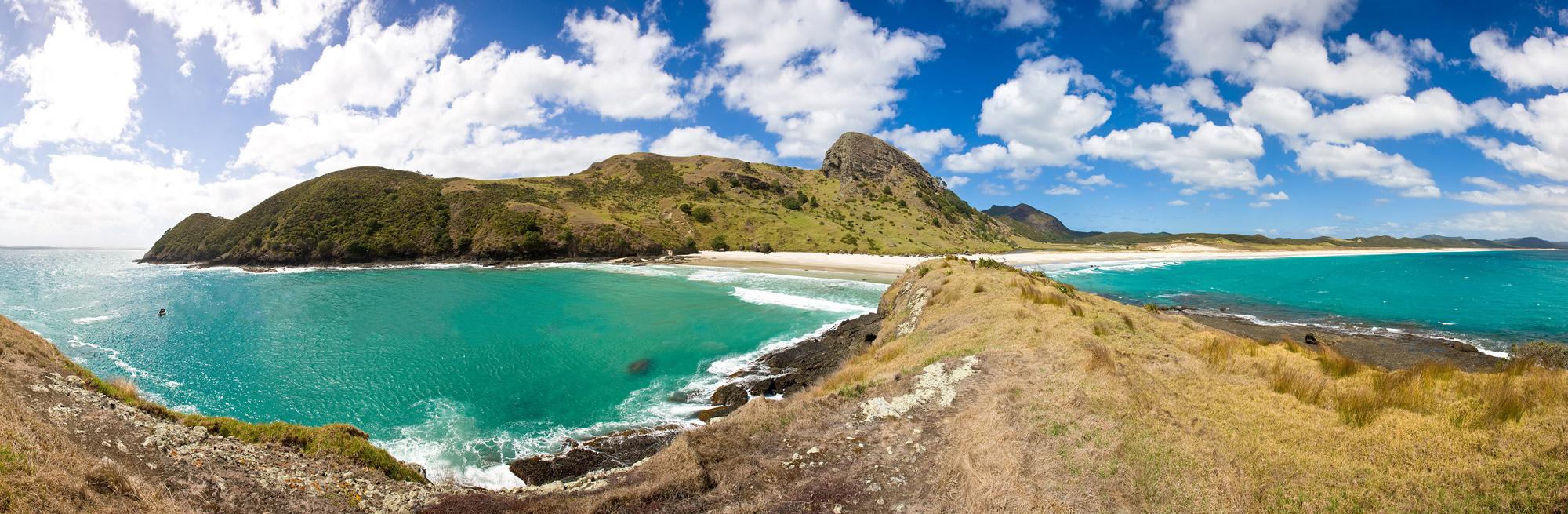
Piwhane / Spirits Bay: Where the Dead Begin Their Journey Home
"I can shelter from the wind. But I cannot shelter from the longing for my daughter." The words belong to Tohe, a chief of the Ngati Kahu people and one of Muriwhenua's most important ancestors, spoken before he set off on a journey south from which he would never return. His farewell gave this bay one of its Maori names: Kapowairua, meaning "to catch the spirit." At the northern tip of New Zealand's Aupouri Peninsula, where the land narrows to almost nothing before yielding to the sea, Piwhane / Spirits Bay holds a role in Maori cosmology that few physical places anywhere in the world can match. This is the departure lounge for the dead.
The Last Doorway
According to Maori tradition, the spirits of the dead travel north along the length of New Zealand to reach this remote stretch of coast. Above the bay stands an ancient pohutukawa tree, gnarled and wind-shaped, where the spirits gather before departing this world for their ancestral home. The tree marks the threshold between the living and whatever comes after. Nearby Cape Reinga / Te Rerenga Wairua, where the Tasman Sea and Pacific Ocean collide in a visible turbulence of currents, is the point of final departure. The Ngati Kuri, the iwi of this area, are the guardians of this sacred geography. The bay's official dual name, Piwhane / Spirits Bay, was formally adopted in 2015 as part of Treaty of Waitangi settlements with Ngati Kuri, Te Aupouri, Te Rarawa, and NgaiTakoto.
Tohe's Long Walk South
Tohe left these northern shores and walked south along the western coast, naming more than one hundred places as he went. Each name was an act of claim and memory, fixing the landscape into story. He traveled as far as Whangariki near Maunganui Bluff, where he died. The journey was both physical and mythological, a naming ceremony stretching hundreds of kilometers down the coast. His farewell words became the origin of the name Kapowairua and embedded this bay into the narrative architecture of Muriwhenua identity. The bay carries both names now, Piwhane and Kapowairua, each pointing to a different aspect of the same sacred place: one to the landscape itself, the other to the human grief that made it meaningful.
Where Life Persists
The living world at Spirits Bay is insistently present. Paradise ducks graze the grasslands behind the beach. New Zealand dotterels and oystercatchers work the tidal flats, while Caspian terns patrol the shallows. The bay curves between Cape Reinga to the west and Ngataea / Hooper Point to the east, with an 8.5-kilometer walking track running its length. The remoteness is genuine; this is one of the least accessible stretches of the New Zealand coast by road, and the isolation preserves something rare. Mosquitoes, it should be noted, are numerous enough that the Department of Conservation considers them worth warning about. The sacred and the mundane share the same sand.
The Stranding of 2010
In September 2010, more than eighty pilot whales beached themselves over five kilometers of Spirits Bay. About forty died, some from drowning in the surf, others euthanized because rocks had torn their bodies beyond recovery. The surviving whales could not be refloated at Spirits Bay itself, where weather and sea conditions made rescue impossible, so volunteers and conservation workers transported them overland to Rarawa Beach. It was considered the largest whale transport ever attempted. Most of the relocated whales survived and returned to the sea. The stranding came just a month after fifty-eight pilot whales had beached at Karikari Beach further south, a grim clustering of events that researchers could not fully explain.
A View From Above
From the air, the Aupouri Peninsula reads as a long finger of land pointing north into open ocean, thinning until it becomes little more than a ridgeline between two seas. Spirits Bay sits near the very tip, a crescent of pale sand backed by low scrub and wetland, facing northeast into the Pacific. The pohutukawa tree above the bay is invisible at altitude, but the landscape it anchors is unmistakable: the convergence point of currents visible as shifting color bands in the water off Cape Reinga, the bay's isolation emphasized by the absence of roads or settlement. It is a place that looks, even from cruising altitude, like the end of something.
From the Air
Located at 34.44°S, 172.82°E at the northern tip of New Zealand's Aupouri Peninsula. From altitude, the peninsula appears as a narrow strip of land tapering northward between the Tasman Sea and Pacific Ocean. Spirits Bay is a crescent-shaped bay on the northeast side near Cape Reinga. Nearest airport is Kaitaia Aerodrome (NZKT), approximately 100 km to the south. The convergence of the Tasman Sea and Pacific Ocean is often visible as distinct color bands and turbulence off Cape Reinga. Best viewed at 3,000-5,000 feet for the full peninsula context.