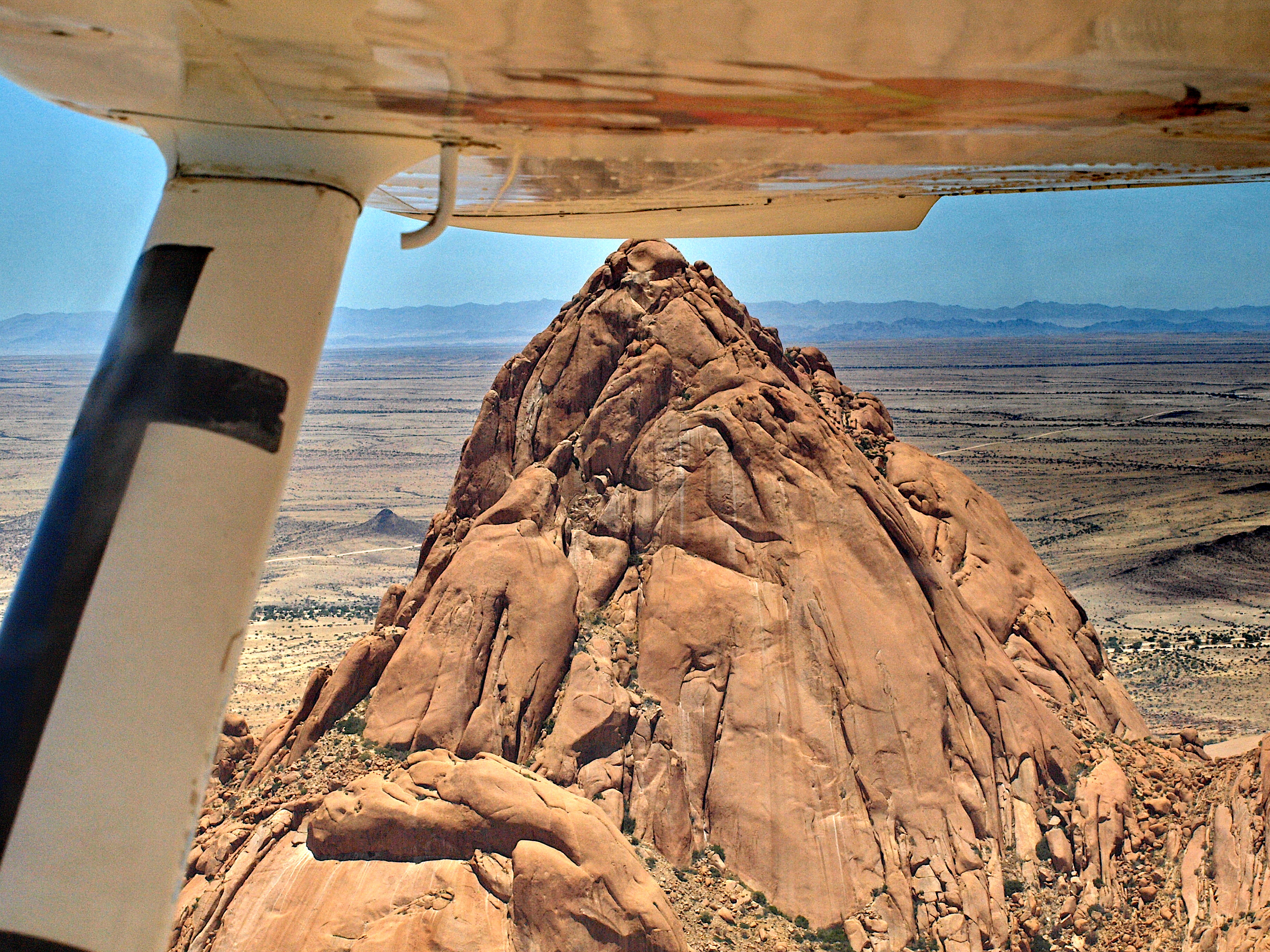
Spitzkoppe
Fifty kilometres from the nearest town, on a gravel road that crosses empty plains, granite peaks appear on the horizon like something geological that forgot to erode. The Spitzkoppe -- a cluster of inselbergs in Namibia's Erongo region -- rises so abruptly from the surrounding flatland that the effect is less mountain range than architecture, as if someone dropped cathedrals of stone into the desert and walked away. The Groot Spitzkoppe reaches 1,728 metres above sea level, its pointed summit earning the nickname 'the Matterhorn of Namibia' for a resemblance that is more about attitude than altitude. The Klein Spitzkoppe, at 1,584 metres, and the nearby Pontok Mountains complete the group. They have been landmarks for travellers crossing this landscape for thousands of years -- and the people who sheltered in their overhangs left proof.
Painted Stone, Damaged but Enduring
In the sheltered overhangs and shallow caves of the Spitzkoppe, the San people painted scenes onto rock surfaces using pigments made from ochre, charcoal, and animal fat. These images -- of animals, hunts, rituals -- survived millennia of desert weather only to suffer vandalism in recent decades. The damage is real and visible, but what remains is still worth the walk. Some of the painted sites are accessible only with a local guide, and hiring one is both required and worthwhile. The guides know which overhangs hold the best-preserved panels, and they carry knowledge about the paintings that no signpost could convey. For the San, these rocks were not canvases in any Western sense. They were thresholds between the physical world and the spirit world, and the act of painting was itself a form of crossing.
Island Mountains in a Sea of Gravel
The word 'inselberg' is German for 'island mountain,' and at Spitzkoppe the term earns its poetry. The granite formations are remnants of a much larger geological structure, exposed over roughly 120 million years as softer surrounding rock weathered away. What remains is hard Jurassic granite in colours that shift through the day -- pale gold at dawn, deep rust at midday, violet at dusk. The rock surfaces are smooth in places, rough and fractured in others, and the formations create natural arches, shelters, and balancing-rock sculptures that look engineered but are entirely the work of wind and time. Rock hyraxes -- small, round mammals that are, improbably, the closest living relatives of elephants -- scramble across the sun-warmed surfaces, their barking calls echoing off the stone.
Camping Among Giants
A women's cooperative from the local Damara community manages the Spitzkoppe area, maintaining campsites scattered among the rock formations. The setup is deliberately simple: no running water at the sites, only some with pit toilets, and nothing between your tent and the granite walls except open sky. What the campsites lack in amenities they compensate for with settings that no resort could replicate -- pitching a tent inside a natural rock amphitheatre, cooking under a stone overhang that shelters you from wind while framing a view of the plains below. Traditional Damara huts are available for rent as well. A small gift shop at the entrance supports the cooperative. Visitor numbers remain low despite the scenery, which means you are likely to have entire formations to yourself, the silence broken only by hyraxes and wind.
Getting There and Staying Alert
From the B2 highway, a series of district roads -- D1918 to D3716 -- lead to Spitzkoppe across roughly 50 kilometres of gravel. The nearest town is Usakos; the alternative base is Uis, about 90 kilometres away. Most campsites are reachable in an ordinary car, though the roads require patience and low speeds. The isolation that makes Spitzkoppe beautiful also introduces risk. Tourists have been targeted on the approach roads by people staging fake breakdowns or scattering tyre spikes. Namibians themselves do not expect travellers to stop for strangers with car trouble in this area -- for precisely this reason. The advice is practical rather than paranoid: keep driving, bring enough water to last well beyond your planned stay, and carry a satellite phone if venturing onto the 4x4 tracks that thread through the surrounding desert. The Spitzkoppe rewards preparation with an experience that feels genuinely remote in a world where that quality is increasingly rare.
From the Air
Located at 21.83S, 15.20E in the Erongo region of central Namibia. From altitude, the Spitzkoppe inselbergs are unmistakable -- sharp granite peaks rising abruptly from flat desert plains, casting long shadows in low-angle light. The Groot Spitzkoppe (1,728 m) is the tallest peak. Nearest town is Usakos, approximately 50 km to the southeast along gravel roads. Walvis Bay Airport (FYWB) is the nearest airport with scheduled service, roughly 200 km southwest. The B2 Trans-Kalahari Highway is visible as the main paved corridor running east-west through the region. The surrounding terrain is flat gravel plains with no significant obstacles.