Splendid China (Florida)
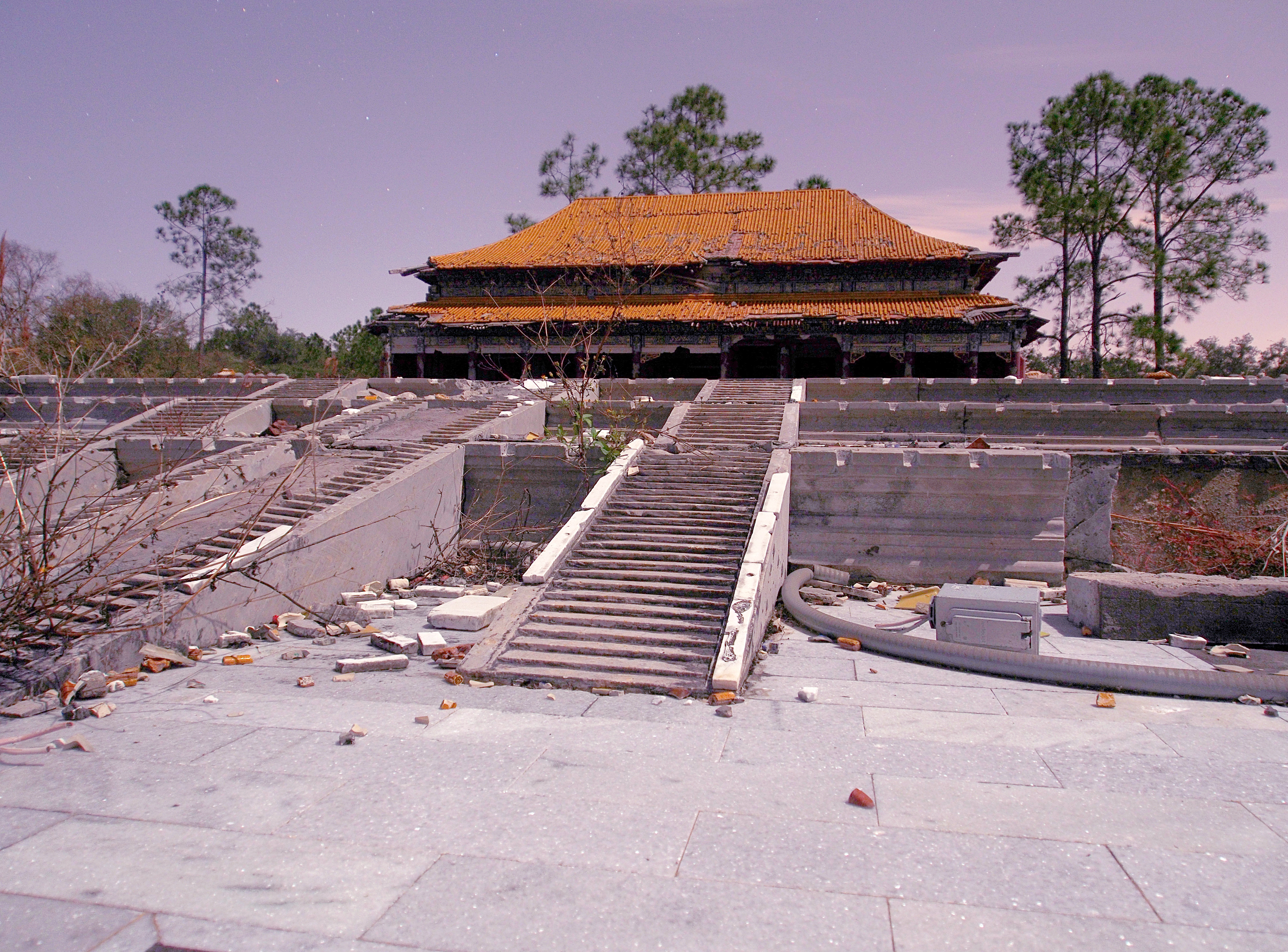
The Great Wall of China once stretched half a mile through central Florida. Built from seven million tiny bricks at one-tenth scale, the replica was the centerpiece of Splendid China, a $100 million theme park that opened near Four Corners, Florida, in 1993 and became one of the strangest chapters in the Orlando attraction wars. Owned and operated by China Travel Service, a state-owned corporation of the Chinese government, the park featured more than 60 handcrafted miniature replicas of Chinese landmarks. It attracted protests from Tibetan and Uyghur activists on its opening day, bled $9 million a year by the end of the decade, closed on December 31, 2003, and spent the next ten years decaying in the subtropical humidity until bulldozers erased it in 2013. Today a Jimmy Buffett-themed Margaritaville resort sits on the land. The transformation from miniature Potala Palace to swim-up bar is almost too on the nose.
A Taiwanese Educator's Gamble
The idea began with Josephine Chen, a former educator from Taiwan who toured the original Splendid China Miniature Scenic Spot in Shenzhen, China, in 1988. That park, operated by China Travel Service, sat close to Hong Kong and drew 3.5 million visitors in its first year, recouping its entire $100 million investment in twelve months. Chen saw potential in bringing the concept to Florida, the world capital of theme parks. She negotiated an agreement with China Travel Service, which was controlled by the Overseas Chinese Affairs Office under the China National Tourism Administration. Under the deal, Chen supplied the land and management services while CTS constructed the buildings and supplied non-management personnel. Groundbreaking took place on December 19, 1989. Chinese artisans crafted each miniature by hand to maintain authenticity. The replica of the Leshan Giant Buddha stood four stories tall. The initial artists hired to perform in the park were Chinese nationals, but after several attempted to seek political asylum in the United States, they were replaced by local performers.
Protests at the Gate
Splendid China was controversial from its first day. A group called Citizens Against Communist Chinese Propaganda staged demonstrations at the park, objecting to what they saw as Chinese government propaganda embedded in exhibits depicting Mongolia, Tibet, and Eastern Turkestan. The protests were persistent and organized. In November 1995, the Pinellas County school board voted to ban student trips to the park. In March 1996, five college students sat down and physically closed the front gate while a crowd of demonstrators watched. The following month, the Florida Teaching Professionals-NEA State Conference passed a resolution overwhelmingly banning personal or school trips to the park by its members. In October 1997, Takster Rinpoche, brother of the 14th Dalai Lama, attended the 20th demonstration at the park to commemorate the 48th anniversary of the Chinese takeover of Eastern Turkestan. By December 1999, activists had staged 32 demonstrations at the main gate. The Chinese government had bought out the American partners in December 1993, making Splendid China entirely state-owned and deepening the tensions that would shadow the park for its entire existence.
Nine Million Dollars a Year
The financial picture was bleak from early on. In May 1996, the Orlando Sentinel reported a management shakeup that replaced the park's president, general manager, and senior vice president for entertainment. By May 1999, the Far East Economic Review confirmed what locals already suspected: Florida Splendid China was hemorrhaging $9 million annually. In a market dominated by Disney, Universal, and SeaWorld, a quiet park of miniature replicas could not compete for the attention or dollars of Central Florida tourists who had come for roller coasters and character meet-and-greets. In May 2000, park president Sunny Yang confirmed the property was about to be sold. By November, Yang had been sent back to mainland China amid allegations of financial mismanagement. The gates closed for good on December 31, 2003, a decade after opening.
From Forbidden City to Margaritaville
Abandonment was worse than closure. Thieves and vandals descended on the empty park, carrying off hundreds of items ranging from small miniatures to portions of life-size statues. The perpetrators were never caught. The property cycled through several owners and sat on the market at an asking price of $30 million in July 2009. On May 9, 2013, demolition crews finally began tearing down what remained. By March 2016, every trace of the park had vanished beneath the construction of a Margaritaville Resort, complete with resort homes, condos, and a Jimmy Buffett-themed setting. The former park occupies a parcel along the southern and eastern property of the resort, bordered by Fins Up Circle, Formosa Gardens Boulevard, and Funie Steed Road. Somewhere beneath the pool decks and tiki bars, the foundations of a half-mile Great Wall replica and a four-story Buddha lie buried in Florida sand, monuments to an attraction that never found its audience.
From the Air
Located at 28.3342N, 81.6086W in Four Corners, Florida, approximately 5nm southwest of the Walt Disney World Resort complex. The former Splendid China site is now occupied by Margaritaville Resort Orlando. The area falls under the Walt Disney World permanent FAA Temporary Flight Restriction zone. Nearest airports include Orlando Executive (KORL) approximately 18nm east and Orlando International (KMCO) roughly 22nm southeast. The flat terrain of Central Florida offers no distinguishing visual landmarks at the former park site.