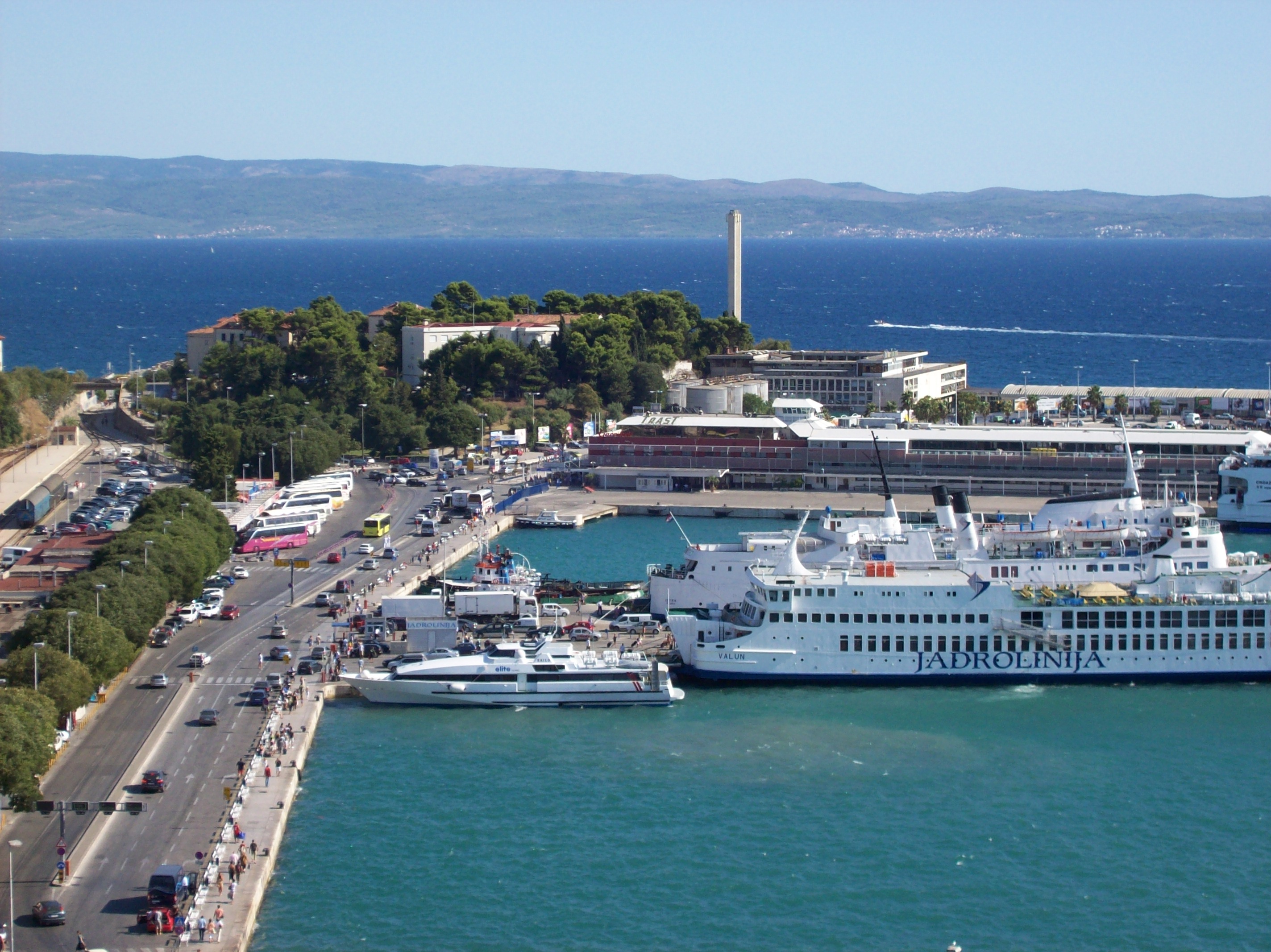
Split
Most Mediterranean cities were built over Roman ruins. Split was built inside a Roman building. In 305 CE, Emperor Diocletian constructed a massive palace on this stretch of Adriatic coast for his retirement, and the city grew up within its walls. His mausoleum became the cathedral. The palace grid dictated the streets. Today Split holds 180,000 people in the city proper and 350,000 in the metropolitan area, making it Croatia's second city and the ferry hub connecting the mainland to the islands dotting the Dalmatian coast. Walk through the palace quarter and you will find not a museum but a living neighborhood, its ancient stones housing apartments, restaurants, and seventeen centuries of accumulated life.
Diocletian's Palace
Diocletian's Palace covers 30,000 square meters, its walls stretching 170 to 200 meters on each side. Such scale tells you what an emperor's retirement required. In 305 CE, Diocletian became the first Roman emperor to voluntarily give up power. He withdrew here and grew cabbages until he died. Centuries later, when Slavic raiders destroyed nearby Salona in the 7th century, refugees flooded into the palace's protective walls and began transforming an imperial residence into a medieval city.
Today the palace is not a preserved ruin. People live in it. Apartments fill former imperial chambers. Restaurants occupy vaulted basements, and shops line the underground passages. Elsewhere, archaeology would forbid this kind of adaptation, but Split chose habitation over preservation. The Peristyle, where Diocletian once received visitors, now hosts tourists and evening concerts. What makes the palace remarkable is not how well it has been protected but how thoroughly it has been used.
The Riva
Split's waterfront promenade stretches along the harbor, palm-lined and open to the sea beyond. This is where the city displays itself. Cafes fill with Spalatini -- as residents call themselves -- conducting the social rituals of a Mediterranean evening. Ferries serving the islands dock along its length, and summer yachts crowd the marina. No one owns the Riva; it remains the democratic space where Split's public life happens, resistant to privatization by wealth or exclusion by status.
From the Riva you can take in everything Split offers at once. The palace walls rise behind you. The harbor spreads before you. Islands shimmer on the horizon. At sunset, golden light catches the palace's southern facade while the evening promenade fills the walkway with locals and tourists alike. It functions as the city's living room, the stage on which Split performs its daily life.
The Cathedral
Split's Cathedral of Saint Domnius started as something deeply ironic: the mausoleum of Diocletian, an emperor who persecuted Christians. History has a taste for such reversals. His octagonal burial chamber was consecrated as a cathedral, and now it holds the relics of martyrs created by the very persecutions he ordered. A Romanesque portal came in the 12th century, along with the bell tower rising beside the building. Later still, a Renaissance choir screen was added, layering period upon period over the Roman foundation.
Step inside and the space feels cramped by modern standards. Diocletian designed it for a sarcophagus, not a congregation. Pulpit, choir stalls, and altars crowd together in a density that architecturally pure buildings never achieve. Every surface competes for attention. This is Christianity claiming Roman imperial space -- a theological statement made not in words but in stone and repurposed geometry.
The Islands
From Split's harbor, ferries and catamarans depart daily for Hvar, Brac, Vis, and dozens of other islands. Croatia's Adriatic coast holds over a thousand islands, offering beach escapes and isolated retreats beyond what any urban center can provide. Visitors who base themselves in Split can day-trip to nearby islands or push onward to them as final destinations.
This gateway function shapes everything about Split's tourism. More visitors pass through than stay. Hotels, restaurants, and services have evolved largely to serve transit. Yet Split deserves more than a one-night layover. Its palace is genuinely unique. Its nightlife rivals anything on the islands. And it pulses with an urban energy no island can replicate. Split is a destination in its own right, even if the gateway role often overshadows that truth.
The Game of Thrones Connection
When Game of Thrones needed Meereen, it came to Split. The vaulted basement of Diocletian's Palace became the dungeon where Daenerys's dragons were chained. Above the city, the fortress of Klis served as Meereen's exterior. Split's ancient walls appeared as backdrop in scene after scene. Since the show's global success, the city's marketing has been transformed, even if its character has not.
Game of Thrones tours now operate daily, guiding fans through filming locations where fantasy geography overlays actual places. Is it superficial? Perhaps -- serious archaeology might bristle at the comparison. But something unexpected happens along the way. Visitors drawn by fiction discover real history far more extraordinary than any screenplay could invent. After all, a palace built for a Roman emperor who abdicated to grow cabbages is more remarkable than any dungeon designed for CGI dragons.
From the Air
Split (43.51N, 16.44E) lies on Croatia's Dalmatian coast along the Adriatic Sea. Split Airport (LDSP/SPU) sits 24km west of the city center, with one runway 05/23 measuring 2,550m. From the air, Diocletian's Palace is visible in the city center along the waterfront. West of the palace, the Marjan hill and forest peninsula extend outward. The ferry port and marina line the waterfront below. Islands are visible offshore. Coastal plain backs up against mountains inland. Weather is Mediterranean: hot dry summers, mild wet winters. Bora winds can be strong, especially in winter.