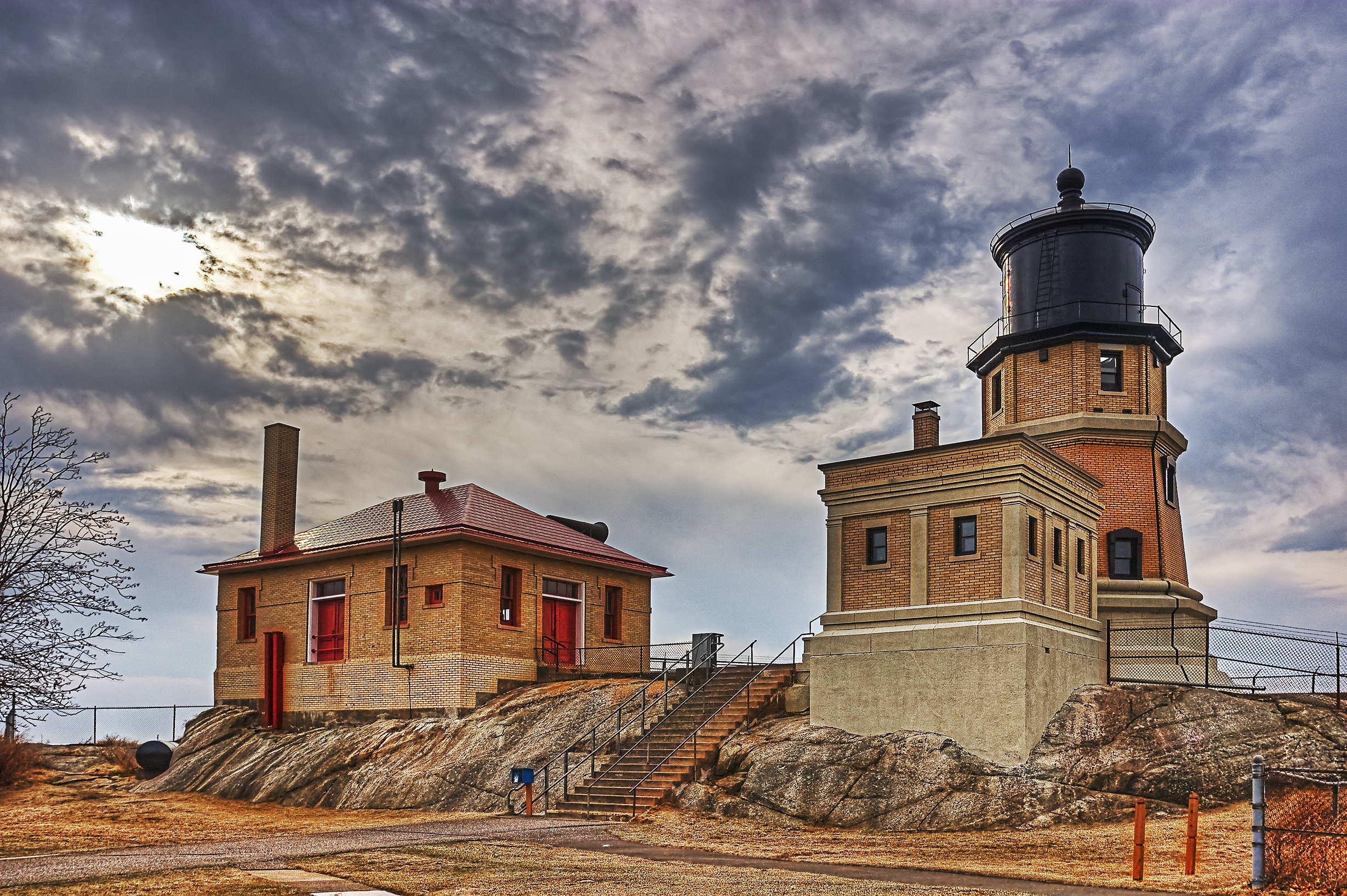
Split Rock Lighthouse
Every November 10, a light that has been officially retired since 1969 burns again. Split Rock Lighthouse, perched on a sheer 130-foot cliff along Minnesota's North Shore, rekindles its third-order Fresnel lens in memory of the 29 crewmembers of the SS Edmund Fitzgerald, lost on Lake Superior on that date in 1975. It is a fitting gesture for a lighthouse that owes its own existence to catastrophe. The Mataafa Storm of November 1905 wrecked or damaged 29 ships across the lake, exposing the lethal gap in navigational aids along this stretch of basalt and iron coastline. The United States Lighthouse Service responded by commissioning engineer Ralph Russell Tinkham to build a light on one of the most inaccessible sites on Superior's shore. The result, completed in 1910 for $75,000, is now considered one of the most photographed lighthouses in America.
Built by Crane, Lit by Kerosene
In 1909, the cliffs southwest of Silver Bay had no roads. Every brick, every steel beam, every sack of concrete arrived by boat and was hoisted to the clifftop by derrick crane. The octagonal tower that rose from that rock is a steel-framed brick structure on a concrete foundation, topped with a large steel lantern housing a Fresnel lens manufactured by Barbier, Bernard and Turenne in Paris. Tinkham had designed the tower for a larger second-order lens, but when construction costs overran the budget, only a third-order lens could be funded. That smaller lens still did remarkable work. It floats on a bearing surface of liquid mercury, enabling near-frictionless rotation driven by an elaborate clockwork mechanism -- heavy weights descend through the tower's center, and the keeper cranks them back to the top to reset the system. When the lamp was first lit on July 31, 1910, it burned kerosene oil vapor. The lighthouse soon proved so scenic that excursion boats added it to their routes, and by 1924 the state built a road -- now Minnesota Highway 61 -- just to give land visitors access.
Sirens, Diesel, and the Diaphone
A lighthouse is only half the warning system; fog demands its own voice. Split Rock's fog signal building, adjacent to the tower, originally housed a pair of sirens powered by two Franklin gasoline-driven air compressors built by the Chicago Pneumatic Tool Company. In 1932, the gasoline engines gave way to diesel. Four years later, the sirens themselves were replaced with a Type F-2-T diaphone signal -- the deep, distinctive 'bee-you' tone that mariners could identify through the thickest weather. The station was electrified in 1940, the same year the kerosene vapor lamp was swapped for a 1,000-watt electric bulb. The original incandescent lamp was shipped to Au Sable Point Lighthouse in northern Michigan, where it continued its career. But modernization also brought obsolescence. Improved navigational technology made the fog signal redundant by 1961, and the U.S. Coast Guard retired the light itself in 1969, the same year the site was added to the National Register of Historic Places.
A Keeper's 37-Year Watch
The Minnesota Historical Society took stewardship of Split Rock in the 1970s, restoring the entire complex -- tower, fog signal building, oil house, and three keepers' dwellings -- to its appearance in the late 1920s. The site was designated a National Historic Landmark on June 30, 2011. But the most remarkable tenure belonged to keeper Lee Radzak, who served from 1982 to 2019 -- 37 years, the longest of any keeper in the lighthouse's history. Radzak's daily presence gave continuity to a place that had already outlived its original purpose. Under his watch, the lighthouse became one of Minnesota's most visited historic sites, drawing photographers, history enthusiasts, and families following Highway 61 along the North Shore. The United States Postal Service honored the lighthouse with a stamp on June 17, 1995, as part of the 'Lighthouses of the Great Lakes' series -- one lighthouse chosen per lake, designed by artist Howard Koslow.
The Light That Remembers
Split Rock's retirement was never quite complete. The annual November 10 ceremony, honoring the Edmund Fitzgerald and all mariners lost on the Great Lakes, has become one of the most powerful traditions on Lake Superior. The Fitzgerald, a 729-foot ore carrier, sank in a storm roughly 17 miles from Whitefish Point on November 10, 1975, taking all 29 crew members. Gordon Lightfoot's ballad made the wreck famous beyond the maritime world, but at Split Rock the remembrance is quieter -- a beam of light sweeping across dark water, a roll call of names. The ceremony draws hundreds each year, standing on the clifftop in November wind. It is a reminder that Lake Superior has never been tamed. The Mataafa Storm that created this lighthouse and the storm that sank the Fitzgerald were separated by 70 years, but the lake beneath remains the same -- cold, deep, and indifferent to human schedules. Split Rock stands as both witness and warning.
From the Air
Located at 47.200N, 91.367W on a 130-foot cliff along Minnesota's North Shore of Lake Superior, roughly 38 miles northeast of Duluth. The octagonal tower and white keeper's dwellings are visible from the air against the dark basalt cliff face. Best viewed from over the lake at 1,500-2,500 feet AGL approaching from the east or northeast. Split Rock Lighthouse State Park surrounds the site. The nearest airport is Two Harbors Municipal (KTWM), approximately 18nm southwest. Duluth International Airport (KDLH) is about 45nm to the southwest. Minnesota Highway 61 is a reliable visual reference running along the shoreline. Lake effect weather can develop rapidly along the North Shore; morning approaches often offer best visibility.