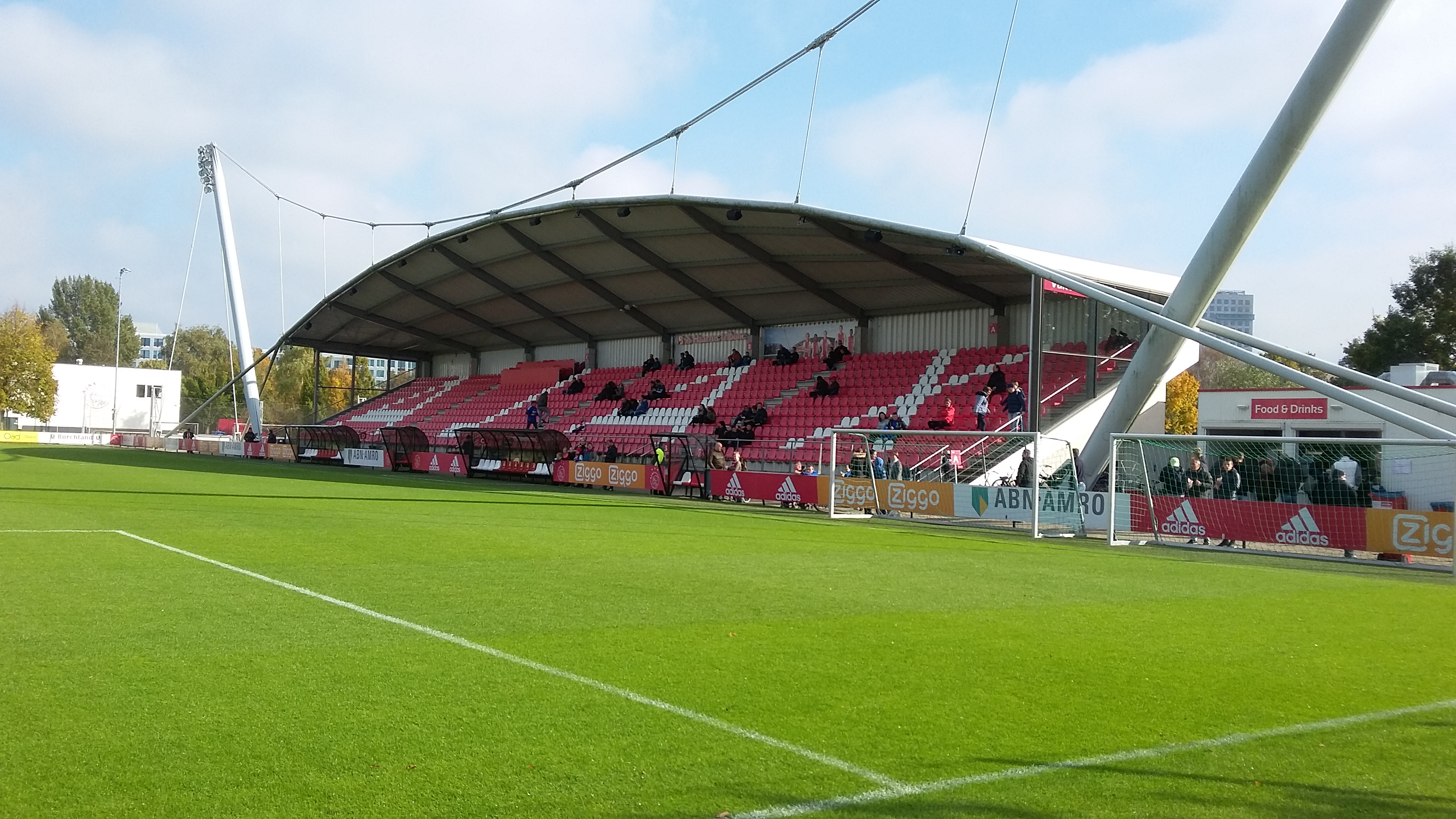
Sportpark De Toekomst
The name is a small piece of Dutch football honesty. When AFC Ajax built a new training complex in the mid-1990s on the southern edge of Amsterdam, they called it De Toekomst - The Future - and meant it literally. The site was where the next generation of Ajax players would be made. It opened in 1996, the same year the senior team moved into the Amsterdam Arena across the road, and the symmetry was deliberate. The first team trains here. The reserves train here. The women's team plays its home matches here. The youth academy from the F-pupils up through the A-juniors runs almost every drill, every match, every training tournament on these nine pitches. If you spent a Saturday in this corner of Ouder-Amstel watching, you would see most of Ajax's roster for the next twenty years walk past you.
The Move from De Meer
The story starts with a death and a birth. In 1991 the club decided that its old home, the De Meer Stadion in the Watergraafsmeer district, was finished. A new stadium would rise on the other side of the city, designed for European football's new commercial age - the Amsterdam Arena, later renamed the Johan Cruyff Arena. The old training grounds, Sportpark Voorland behind De Meer, would be cleared for housing. The club needed new fields, and quickly. The first plan was Sportpark Strandvliet on Zwartelaantje, but the existing tenants - the local football club SV Amstelland - refused to leave. Ajax then looked next door, at a sport park in Ouder-Amstel called De Toekomst, where the existing tenants TOS-Actief were willing to relocate. The deal closed. By 1996 the new complex was finished.
The Design
The Dutch architect René van Zuuk drew the park: five grass pitches, two artificial-turf surfaces, a covered grandstand seating 1,250, additional bleachers, and a clubhouse for 250. The signature element is the main stand's roof - a long bent canopy that hangs from two leaning steel pillars, a piece of structural drama in a complex that otherwise hides itself in the suburban landscape. Van Zuuk won the Dutch National Steel Prize, in the category of characteristic steel components, for the design. When Jong Ajax - the reserve team - was promoted into the second-tier Eerste Divisie for the 2013-14 season, the main stand was expanded by 800 seats with another 100 set aside for away supporters, bringing total seating to about 2,250.
Letters from De Meer
Look at the back of the main stand and you will see four large white letters: a, j, a, x. They are a replica of the original AJAX lettering that hung above the entrance of the old De Meer Stadion, the home the club left behind in 1996. The actual originals are not lost - they now sit above the main entrance of the Johan Cruyff Arena, the new stadium that replaced De Meer. The replica at De Toekomst is a deliberate echo, a way of telling the young players who pass under it every morning that the club they are training for has a longer past than the buildings they see around them. Since 6 June 2009, the main stand itself has been named after Bobby Haarms, a former Ajax coach and honorary member of the club who died in 2009 after sixty-some years inside it.
The Daily Population
On a typical weekday morning, De Toekomst holds more Ajax personnel than any other place on Earth. The first team works on one set of pitches under the senior coaching staff. Jong Ajax, the reserve team competing in the Eerste Divisie, trains and plays its home matches on another. The Ajax Women side, which competes in the Eredivisie Vrouwen, plays its home games here as well. Then come the academy age groups: A-juniors A1 and A2, B-juniors B1 and B2, C-juniors C1 and C2, D-pupils D1 through D3, E-pupils E1 through E3, and the F-pupils F1 through F3. Ajax Amateurs, who compete in the Derde Divisie, are based here too. The youngest players might be seven or eight. The oldest are running drills next to professionals. The whole pyramid of the club is condensed into a single sports park.
The Future Cup
Every spring, De Toekomst hosts the Future Cup, an international tournament for under-17 teams from across European football and beyond. The tournament took its name from the venue, and in some sense it captures the venue's whole purpose: this is where you find out which fifteen-year-olds will become household names and which will not. The Ajax academy has, over the past thirty years, sent an enormous number of players into Europe's top leagues - Patrick Kluivert, Edgar Davids, Clarence Seedorf, Wesley Sneijder, Christian Eriksen, Frenkie de Jong, Matthijs de Ligt. Most of them spent more time on these particular pitches than at any other ground in the world. The complex is not glamorous. It is fenced, suburban, surrounded by motorway and tram lines and the looming bulk of the Johan Cruyff Arena beside it. But it is the place the club's name actually means.
From the Air
Coordinates 52.314 N, 4.929 E. Sportpark De Toekomst sits in Ouder-Amstel on the southern edge of Amsterdam, immediately east of the Johan Cruyff Arena - the two complexes are an easy walking distance apart. From the air the cluster of green football pitches and the curved roof of the main stand are unmistakable, set against the dense Bijlmer urban fabric to the north. Best viewed at 1,500 to 3,000 ft AGL. Closest airport: Amsterdam Schiphol (EHAM), 12 km west. Hilversum (EHHV) lies 22 km east, Lelystad (EHLE) 40 km north-east. The Schiphol arrival corridors run nearby - check Class C boundaries before transit, especially during peak inbound waves.