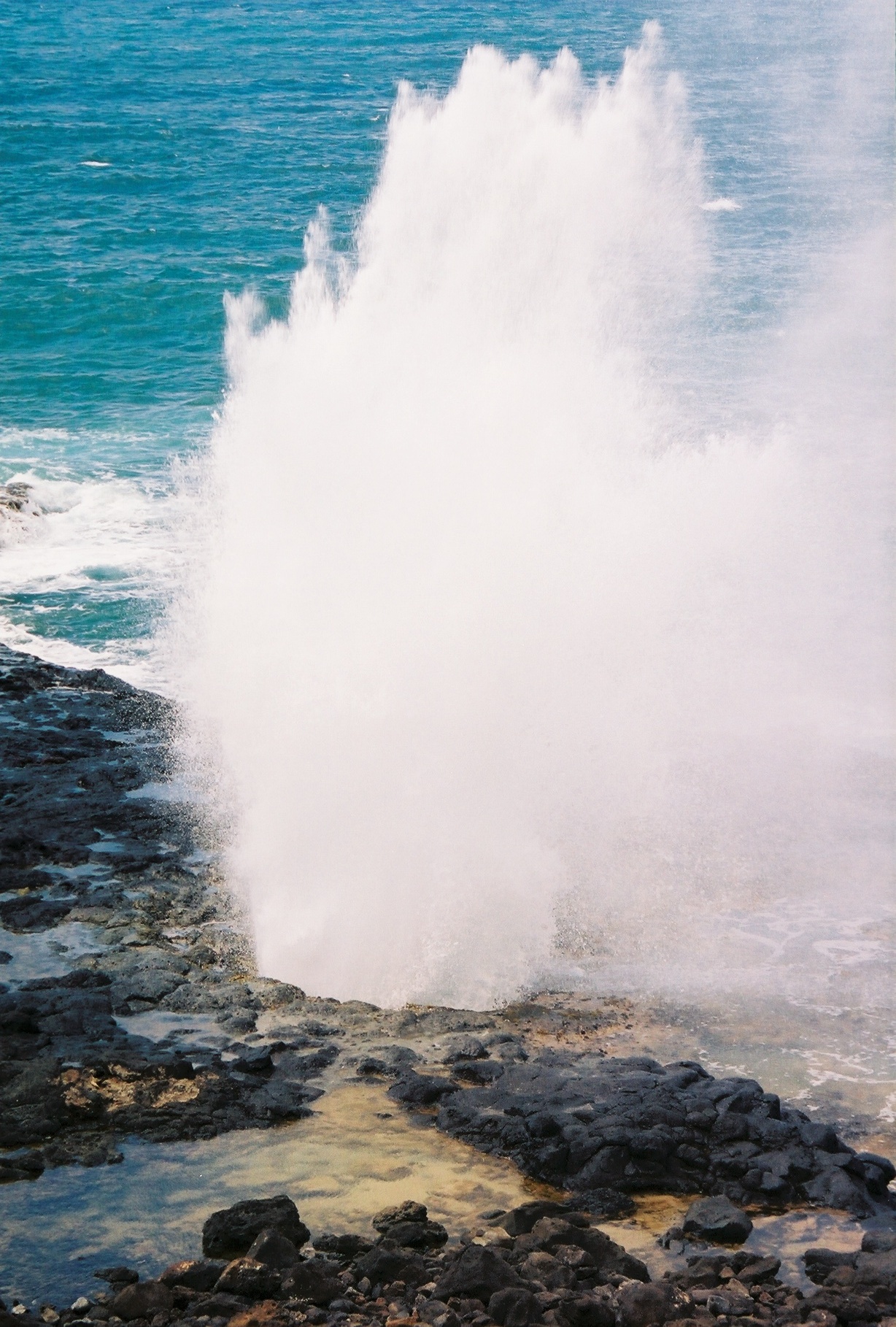
Spouting Horn
You hear it before you see it. A deep, guttural hiss rises from the rocks ahead, and then a geyser of white spray erupts fifty feet into the air, hanging for a moment against the blue sky before collapsing back into the shoreline. This is Spouting Horn, a natural blowhole on Kauai's south coast where the ocean has been punching through a lava tube for centuries, and where Hawaiian legend says a giant lizard is still trapped, roaring with every wave.
How the Ocean Built a Cannon
The mechanics are simple but the result is theatrical. Kauai's south coast near Poipu, a name that translates to "crashing," takes a relentless beating from Pacific swells. Over millennia, these waves have eroded the basalt lava rock along the shoreline, carving narrow tubes and channels through the stone. Spouting Horn is one such tube, angled just right so that incoming waves compress air and water into a constricted opening and blast it skyward. The spray can reach fifty feet on a strong swell, and each eruption is preceded by that distinctive hiss, the sound of air being forced through rock at high pressure. The original Hawaiian name for the feature was puhi, meaning blowhole. Visitors standing at the railed overlook feel the mist on their faces and the rumble through the soles of their shoes.
The Lizard in the Rock
Hawaiian folklore offers a different explanation for the sound. According to the story, a giant lizard called a mo'o once guarded this section of coast. One day, a young man named Liko went swimming in nearby waters. The mo'o saw him as a threat and attacked. Liko dove into the ocean and swam toward shore, threading himself through a narrow lava tube that led to the surface. The mo'o followed, but her body was too large. She became wedged in the tube, trapped forever in the rock. Every time a wave forces water through the blowhole, the people of Kauai say you are hearing the lizard's roar, the frustrated cry of a guardian who cannot free herself. The story does what the best legends do: it takes a geological phenomenon and gives it a heartbeat.
A Stop on the Heritage Trail
Spouting Horn sits along the Koloa Heritage Trail, a ten-mile route through the Koloa district that connects the area's natural and cultural landmarks. The blowhole is one of the trail's most visited stops, drawing crowds who line the lookout to watch the eruptions and browse the vendors selling jewelry and crafts in the adjacent parking area. The site is compact and unpretentious: a paved walkway, a safety railing, and the ocean doing its work. There are no admission fees, no elaborate interpretive centers. The attraction is the raw performance of water and stone, repeated with every incoming wave, never quite the same twice. On days when the south swell runs high, the eruptions become genuinely dramatic, and the hiss builds to something closer to a scream.
From the Air
Located at 21.885N, 159.494W on Kauai's south shore near Poipu. The blowhole is on the rocky coastline just west of Poipu Beach, identifiable from low altitude by the intermittent spray plume. Lihue Airport (PHLI) is approximately 10 nautical miles east-northeast. Best viewed at 500-1,500 feet AGL on days with moderate to heavy south swell. The adjacent Allerton Garden and Lawai Bay are visible nearby.