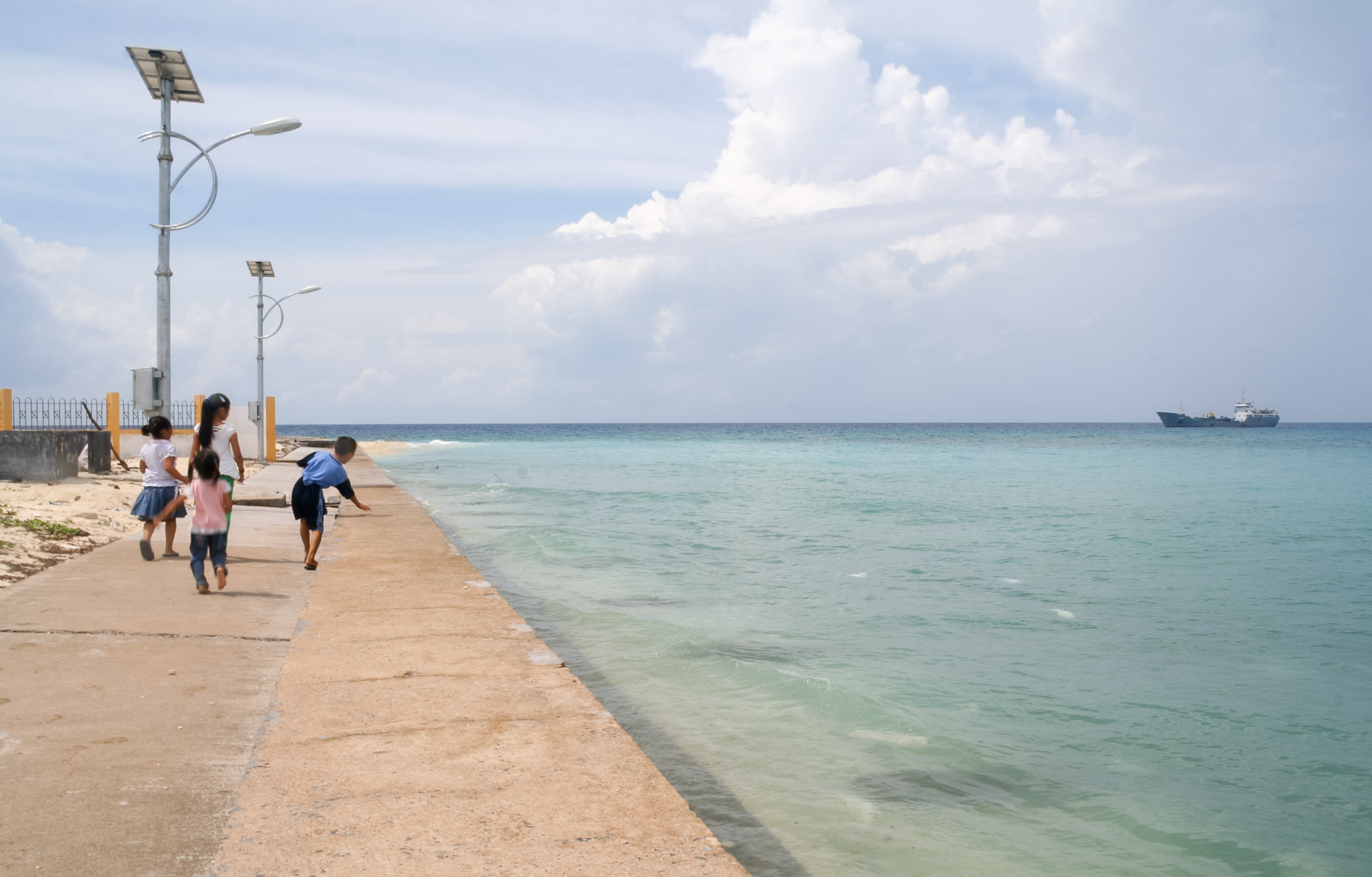
Spratly Island
The runway runs the entire length of the island. Both ends terminate on beachfront. Homes press against its edges, and a small two-story building with a control tower on the roof watches over a tarmac apron barely large enough for a Twin Otter. This is Spratly Island -- not the archipelago that bears its name, but the single island at the heart of one of the most complicated territorial disputes in modern geopolitics. Named for Richard Spratly, a British whaling captain who sighted it in 1843, this flat coral feature sits in the southern reaches of the South China Sea, claimed in whole or in part by Vietnam, China, the Philippines, Taiwan, Malaysia, and Brunei.
A Runway in the Sea
Spratly Island is, in practical terms, barely more than an airstrip surrounded by ocean. The original runway was built in 1976-77, and by 2004 it measured roughly 600 meters -- enough for small propeller aircraft like the PZL M28 Skytruck or the de Havilland Canada DHC-6 Twin Otter to land. Since 2016, satellite imagery and reports have documented extensive land reclamation and construction work, with the runway extended to at least 1,200 meters. New harbors have appeared where none existed before. The island's infrastructure tells the story of its strategic importance: solar panels and wind turbines generate power, a small jetty with two piers serves visiting vessels, and facilities include a clinic, a cultural house, a radio tower, and a Buddhist pagoda. A primary school opened in April 2013, a quiet assertion that people live here permanently, that this is not merely a military outpost but a community. A 5.5-meter-high obelisk stands at the southern tip, a marker of sovereignty in a place where sovereignty is exactly what everyone argues about.
The Weight of Competing Claims
What makes Spratly Island significant is not its size -- it is tiny -- but its location. The broader Spratly Islands archipelago sits astride some of the busiest shipping lanes on Earth, in waters believed to hold substantial oil and natural gas reserves. Six governments have staked overlapping claims to various features in the chain. Vietnam administers Spratly Island itself and has steadily reinforced its presence there. China has built artificial islands elsewhere in the archipelago, transforming reefs into military installations with airstrips and radar arrays. The Philippines, Taiwan, Malaysia, and Brunei each assert rights to portions of the group. In 2016, an international tribunal in The Hague ruled against China's expansive claims, but the ruling has done little to settle the matter on the water. The contest plays out not in courtrooms but in concrete and coral fill, in the slow accumulation of buildings, piers, and runways on features barely above the waterline.
Life on a Contested Speck
The ecology of Spratly Island reflects its harsh conditions. The vegetation is sparse: Barringtonia asiatica trees, beach morning glory, and Heliotropium foertherianum struggle in the salt air and thin soil, alongside scrubby bushes and grasses that grow poorly in the relentless climate. The surrounding waters, however, are a different matter entirely -- the South China Sea teems with marine life, and the reefs around the Spratly chain support some of the most biodiverse coral ecosystems in the world. For the people who live on the island, daily existence is shaped by isolation and purpose. The primary school educates children who grow up hearing waves on two sides of their home. Energy comes from the sun and wind rather than from any mainland grid. Every structure, every improvement, every family that stays is a statement: we are here, and we intend to remain.
Seen from Above
From the air, Spratly Island appears as a pale sliver against the deep blue of the South China Sea, its runway a thin line bisecting the land from shore to shore. The surrounding waters shift from turquoise over the shallow reef to a profound cobalt where the seafloor drops away. There is something arresting about seeing a place so small carry so much geopolitical weight -- a coral platform barely above sea level, yet central to the strategic calculations of half a dozen nations. The island sits roughly 500 kilometers from the Vietnamese coast, 300 kilometers from the nearest Philippine island, and over 1,000 kilometers from mainland China. Those distances matter. They define the claims, shape the logistics, and explain why a runway on a tiny island in the middle of the ocean is worth building, extending, and defending.
From the Air
Spratly Island is located at 8.64N, 111.92E in the South China Sea. The island features a runway visible as a thin line running the full length of the landmass. Approach from any direction over open ocean. The surrounding reef creates a turquoise halo visible from altitude. Nearest major airports include Cam Ranh (VVCR) in Vietnam approximately 500 km to the northwest and Puerto Princesa (RPVP) in the Philippines approximately 370 km to the east. Recommended viewing altitude 3,000-5,000 feet for island detail, higher for the reef and ocean color contrast.